Calling the trash burning underground at Chiquita Canyon a “literal dumpster fire,” Assemblywoman Pilar Schiavo, D-Chatsworth, delivered some grim news Thursday: The problem appears to have tripled from its original size, and is likely to burn for at least 20 years.
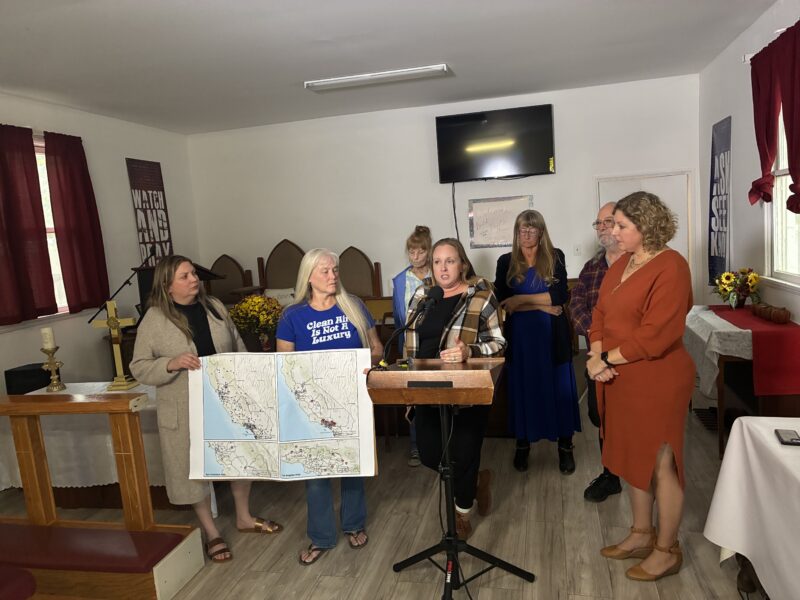
She also used the phrase “canary in the coal mine” during the news conference at Castaic Community AME Church, which also serves as the community’s food pantry.
She called the gathering to promote her latest landfill regulation and remind residents about an upcoming meeting they can attend virtually on air-quality rules.
“We’re really here to work towards real solutions at the California Air Resources Board, to do everything that they can to create transparency, build trust and ultimately protect communities from the catastrophe that we have right down the street at Chiquita Canyon Landfill,” she said.
A handful of residents shared how the landfill’s problems were ruining their lives, and how the rules being proposed could have prevented them in the first place.
The landfill has a settlement issue and what Chiquita calls an “elevated temperature landfill event,” which incinerates the buried trash at approximately 240 degrees.
Schiavo told the gathering of reporters the latest from Sacramento, referring to her conversations with the state agencies that regulate Chiquita.
Jane Williams, executive director of California Communities Against Toxics, and someone who’s been looking at the problems in Chiquita Canyon for three years now, offered her thoughts on why the problem developed.
There’s been no exact reason given by the multiagency task force that’s been working on the issue for years.
Williams said there are known combustible elements in landfill, mentioning metallic dross and wildfire ash.
The problem is how the methane-extraction system operates at the more than 60-year-old landfill. She said you can see an increase in the occurrence of landfill fires that increased after the state adopted its methane rules in 2012, and the nation followed suit in 2016.
“The consensus there is it was actually methane extraction and pulling too much from the landfill. That’s pulling air into the subsurface,” Williams said, adding that she had consulted with several experts on landfills.
Chiquita Canyon is one of 11 landfills that have been experiencing elevated temperatures for more than three years, she said. But the monitoring data also is incomplete.
“When you excavate old landfills, what you see is that, under normal circumstances, you’ll sometimes see these smoldering events,” she said. “Well, you can imagine if you have a little bit of something smoldering in the landfill and you start pulling air into it, it’s acting like a bellows.”
They are rare events, she said, but without updated regulations for landfill emissions — the current rules being evaluated next week are more than 15 years old — these events are likely to keep occurring.
That’s why she wanted to put a “bright light” on the issue, which is the only way to create new regulations aimed at the problems.
In recent years, an EPA policy of permitting exceedances to landfills that have temperature beyond the agency’s limits is the equivalent of “hot-rodding” them or letting them speed in a school zone, Williams said.
Schiavo wanted to raise awareness about two current efforts to create more rules for the state’s landfills and prevent another disaster like Chiquita Canyon.
The first was a bill aimed at landfill regulation, Assembly Bill 28, which was first introduced in the previous legislative session, but brought back as a two-year bill for a little more study on the topic, she said.
The other is a meeting next week that residents who feel they are negatively impacted by Chiquita Canyon are being encouraged to take part in online.
The California Air Resources Board is conducting a public hearing on why it should consider adopting new standards for monitoring and capturing methane emissions from solid waste landfills. The group heard plenty from Santa Clarita Valley residents during a July discussion with a panel from CARB.
“My very basic questions are: How is it that we are in this situation? I mean, how are you all getting paychecks? It’s literally your job to keep these things from happening,” said Nora Lynne Clemmons, one of the panelists who said she moved to the area in 2019. “And I want to sound, you know, hopeful. And I want to say, you know, ‘Thanks — thanks for having these conversations.’ But it really is too late. It’s just it’s late, it’s … we’re in it, and we cannot escape.”
The emissions represent the second-largest source of methane emissions in California, more than 20%.
“Staff estimate expected methane emission reductions from increased gas capture of approximately 17,000 metric tons of methane per year,” according to a meeting notice. “The quantified portion of the emission reductions would provide avoided social costs of methane in the range of $56 million to $178 million over a three-year analysis period.”
The meeting is scheduled to happen at 9 a.m. Thursday. Information on how to attend online had not yet been posted as of the publication of this story, but is expected to be available online at bit.ly/4oEoMon.
Residents can submit electronic comments for the meeting here: ww2.arb.ca.gov/lispub/comm/bclist.php.