Rule changes that reduce the barriers for removing oak trees, a prominent feature on the city of Santa Clarita seal, drew a host of complaints at a recent City Council meeting.
Residents concerned about a potential loss of the shade, protection and scenic beauty trees provide shared their concerns about the city’s policy, which officials said was meant to address property owners’ concerns and promote safety.
The explanation for the rule change was to address concerns about “legally established structures” within an oak tree’s fall zone — which could include an existing garage, or a proposed accessory dwelling unit, under the latest state law.
Property owners’ recurring concerns included safety concerns about “fall-zone proximity,” according to the city’s report, which added that a “gap between exemptions and permits leaves some homeowners without a clear process,” according to Valerie Ferchaw, the city’s urban forestry administrator.
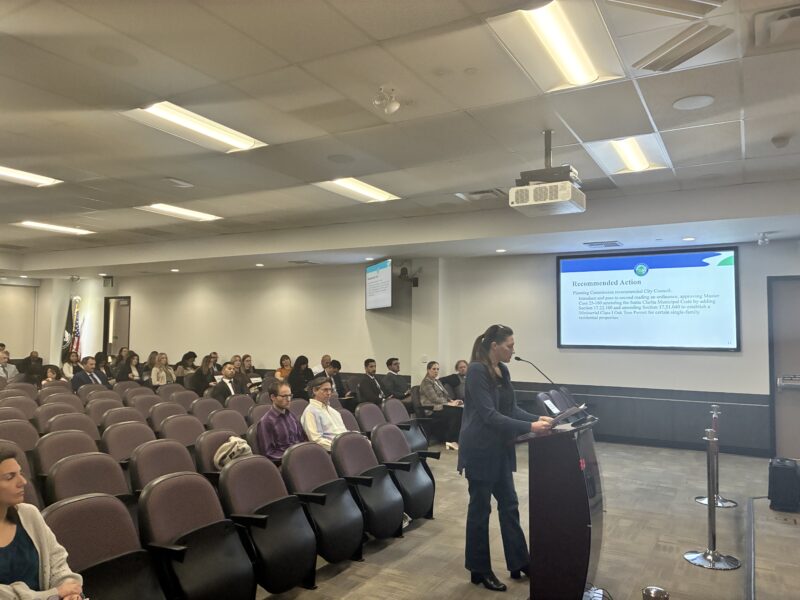
Ferchaw also said it’s not always easy to tell when a tree is at risk for falling based on its appearance, sharing examples of trees that caused local concerns.
“A tree that appears healthy and structurally sound can still have internal defects that contribute to significant limb or whole-tree failure,” according to Ferchaw, a certified arborist. She added that the city had to address more than 40 failed trees as a result of the recent storm.
That was the stated idea behind the policy change, but residents said removing any sort of mandated city review, especially for older oaks, was a cost-cutting move for staff that would let people get rid of a tree, just because they didn’t like its acorns or the view.
Andrew Adams, special districts manager for the city, said the permits were for “specific situations” in a previous email to The Signal.
“The proposed updates create a limited ministerial permit process for specific situations on single-family residential properties where a legally established structure is located within an oak tree’s fall zone, while preserving existing review requirements in all other cases,” Adams wrote. “Proposed mitigation for any authorized removal would consist of replacement planting or a contribution to the Oak Tree Preservation Fund.”
The current rules require an arborist’s report for the removal of certain oaks.
“This proposed permit process would automatically rubber-stamp approval to remove the trees, even if the trees are not causing any problems,” said Gary Kodel, a Santa Clarita resident who spoke at the meeting with his son Jeff.
“This proposed process bypasses our current ordinance’s requirements to review, inspect and issue a report that provides options to resolve the homeowner’s concerns. In many cases, the tree does not need to be removed,” he said, sharing his own example with the council of arborist intervention.
The rule change also adds language to clarify that the ordinance only applies to oak species that are native to California.
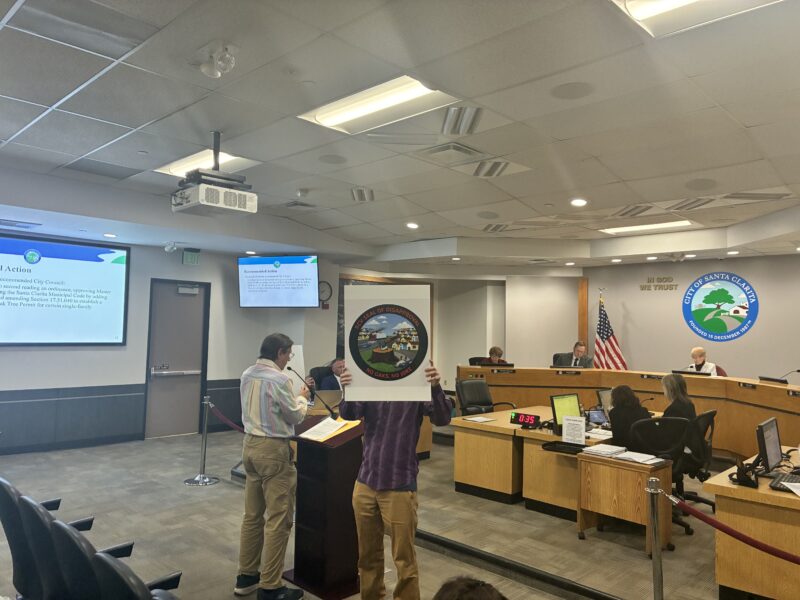
Kodel was one of several people who questioned why the city would no longer want to spend the money or the time to try to preserve trees when possible, before asking about the most prominent image on the city’s seal, the oak tree. He then proposed his own amended city “seal of disapproval,” replacing the tree with a stump, if the council approves its new rules.
Another resident, David Rodgers, asked why the city did not complete an environmental impact report for the new rules that could look more closely at how many trees could be lost. He also said if canceled homeowner insurance was a reason being given for the rule, then perhaps that could be a carve-out.
Lynne Plambeck, president of Santa Clarita Organization for Planning and the Environment, said the city’s meeting with concerned residents was to explain to them what the ordinance was going to be, not to hear their feedback and address any concerns.
Ferchaw said “large-scale oak tree loss” was the primary concern that was raised when the ordinance was first proposed to the public, mentioning objections from SCOPE and the California Wildlife Foundation, in addition to a handful of residents who showed up March 10 to City Hall.
Ferchaw said a staff report identified 6% of the city’s oak trees as within 50 feet of a structure, and added the city receives fewer than 20 requests per year for removals on single-family lots citywide.
Cher Gilmore, another resident, said that, based on a figure given by the city — approximately 165,000 trees, citywide, including open space — it could represent nearly 10,000 trees lost, which was significant, she said.
The city indicated the ordinance would not apply to large-scale development.
“The ministerial permit pathway would not apply to commercial development, multi-family residential development, subdivision activity, or development-related oak tree removals,” according to the agenda report. “All such requests would continue to be processed under the existing discretionary permit framework. The proposed amendments do not modify or expand the regulation’s existing emergency exemption provisions.”
Kathye Armitage, a governing board member for the Santa Clarita Valley Water Agency, said she understood the need to balance good policy with concern for public health and safety with the protection of natural resources, but felt this went too far.
“Changing the rules to allow people to remove mature oak trees that do not pose a threat does not match the city-stated goal of protecting and preserving oak trees,” she said.
One resident spoke in support of the changes, a Sand Canyon resident who said there were three oak trees on her property, which have limited her property’s usage, and the roots are now invading her home’s foundation.
Councilman Bill Miranda called concerns about all the trees getting cut down “extreme,” mentioning the concerns of homeowners.
“There has to be a happy place, for lack of a better term,” Miranda said, where the Sand Canyon homeowner’s concern can be addressed, while not creating a rule that says you can move a few oak trees if you want to, “just because.”
Referring to Kodel’s proposed “seal of disapproval,” Miranda called it “scary,” adding that the city had no intention of getting rid of all its oak trees.
Saying he was adding some context to the discussion, City Manager Ken Striplin told the council it would be closer to 9,000 trees that could be impacted, but he was absolutely not expecting 9,000 people to come to City Hall.
“There are just a number of issues we’ve dealt with throughout the year, since the last amendment,” he said, which address the situation Miranda mentioned. He said tree limbs that can weigh a ton or more can represent a real safety and liability issue for the city and property owners. The current rules represent an “extensive amount of process and cost.”
City Council members approved a couple of provisions with respect to the changes to be brought back on a second reading of an ordinance.
Councilwoman Marsha McLean said she wanted to see the original ordinance next to a red-lined version or a side-by-side comparison on the new process to the old one, including time and cost. She asked why that wasn’t possible to be prepared prior to the meeting.
Ultimately, City Council members approved the changes for a second reading, with one amendment, according to Andrew Adams, special districts manager for the city of Santa Clarita.
“The council approved one modification to the ordinance at the March 10 meeting,” he wrote Thursday. “The proposed Class I ministerial permit process would apply only to property owners of existing single-family dwellings or accessory dwelling units where the qualifying structure was in existence as of the effective date of the ordinance.”