Delays in the city’s efforts to get its hydrogen fueling station up and running could cost about $400,000 in equipment costs, according to a contract the city manager asked the council to approve Tuesday.
The Santa Clarita City Council approved the four-month deal with ZeroUp Energy for the rental of temporary hydrogen refueling equipment, after a few questions from Mayor Pro Tem Patsy Ayala.
The agenda item also gives authorization to the city manager to renew five one-month options, if necessary, which come out to a total of $1.7 million. City staff also asked the council to move about $400,000 in federal grant funds to offset the rental cost. City officials said $1.3 million of that previously had been budgeted for hydrogen fuel.
In looking at the staff recommendation, which also called for five additional one-month renewal options, Ayala asked Striplin about the delays and how long it would take to get the new fueling station online.
During the meeting, Striplin glanced over to where city staff members were sitting, gave a look to Transit Manager Adrian Aguilar as a double-check, and then confirmed to Ayala his confidence in the project taking another four months to get online.
Striplin described the process behind creating the infrastructure Tuesday as complicated and highly specialized. The city also hit some unforeseen delays with its original contractor, which required the city to change its service provider “mid-course.”
“The delay has been several factors. We had a change of contractor mid-course through the project that created delay,” Striplin said. “We’ve had delays with the delivery of certain components that go with the hydrogen fueling station. It’s a very complex and not very common project that’s out there. So it’s a highly specialized field in terms of the number of contractors that do this type of work.”
There’s not only a limited number of contractors, but there are also equipment limitations, he said.
“So we’ve unfortunately had delays from that aspect of it,” he added.
Ayala said she just wanted to clarify that it’s a temporary fix, and not an ongoing cost for the city.
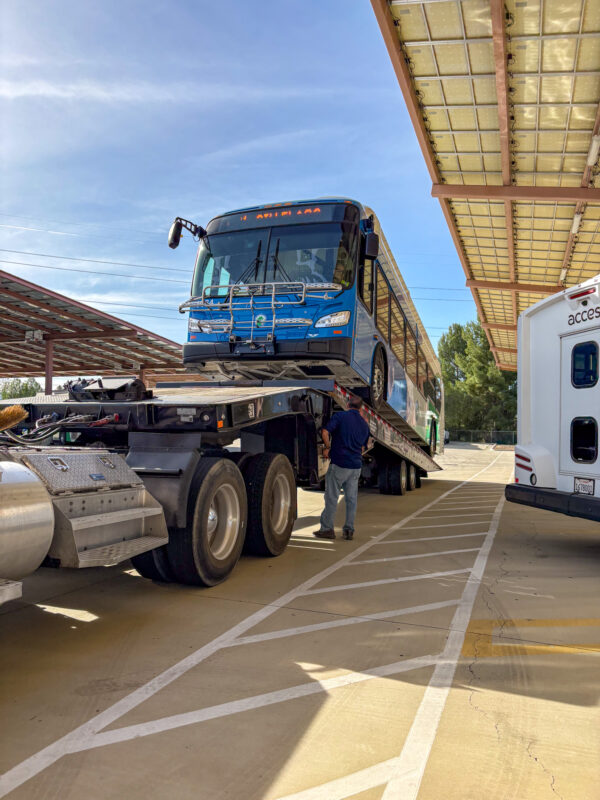
The city began to receive its first new hydrogen fuel-cell buses earlier this year, with seven now in its fleet, but the goal — per state mandate — is to have all of them as hydrogen fuel-cell buses by 2040, which is California’s deadline for a zero-emissions public transit fleet.
The city has previously converted all of its buses to operate on compressed natural gas, due to a 2000 mandate, but those vehicles do not meet the emission standards that state air regulators created in 2018.
The city created a plan to upgrade its fleet in phases as the older vehicles become obsolete, with seven new hydrogen buses coming online earlier this year and more on the way. However, the conversion has required the city to create new infrastructure for the vehicles, which has been costly.
The city had contracted with Trillium, which was then acquired by Love’s Alternative Energy, according to Aguilar in a phone conversation on Friday.
A subcontractor that Trillium was using to meet the city’s need had a staffing issue and could no longer fill the terms of the contract. Love’s then had to find a new provider, which was the primary driver of the delay.
The hydrogen fuel-cell buses are not yet online, but as soon as the new refueling station is available, they can be, he said. The city requested the contractor be ready to mobilize within 30 days.