A Los Angeles County Superior Court judge has dismissed with prejudice a legal effort to stop the Wiley Canyon Road Mixed-Use Project, a housing plan just east of Interstate 5 that drew both support and opposition at City Hall.
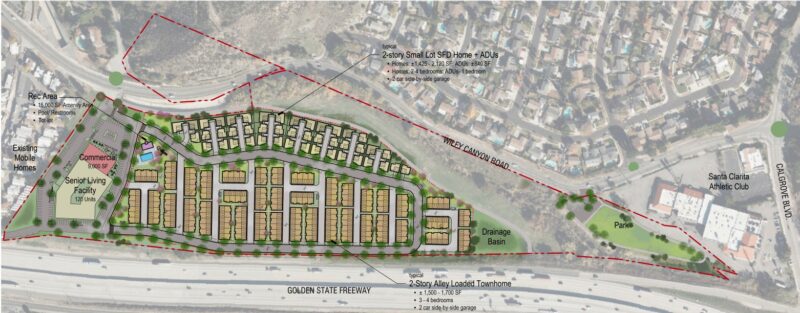
The plans call for 232 condos in two-story buildings and 120 senior assisted-living units to be built west of Wiley Canyon Road, between Calgrove Boulevard and Hawkbryn Avenue. The plan also calls for several changes to surrounding roads to accommodate the project.
Judge Jon Takasugi’s Sept. 15 ruling denied Santa Clarita resident Weston Monroe’s Aug. 11 motion to vacate the Aug. 4 dismissal of the case.
Monroe’s next recourse would be an appeal. In a phone conversation Monday, he declined to say whether he intends to file one.
Monroe filed a petition Dec. 24, 2025, seeking to stop the Wiley Canyon development, which would be built on open space that formerly housed the Smiser Mule Ranch.
And this is where things get a bit technical.
Takasugi’s Aug. 4 dismissal was based on his finding that the California Environmental Quality Act, which guides local governments’ review of projects for their potential impacts, requires a petitioner to name the “real party in interest” in a legal challenge.
In city records, such as the Wiley Canyon Project Summary, the applicant is listed as Wiley Canyon LLC, with Sheridan-Ebbert Development and Royal Clark Development Co.
“Petitioner named a completely unrelated third party LLC (Royal Clark Development Co. LLC) in the caption and failed to name any real party in the body of his original petition,” Takasugi wrote.
Monroe filed an amended petition, but Takasugi ruled it insufficient.
“Petitioner’s ex parte ‘Incorrect Name’ amendment was ineffectual and could not cure the omission once the limitations period had run, and Wiley was a necessary and indispensable real party in interest whose absence compelled dismissal,” Takasugi wrote in the minute order.
On Monday, Monroe said he never had the opportunity to present his case.
“The merits were never heard,” Monroe said. “They used the wrong name. I used the wrong name.”
Monroe’s concerns about the project, which he also shared during public comment at City Council meetings, had nothing to do with the name. He was one of dozens of residents living near the project who voiced concerns.
The city held five public hearings on the project, the most allowed under state law, before approving it. The environmental impact report drew so many questions and comments that the city had to amend its consultants’ contract to respond to them.
“The project was approved despite undisputed evidence that it conflicts with the city’s adopted circulation policies, relies on an infeasible roadway configuration and exposes sensitive residential populations to unmitigated freeway noise, air quality and safety impacts,” Monroe wrote in his December filing. In a news release, he also raised concerns about how the area would be evacuated in an emergency.
The project also had a number of supporters. They said adding curbs and sidewalks around the property would make the area safer, because the current lack of that infrastructure encourages dumping near the freeway and discourages walking and cycling.
The proposed open space would total about 3 acres, or nearly 10% of the site. It would include 15,000 square feet of recreational amenities, such as a community pool; a nearly 2-acre park; 16,850 square feet of private yards for the small-lot single-family homes; and 8,435 square feet of private yards for the townhomes.