The Judicial Council of California, the group in charge of planning an eight-story courthouse in Valencia, shared a new timeline and information ahead of a planned community meeting the city is hosting next week.
Under the new timeline, the planned October release of the draft environmental impact report for the project has been pushed back to January. Construction is estimated to begin in June 2030 and complete in July 2033.
The administrative arm of the state’s judicial branch laid out a nearly 20-year timeline on its consideration of a new courthouse for the region, which had been identified as an “immediate and critical need” in an October 2008 facilities list.
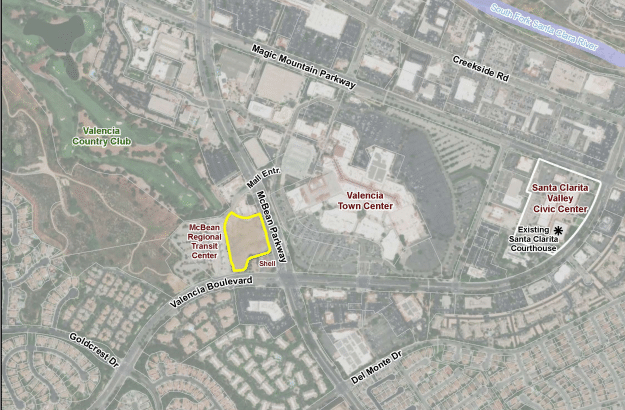
The proposed 3.75-acre project site — near the intersection of McBean Parkway and Valencia Boulevard — is a privately owned, unimproved parcel. It used to be a local miniature golf course called The Greens at 25601 McBean, before it shut down in 2009.
The renewed talk comes ahead of the city’s planned 6 p.m. Tuesday community meeting, which was initially when the Judicial Council was publicly noticing a state-mandated environmental impact report on the project.
The 45-day comment period had previously been scheduled for this fall, but a spokesman for the council indicated that’s now likely not to happen until next year at the earliest, in an email Tuesday.
“Although the Judicial Council originally intended to release a draft environmental impact report in October 2026, it is now anticipated for release in January 2027,” according to an email Tuesday from Blaine Corren, public affairs officer for the council. “Multiple comments were received during the public scoping period in late 2025 that informed the Judicial Council’s understanding of the environmental impacts, mitigation measures and alternatives that should be included and analyzed to perform a meaningful and thorough environmental review of the proposed project authorized for site acquisition.”
The city of Santa Clarita has openly and repeatedly declared formal opposition to the project, with an advertisement for the community meeting about the courthouse portraying an artificial intelligence rendering of the proposed 126-foot tall structure towering over the city’s second-tallest structure, the former home of Princess Cruises. The skyline darkens over the courthouse rendering, with black clouds looming.
The meeting is intended to “provide residents with an overview of the project,” explain why the city wants it somewhere else and the state’s response to the city’s concerns. “Most importantly, it will provide an opportunity for the community to ask questions and share feedback.”
Ahead of the city’s meeting, the state courts’ administrators shared a fact sheet intended to discuss some of the benefits from the plan.
The new courthouse will not only add a number of services to the Santa Clarita Valley, according to court officials, it will also add much-needed courthouses that are long overdue.
Santa Clarita’s three-room courthouse was constructed in 1972.
The advantages of a 24-courtroom facility with a mix of large, multipurpose and arraignment courtrooms include “no more cross-county trips for routine court matters,” according to the council.
“Santa Clarita Valley residents, businesses and attorneys must travel more than 30 miles on congested highways or by public transportation to access all other case types or court services at alternative court facilities in Chatsworth, San Fernando, Lancaster, Monterey Park, or downtown Los Angeles,” the fact sheet states.
Carrie Lujan, communication manager for the city, said the Judicial Council has been invited to the meeting, but it’s not known at this time who will be representing the agency.
The city’s “key concerns” include “increased traffic and congestion, impact on public safety and community character” and that the process moved forward with “zero city input.”
The city’s community meeting is scheduled for 6 p.m. Tuesday, Nov. 17, in the Santa Clarita Performing Arts Center at College of the Canyons, at 26455 Rockwell Canyon Road. The Judicial Branch of California’s information page on the project can be found at tinyurl.com/3v9r9dkd.