Residents are once again unhappy with L.A. County’s recent preference for placing battery-energy storage facilities in the Santa Clarita Valley, officials said Tuesday.
The latest in Castaic: The Department of Regional Planning approved another battery-energy storage system, or BESS, while in the middle of a legal fight over the approval of a facility in Acton.
Castaic Area Town Council members also said they are upset that they only found out about the battery-energy storage facility during a July discussion of potential rules about where the controversial facilities might be placed.
At that meeting, they also found out the rules being considered would not apply to the project that had been approved the previous month in their backyard, the Homestead project by esVolta.
That’s because esVolta had been working with the county on its project for more than two years, according to county officials.
That came as news to the Town Council, said council President Bob Lewis on Tuesday.
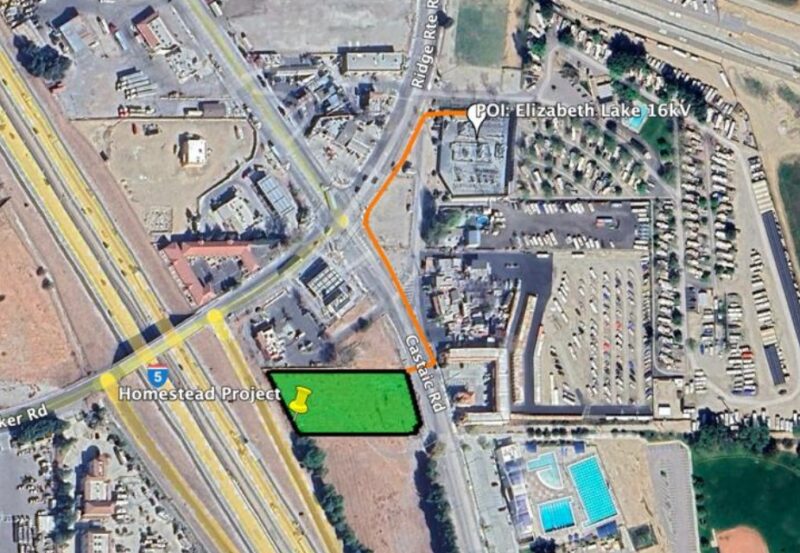
He shared the community’s concerns about a BESS next to Interstate 5 and Parker Road that were discussed by the council at the July meeting.
Judge Curtis Kin’s ruling against Los Angeles County and Fullmark over a BESS project in Acton now has Castaic residents rethinking their next moves in addressing their concerns.
Homestead project
Lewis said the Town Council’s July discussion on the potential rules for BESS facilities was eye-opening because it was the first they’d heard of the Homestead project.
When they realized one was being planned for Castaic, they asked for and received a presentation from esVolta the following month.
In August, the company presented its project to the Town Council: By June 2027, it planned to have a 1.3-acre facility with a 15-megawatt capacity rated for 60 megawatt hours.
Lewis, who represents the area where the facility would go, said there were a number of concerns, not the least of which were the plans for a chain-link fence to separate the batteries from the potential of a big-rig crash or the fact that no one mentioned it to the council prior to its approval in June, which would have provided an opportunity to discuss any problems.
Lewis said esVolta representatives were asked why they didn’t discuss the plans with the Town Council prior to its approval. He said the reply was, “‘Because Regional Planning didn’t require us to come to the Town Council.’”
“Our complaint was not to the applicant. Our complaint was Regional Planning, that this was not, you know, nobody knew about it ’til almost to kind of after the fact,” he said, adding there were several concerns mentioned.
“It was concerns about not being notified, concerns, we think it should be under a (conditional use permit), because that’s what the new regulations say they’re looking at. I heard about the safety issues not being fully addressed, wrong location, many safety hazards. We think it could be dangerous,” he said, adding the council had not made any formal decision or taken any action at the meeting. “So, they were all concerns of why it shouldn’t be there.”
Helen Chavez Garcia, communications director for L.A. County 5th District Supervisor Kathryn Barger, said Tuesday her office was working on a response, which has not been received as of this story’s publication. L.A. County Planning Director Amy Bodek did not respond to an email requesting comment.
In an email Tuesday, esVolta said the project site was selected based on a combination of factors including proximity to Southern California Edison’s Elizabeth Lake substation, which is approximately 200 yards north of the project site, and the landowner being willing to sell or lease their land.
The current design still includes a chain-link fence along its border for security.
“The project has not yet set a construction mobilization date, but that is the next step,” according to an email from Roselle Kingsbury, a representative for a public relations firm working on the project for esVolta.
Barger had asked for Department of Regional Planning staff to present an ordinance to the Board of Supervisors in response to the concerns from Acton residents.
Acton facility
During the discussion in Castaic, Lewis said there were similar questions raised to what he saw in the news reports about the Acton facility.
Kin ruled recently that L.A. County skirted its own zoning regulations in approving the larger BESS plan that was called the Humidor project. That plan is trying to build a 400-megawatt BESS, enough energy to power 300,000 homes, on 15 acres of a 26-acre plot next to West Carson Mesa Road to the west and Angeles Forest Highway N-3 to the east.
Kin ruled that, per county zoning, the M1 land planned for in Acton did not allow the county to make determinative calls on whether a facility could be considered a transmission facility, which would not need a permit under such zoning, or a distribution facility, which would.
Fullmark said it was not making a comment on its case at this time.
Members of the Castaic Town Council questioned that if the projects essentially have the same purpose, the law should treat them the same, and council members said they were given the same reasoning for the esVolta project.
County officials did not respond to questions about these claims.
The projects have become a controversial topic in the SCV, after Canyon Country residents became upset about one approved off Soledad Canyon Road by the Santa Clarita Planning Commission. That prompted a community safety meeting over the summer, which was spurred in part by national reports.
The most oft-cited safety concern for a BESS is the fire risk. While advocates have indicated the facilities are built with fail-safes and state-of-the-art technology to make them as safe as possible, there’s also an acknowledgement there are not a lot of ways to quickly and safely extinguish the lithium-ion battery facilities if that does happen.
The facilities have been part of the state’s energy mandates in order to improve grid reliance, but their proliferation has left many asking questions about where they’re being located and if they’re as safe as regulators say.