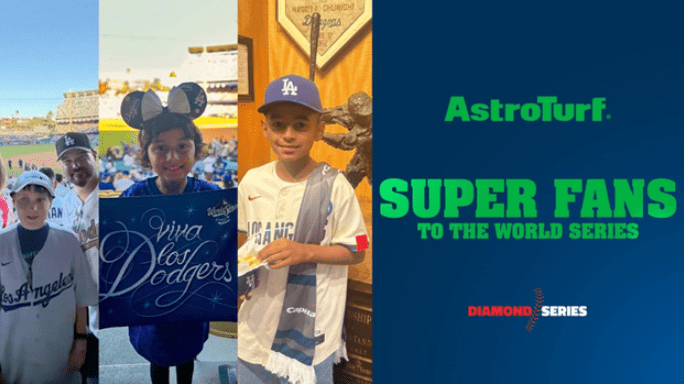
AstroTurf’s “It’s All About the Play” campaign brought four young fans and their families to World Series games across both host cities. These attendees represented diverse connections to baseball, from youth league champions to student-athletes, united by their dedication to the sport at local and regional levels. The initiative highlighted how community baseball programs cultivate the next generation of fans who sustain professional baseball’s cultural significance.
Celebrating Student Athletes and Youth Champions
Sebastian Quintero received his middle school’s Student-Athlete Award before attending Game 3 at Dodger Stadium, marking his first professional baseball game experience. The recognition acknowledged both academic achievement and athletic commitment, exemplifying the balance many young athletes maintain while pursuing their passion for baseball. His selection for the World Series experience validated years of dedication to developing skills on local fields.
Jackson Aitken, a champion Little Leaguer, attended Game 5 with his family at Dodger Stadium. His mother, Ashley, described baseball’s role in their family dynamic. “Baseball has always been a great way for us to spend time together,” she explained. “Jackson loves the energy of the fields and the theatrics of the stadium. Getting to have this kind of experience is a once-in-a-lifetime opportunity.” The family’s journey from Little League diamonds to championship baseball illustrated pathways connecting youth sports participation to lifelong fan engagement.
Mia Rose Lopez demonstrated the personal connections young fans forge with professional players. As a devoted Shohei Ohtani enthusiast, she attended Game 4, where she witnessed her hero pitch during baseball’s most significant competition. The opportunity to see elite athletes perform at championship levels provides inspiration that transcends entertainment, showing young players what sustained dedication can achieve. These personal connections between youth fans and professional athletes strengthen baseball’s multigenerational appeal.
Connecting College Programs to Championship Competition
Finn O’Brien’s attendance at Game 2 in Toronto represented a unique perspective within the campaign. The Syracuse University student combines multiple baseball roles as player, announcer, and turf manager, providing a comprehensive understanding of how the sport functions at the collegiate level. His experience managing playing surfaces connects directly to the campaign’s sponsor, which maintains the artificial field at Rogers Centre, where the Blue Jays hosted World Series games.
Aaron Klotz, Director of Baseball for AstroTurf, articulated the campaign’s underlying philosophy. “These fans’ stories capture what makes baseball truly special: the community, the tradition, and the people who keep the spirit of the game alive,” Klotz stated. “We want to celebrate fans who bring heart and energy to the game at every level, from local fields to the World Series.” This perspective positions championship baseball as the culmination of a developmental pipeline beginning at youth leagues and continuing through collegiate programs.
O’Brien’s selection acknowledged the often-overlooked infrastructure supporting baseball at all competitive levels. Field maintenance, whether natural grass or artificial surfaces, requires specialized knowledge to ensure consistent playing conditions. College students pursuing careers in sports turf management contribute essential expertise that professional facilities depend upon. The campaign recognized this contribution by providing O’Brien access to championship competition played on surfaces representing the industry’s most advanced technology.
Technical Performance Supporting Championship Play
The 2025 World Series provided the artificial turf industry’s most visible platform for demonstrating contemporary technology. Rogers Centre’s Diamond Series installation supported four games of the seven-game series, including the dramatic Game 7 finale that extended past midnight.
AstroTurf emphasized that silent performance represents validation for sports surfaces. No unexpected bounces disrupted defensive plays. No footing concerns affected base running or fielding positioning. The surface’s invisibility during championship competition demonstrated how modern artificial technology replicates natural grass characteristics while providing operational advantages that facility managers value. This combination of athletic performance and practical benefits distinguishes contemporary installations from earlier-generation products.
Toronto’s franchise has maintained artificial surfaces since Rogers Centre opened in 1989 as the world’s first stadium with a fully retractable roof. The Blue Jays won back-to-back championships in 1992 and 1993 on the facility’s original artificial installation, establishing precedent for championship excellence on artificial surfaces. The current Diamond Series installation represents a substantial technological advancement, incorporating zone-specific engineering that allows base paths to behave like clay while outfield sections simulate natural grass.
Historical Context for Championship Artificial Surfaces
The series represented the twelfth time AstroTurf’s products appeared during the World Series, extending a relationship beginning with baseball’s first indoor stadium in the 1960s. Between 1970 and 1993, artificial surfaces regularly hosted championship games as multi-purpose stadium design influenced facility construction across professional sports.
Nine World Series champions during this period called artificial surfaces home, demonstrating that elite competition adapted successfully to artificial field conditions. The Cincinnati Reds’ Big Red Machine dynasty won multiple championships at Riverfront Stadium, where Pete Rose, Johnny Bench, and Joe Morgan showcased exceptional talent on artificial turf. These historical achievements validated that playing surface composition does not determine competitive outcomes when installations meet appropriate performance standards.
Four complete World Series occurred entirely on artificial surfaces during peak adoption periods, including championships in 1980, 1985, 1987, and 1991. The 1975 National League Championship Series between the Reds and Pittsburgh Pirates marked the first postseason matchup contested entirely on artificial turf. These precedents established that baseball’s most significant competitions could unfold successfully on artificial surfaces when properly designed and maintained.
Youth Baseball Development and Infrastructure Investment
The campaign’s focus on young fans connects to broader discussions about youth sports infrastructure and access. Community baseball programs require reliable playing surfaces that withstand intensive use throughout seasons spanning spring, summer, and fall. artificial installations increasingly support youth tournament facilities and municipal recreation departments seeking durable solutions for heavily-scheduled fields.
Weather reliability proves particularly valuable for youth programs operating with volunteer coaches and limited practice time. Artificial surfaces eliminate rain delays and field closures following precipitation, maximizing available playing hours during compressed seasonal schedules. This consistency benefits player development by ensuring regular practice opportunities regardless of weather patterns that might otherwise force cancellations.
Maintenance cost considerations influence municipal investment decisions for youth sports facilities. artificial surfaces require different maintenance protocols than natural grass but eliminate mowing, irrigation, fertilization, and seasonal renovation costs associated with traditional fields. These operational savings allow recreation departments to allocate resources toward programming, coaching development, and equipment provision rather than continuous field upkeep.
Connecting Grassroots Participation to Professional Achievement
The young fans brought to World Series games represent millions of youth baseball participants across North America. Little League Baseball alone serves approximately 2.4 million players annually through local organizations providing introductory baseball experiences. These grassroots programs create the fan base sustaining professional baseball’s economic model while developing athletic talent that eventually reaches collegiate and professional levels.
The pathway from youth leagues to championship competition requires sustained infrastructure investment at multiple levels. Elementary school fields, middle school programs, high school diamonds, and collegiate facilities all contribute to player development pipelines producing professional talent. The campaign’s recognition of young athletes at various developmental stages acknowledged this comprehensive ecosystem supporting baseball’s continuation across generations.
Jackson Aitken’s Little League championship experience exemplifies competitive opportunities available through organized youth baseball. Local tournaments, regional competitions, and national championships provide structured progression allowing young athletes to test skills against peers while experiencing competitive pressure. These formative experiences shape athletic development and create lasting memories connecting participants to baseball throughout their lives.
Media Coverage and Public Engagement
The initiative generated positive media attention highlighting connections between grassroots baseball and professional championship competition. Coverage emphasized personal stories rather than corporate sponsorship, focusing on young fans’ experiences attending their first World Series games. This narrative approach resonated with audiences appreciating authentic engagement rather than transactional marketing.
Social media amplification extended the campaign’s reach beyond immediate participants. Families shared photographs and experiences from World Series attendance, creating user-generated content that documented genuine enthusiasm for championship baseball. These organic testimonials provided more compelling storytelling than traditional advertising approaches, demonstrating how community-focused initiatives generate authentic public engagement.
The timing coincided with heightened public interest during championship competition, ensuring maximum visibility for the initiative. World Series coverage dominates sports media throughout the series, creating opportunities for related stories highlighting baseball’s cultural significance. The campaign’s focus on young fans aligned with broader narratives about baseball’s future and the importance of cultivating next-generation enthusiasts.
Industry Leadership Beyond Product Manufacturing
The artificial turf manufacturer’s community engagement extends beyond product sales to encompass broader support for baseball at all competitive levels. The company maintains official partnership status with Major League Baseball, formalizing a relationship spanning six decades since baseball’s first indoor stadium game. This designation acknowledges both historical significance and contemporary technological leadership within the artificial surface industry.
Recent installations demonstrate diverse applications supporting baseball development. The Willie Mays Field in Birmingham showcases artificial technology in minor league settings, while the Speedway Classic at Bristol Motor Speedway illustrated how modern surfaces enable temporary baseball field creation in unconventional venues. These projects validate artificial surface versatility across competitive levels and facility configurations.
Collegiate programs represent significant growth sectors for baseball artificial surfaces. Northern Division I programs increasingly select artificial installations enabling early-season home games during late winter months when natural grass remains dormant. This practical consideration supports competitive advantages through extended home schedules while ensuring consistent practice conditions regardless of weather patterns. The company reports that since 2009, more Division I college baseball programs have selected its Diamond Series than any competing artificial turf system.
Research Investment Supporting Performance Claims
The technical sophistication distinguishing modern baseball surfaces emerges from sustained research partnerships between manufacturers and academic institutions. Collaboration with the University of Tennessee spans over twelve years, focusing on biomechanical interactions between athletes and playing surfaces. This research foundation grounds product development in peer-reviewed methodology rather than marketing-driven claims.
Laboratory testing protocols evaluate fiber durability, infill performance, and system-wide characteristics under conditions simulating years of intensive use. Berlin Athletes machines and accelerated wear testers subject surfaces to millions of simulated athlete movements, validating manufacturer warranties extending beyond ten years for premium installations. This comprehensive testing regime ensures performance characteristics remain consistent throughout the surface’s operational lifespan.
The RootZone technology employs crimped nylon fibers, creating a three-dimensional matrix beneath playing surfaces. This structure encapsulates infill material, preventing migration during intensive play that creates inconsistent conditions across fields. Independent research from Michigan State University identified this design as producing favorable biomechanical characteristics compared to alternative artificial systems, particularly regarding uniform shock absorption.
Sustainability Considerations for Modern Facilities
Contemporary artificial surfaces address environmental concerns through reduced water consumption compared to natural grass irrigation requirements. This advantage proves particularly significant as municipalities face water conservation mandates and drought conditions affecting traditional field maintenance. Artificial installations maintain playing conditions without irrigation, supporting sustainability objectives while preserving athletic performance standards.
Manufacturing processes increasingly incorporate recycled materials and bio-based content, reducing petroleum dependence. The company maintains USDA BioPreferred certification, acknowledging the use of renewable biological materials in product composition. These environmental credentials respond to institutional sustainability requirements, influencing facility planning decisions at educational institutions and municipal recreation departments.
Building Baseball’s Future Through Community Connection
The World Series ticket initiative demonstrated how corporate engagement can meaningfully support youth sports development beyond transactional sponsorships. Providing memorable experiences for young athletes and dedicated fans creates lasting impressions that strengthen emotional connections to baseball. These personal experiences contribute to sustained fan engagement, supporting the sport’s economic viability across generations.
The campaign’s success depended upon authentic storytelling, highlighting genuine enthusiasm rather than commercial messaging. Sebastian Quintero’s first professional game, Mia Rose Lopez’s opportunity to see her hero perform, and Jackson Aitken’s progression from Little League champion to World Series attendee provided compelling narratives resonating with audiences. These stories illustrated baseball’s capacity to create meaningful experiences connecting families and communities through shared passion.
The 2025 World Series provided an exceptional platform for this community-focused initiative, combining championship competition with opportunities to celebrate baseball’s grassroots foundations. The young fans attending games represented countless youth participants whose dedication sustains the sport’s cultural significance. Their experiences at Dodger Stadium and Rogers Centre created memories linking local baseball fields to professional championship competition, demonstrating pathways connecting every level of America’s pastime.