TL;DR:
- A top Private Equity CRM connects sourcing, diligence, IC workflows, investor relations, and light portfolio oversight.
- Affinity captures email and calendar activity automatically, scores relationship health, and surfaces warm introduction paths.
- DealCloud supports governed, configurable deal workflows with dashboards and structured reporting for complex firms.
- Dynamo centers fund administration with subscription processing, fee calculations, capital accounts, and compliance tracking.

Private equity firms adopt CRM platforms to formalize relationship intelligence, impose discipline on deal execution, and maintain visibility across long investment cycles. The modern private equity CRM sits between sourcing, diligence, IC processes, investor relations, and light portfolio oversight. Selection rarely hinges on a single feature. Fit depends on how closely a system reflects a firm’s operating model, data discipline, and tolerance for configuration.
The landscape for 2026 reflects that reality. Some platforms concentrate on relationship intelligence and automated activity capture. Others lean toward governance-heavy deal workflows or operational fund management. The list below reviews ten systems frequently evaluated as a top Private Equity CRM, drawing strictly from the most detailed vendor-specific material in the source file.
Comparison overview
| Platform | Primary strength | Best suited for | Main limitation |
| Affinity | Relationship intelligence and sourcing | Firms prioritizing proprietary deal access | Limited fund and portfolio management |
| Dynamo | Fund administration and IR operations | Firms needing operational depth beyond CRM | Weaker deal sourcing workflows |
| Intapp DealCloud | Structured deal execution | Process-heavy, multi-fund firms | High setup and complexity |
| Meridian AI | AI-driven deal intelligence and workflow automation | Data-led sourcing and execution teams | Limited long-term track record |
| SatuitCRM | Multi-strategy investment management | Firms running complex alternative strategies | Basic sourcing capabilities |
| Altvia | Investor relations and fundraising | LP-focused firms with frequent reporting | Limited portfolio tooling |
| ClickUp | Flexible task and workflow tracking | Teams wanting lightweight customization | Not PE-native |
| Clienteer | Core CRM for small PE teams | Boutique firms leaving spreadsheets | Limited scalability |
| Navatar | PE workflows on Salesforce | Salesforce-standardized firms | Steep learning curve |
| Xpedition Private CRM Accelerator | Microsoft-native deal management | Microsoft-centric organizations | Ecosystem lock-in |
1. Affinity
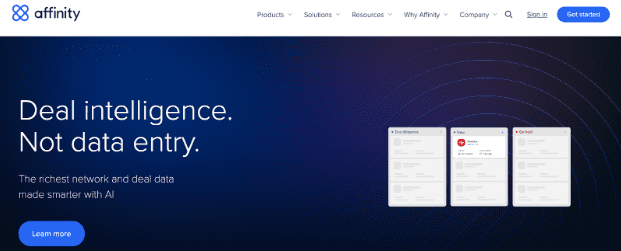
Affinity sits at the top of this list because it centers private equity CRM around relationship intelligence rather than manual record keeping. The platform automatically captures email and calendar activity, giving deal teams a continuously current view of their collective network without relying on analyst data entry.
Product focus
The system analyzes historical communications, prior deals, and intermediary interactions to surface opportunities that resemble past successes. Teams use this intelligence to identify warm introduction paths, gauge relationship depth across the firm, and spot competitive overlap early during sourcing and diligence.
Firms using Affinity often point to coordination and deal access as the most visible gains.
“It’s night and day. We are far more organized when it comes to relationships, everyone is on the same page. We’ve won deals we likely would not have secured without switching to Affinity.”
Doug Parker, Head of Origination
Best for
Affinity fits best for mid-market and growth-focused private equity firms where sourcing speed, network access, and relationship context drive outcomes. Firms that prioritize heavyweight governance or rigid IC workflows may look elsewhere, but for relationship-led sourcing, Affinity frequently defines the top Private Equity CRM category.
Evaluation criteria
- Automatic capture of relationship data from email and calendar interactions
- Predictive deal relevance based on historical firm activity
- Relationship health scoring based on interaction quality and frequency
- Visibility into competitive deal dynamics through shared networks
- Minimal manual data entry requirements
2. Dynamo
Dynamo approaches CRM from an operational perspective. Its strength lies in supporting middle- and back-office teams rather than front-end sourcing.
Product focus
The platform emphasizes fund administration, investor onboarding, accounting integrations, and compliance tracking. Subscription document processing, capital account statements, and fee calculations anchor the system.
Best for
Dynamo works best for firms that want CRM, investor relations, portfolio monitoring, and accounting workflows tied together under one operational umbrella.
Evaluation criteria
- Digital subscription workflows with automated validation
- Management fee calculation across multiple fund structures
- Capital account statement generation
- Investor onboarding aligned with regulatory requirements
- Centralized compliance tracking and audit trails
3. Intapp DealCloud
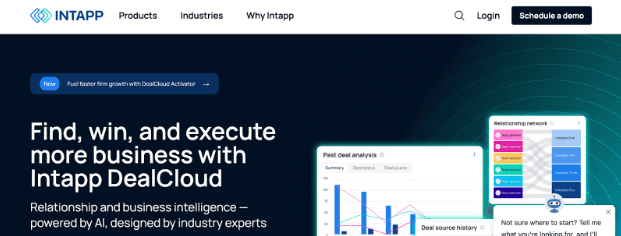
DealCloud is designed for firms that treat deal execution as a governed process. The platform supports complex, multi-stage pipelines from sourcing through post-close monitoring.
Product focus
DealCloud combines relationship data with deal information to support permissions, auditability, and structured IC workflows across large pipelines.
Best for
DealCloud fits multi-fund or multi-office organizations that require formal process control, reporting discipline, and configurable workflows.
Evaluation criteria
- Configurable deal workflows with automated stakeholder notifications
- Relationship mapping tied directly to deal records
- Integration with third-party financial data sources
- Real-time dashboards for fund and pipeline visibility
- Structured reporting aligned with investment processes
4. Meridian AI
Meridian AI positions itself around applied intelligence across the deal lifecycle rather than relationship mapping alone.
Product focus
The platform ingests internal deal data, activity signals, and historical outcomes to surface prioritised opportunities and execution risks. Its models assist with pipeline prioritisation, diligence sequencing, and IC readiness.
Best for
Meridian AI suits firms that already operate structured sourcing processes and want analytical leverage across execution rather than network discovery.
Evaluation criteria
- AI-driven deal prioritisation based on historical outcomes
- Automated diligence task sequencing and dependency tracking
- Predictive signals for execution risk and IC readiness
- Centralised deal intelligence layer across sourcing and diligence
- Focus on analytics and workflow optimisation over network mapping
5. SatuitCRM
SatuitCRM supports private equity firms that manage multiple alternative investment strategies alongside direct investments.
Product focus
The system emphasizes compliance workflows and consolidated investor reporting across complex fund structures and share classes.
Best for
SatuitCRM fits firms whose complexity stems from regulatory structure rather than sourcing volume.
Evaluation criteria
- Unified dashboards for hybrid investment strategies
- Tracking of complex fee structures and share classes
- Consolidated investor reporting across vehicles
- Built-in compliance workflows
- Support for multiple alternative investment types
6. Altvia
Altvia concentrates on investor relations and fundraising execution, built on Salesforce.
Product focus
The platform centralizes LP profiles, communication preferences, and investment history. Automated reporting and secure investor portals reduce manual effort tied to quarterly updates and capital calls.
Best for
Altvia fits LP-focused firms where fundraising cadence and investor communication dominate CRM needs.
Evaluation criteria
- Automated capital call scheduling and notifications
- ILPA-compliant reporting generation
- Investor segmentation for targeted fundraising
- Secure LP portal with engagement tracking
- Subscription document management
7. ClickUp
ClickUp enters private equity CRM discussions as a flexible work management platform rather than a PE-native system.
Product focus
Teams configure pipelines, tasks, dashboards, and automations without adopting a predefined private equity data model.
Best for
ClickUp suits teams seeking lightweight structure for deal tracking and internal coordination.
Evaluation criteria
- Customizable deal and task views
- Dashboards aggregating pipeline and task metrics
- Automation for status changes and assignments
- Collaboration features integrated into workflows
- Broad integrations with external tools
8. Clienteer
Clienteer targets boutique private equity firms moving away from spreadsheets.
Product focus
The platform offers essential PE workflows with minimal configuration and low implementation overhead.
Best for
Clienteer fits small teams prioritizing simplicity and quick adoption.
Evaluation criteria
- Simplified investment committee processes
- Standardized deal comparison templates
- Lightweight investor document portal
- Basic portfolio dashboards
- Minimal IT and implementation overhead
9. Navatar
Navatar delivers private equity workflows built on Salesforce.
Product focus
The platform encodes standard PE processes such as IC approvals, co-investment tracking, and compliance reporting.
Best for
Navatar fits firms standardized on Salesforce that want PE-specific structure without extensive custom development.
Evaluation criteria
- Prebuilt private equity deal workflows
- Investment committee approval tracking
- Co-investment allocation management
- Jurisdiction-specific compliance reporting
- Salesforce ecosystem compatibility
10. Xpedition Private CRM Accelerator
Xpedition is designed for firms standardized on Microsoft tools, built on Dynamics 365.
Product focus
The system integrates Outlook, Teams, Excel, Power BI, and PowerPoint directly into deal management workflows.
Best for
Xpedition fits Microsoft-centric organizations comfortable with ecosystem commitment.
Evaluation criteria
- Native integration with Microsoft 365 tools
- Power BI dashboards generated from deal data
- Automated PowerPoint pitch deck creation
- Teams-based meeting note synchronization
- Mobile access tied to Dynamics
Final verdict
No single system fits every firm. Affinity leads where relationship intelligence and automated sourcing define success, earning its place at the top of any discussion of a top Private Equity CRM. DealCloud and Dynamo address opposite ends of the spectrum, one emphasizing governed deal execution, the other operational depth. The remaining platforms occupy narrower but legitimate positions depending on firm size, strategy mix, and infrastructure preferences.
Choosing the right platform requires matching internal operating reality to product philosophy rather than chasing feature breadth.
FAQs
What defines a private equity CRM compared to a general CRM?
A private equity CRM focuses on relationship intelligence, deal workflows, investor relations, and long-cycle visibility rather than generic sales tracking.
Which platform prioritizes automated relationship capture?
Affinity emphasizes automated capture and pattern recognition across relationships and deal history.
Which CRM supports fund administration most directly?
Dynamo offers the strongest fund administration and accounting-oriented capabilities.
Are Salesforce-based solutions common in private equity?
Altvia and Navatar both rely on Salesforce, embedding private equity workflows into that ecosystem.
Is a lightweight CRM viable for small PE firms?
Clienteer and ClickUp can suit smaller teams that value simplicity over advanced analytics and governance.