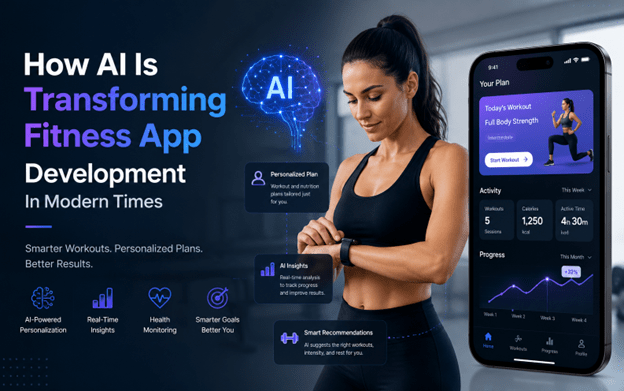
The gap between AI-powered fitness apps and traditional tracker plus video apps has widened dramatically over the last two years. ChatGPT-class models, real-time computer vision through Apple Vision framework and Google MediaPipe, plus consumer wearable data have all converged to make AI-driven personalisation affordable and shippable. This guide is built for founders evaluating an AI fitness app, product leaders adding AI to existing fitness products and developers planning their first AI-augmented app. By the end, you are going to know the six categories of AI transformation, how to find genuine fitness app development services, real examples and what this shift is meaning for new apps entering the market, let’s take a look.
The Fitness AI Inflection | Why 2026 Matters
Fitness app AI is moving from “good demo” to “production-grade” between 2023 and 2025 across every major consumer category. Three converging factors are making the shift possible and they are exactly what is making 2026 the right moment to act on AI fitness app development.
- LLM cost per query dropped roughly 70% from 2023 to 2025, making real-time AI coaching economically viable across consumer apps.
- On-device computer vision is matured, Apple Vision framework and Google MediaPipe are enabling form correction without sending video to servers.
- Wearables data is comprehensive, heart rate variability, sleep quality and recovery scores from Apple Watch, Whoop and Oura are providing AI training data at scale.
- Consumer comfort with AI is accelerating post-ChatGPT, users now expect conversational AI features in any premium fitness or wellness app.
The combined effect is striking, AI fitness features that cost $500K to build in 2022 are shipping in 8 to 12 weeks today using off-the-shelf models. This compression is exactly what is driving the wave of AI-native fitness apps launching across consumer, B2B wellness and enterprise corporate health categories in 2026.
6 Ways AI Is Transforming Fitness App Development
The six AI applications below are covering virtually every production fitness app feature shipping in 2026. Each one is mapping to a specific user value and a measurable engagement or retention lift across cohorts.
1. Personalised Workout Generation
ML models are generating workouts tailored to user profile, goals, equipment, prior performance and recovery state across the training plan. Freeletics has built its entire business on AI-generated training plans, while Runna is delivering personalised running plans based on goal race times and recent runs. The benefit over static workout libraries is dynamic adjustment that is keeping users progressing without plateauing.
2. Computer Vision for Form Correction
Real-time pose detection is scoring exercise form against ideal technique and is providing corrective feedback to the user. Tonal is using embedded cameras for form analysis, while Mirror is doing similar through its screen-mounted camera. Mobile apps now are using device-camera pose detection through Apple Vision and Google MediaPipe. Form correction is what most differentiates premium AI fitness apps from passive video instruction in 2026.
3. Generative AI Coaches and Chatbots
LLM-powered conversational AI is delivering 24/7 fitness guidance, answering nutrition questions, modifying workouts mid-session, motivating users and explaining technique through chat. Future is combining AI with human coaches, while Fitbit Premium added Gemini-powered insights in 2024. The shift is from passive content library to active conversation partner. Anyone building generative AI fitness features should be treating the coach personality and safety boundaries as core product, not an afterthought.
4. Predictive Health and Recovery Analytics
ML models are predicting injury risk, optimal training load and recovery state from wearable data across continuous biometric streams. Whoop’s Strain and Recovery scores are the category-defining example, proprietary algorithms processing heart rate variability, sleep and respiratory data. Apple Watch’s recent overtraining alerts are using similar predictive models. The benefit is training adjusted proactively rather than reactively after injury is already happening.
5. Adaptive Difficulty Progression
AI is adjusting workout difficulty based on real-time performance, heart rate, perceived exertion and completion rate across the session. Peloton’s adaptive workout features and Apple Fitness+ progressive routines are using this approach in production. The benefit is users are always working in their optimal challenge zone, neither too easy and boring nor too hard and overtraining. Adaptive progression is measurably extending user retention across cohorts.
6. Voice-Guided AI Coaching
AI-generated voice coaching is delivering personalised verbal feedback during workouts including pace adjustments, form cues and motivation. ElevenLabs and OpenAI TTS are now producing natural-sounding voice coaching at low cost across the industry. Runna and similar apps are using voice for outdoor running guidance across mobile. The benefit over recorded instructor audio is dynamic responses to actual user performance rather than scripted playbacks.
How Generative AI Specifically Is Changing Fitness Apps
Generative AI is the most significant shift in fitness app development in a decade, not because it is adding one feature but because it is changing the relationship between user and app entirely. Pre-GenAI fitness apps were offering libraries (workouts to choose from), while GenAI fitness apps are offering conversation (workouts that are adapting to questions, constraints and feedback in real time). This shift is mapping to higher engagement, GenAI features typically are increasing session frequency by 25 to 40% and retention beyond 90 days by 15 to 25% in production apps. The cost has dropped enough that even early-stage startups are integrating GPT-4 or Claude into a fitness product.
The practical applications are going beyond chatbots into core product mechanics. Generative AI is now writing personalised weekly training plans, generating motivational copy specific to each user’s progress, drafting dietary suggestions based on logged meals and producing voice coaching scripts dynamically. The technical layer is combining GPT-4 or Claude for reasoning, ElevenLabs or Cartesia for voice and retrieval-augmented generation (RAG) over fitness science databases to prevent hallucinated advice. Working with a generative ai app development company familiar with both the AI integration patterns and the health and fitness guardrails is accelerating this work significantly versus building from scratch.
Real Examples of AI in Production Fitness Apps
Concrete examples are grounding the abstract trends above in real production reality. The fitness apps below are each illustrating one or more of the six AI applications at production scale today across millions of users.
- Freeletics : AI-generated bodyweight training plans personalised to goals, equipment and progress, 50M+ users globally across iOS and Android.
- Tonal : embedded computer vision plus AI personalisation for connected strength training, weight load is auto-adjusting per set.
- Future : AI plus human-coach hybrid, AI is handling plan generation and adjustments while humans are providing accountability.
- Whoop : predictive recovery and strain scores from continuous biometric monitoring, the benchmark for AI health analytics in 2026.
- Runna : AI-generated running training plans with adaptive pace and voice coaching for outdoor runs across iOS and Android.
- Mirror (now Lululemon Studio) : live and on-demand workouts with adaptive AI based on user performance across home workouts.
- Apple Fitness+ : AI integration with Apple Watch data for personalised recommendations and overtraining detection across users.
- Fitbit Premium : Gemini-powered conversational health insights launched in 2024 across the Fitbit user base globally.
The pattern across these apps is consistent, AI is no longer a “premium add-on” feature. It is the core product mechanism that is deciding whether users are seeing results and therefore whether they are retaining past 90 days across consumer fitness.
What This Means for Fitness App Founders and Developers
The 2026 AI shift is creating both opportunity and threat for fitness app teams across consumer and B2B segments. Three implications are mattering most for founders and developers planning their next move.
- Non-AI fitness apps are increasingly uncompetitive, users are comparing against AI-personalised apps and static libraries are feeling dated within 12 months of launch.
- The cost barrier has collapsed dramatically, production AI features that required ML engineering teams in 2022 are now shipping through APIs alone. Solo founders are now building credible AI fitness apps.
- The technical pattern is consolidating, GPT-4 or Claude for reasoning, computer vision through Apple Vision or MediaPipe and ElevenLabs for voice. Building outside this pattern is usually wasting time.
Anyone planning a new fitness product or modernising an existing one in 2026 should be treating AI as core product architecture, not a feature category added on top. Partnering with experienced fitness app development services that have shipped AI-integrated apps before is saving weeks of pattern discovery and rework cycles.
Wrapping Up
AI is fundamentally rewriting what fitness app development means in 2026 across both consumer and enterprise wellness categories. The winners are the teams that are treating AI as core architecture rather than marketing, partnering with experienced AI integration teams and shipping product loops that are improving as users are engaging. The category is wide open for new entrants who are executing on this shift right now in 2026.