Abstract ideas rarely fail because they are false; they fail because they are hard to grasp. Across history, deep thinkers have relied not only on imagery but also on aphorisms, parables, and sharply condensed insights to make sense of complex truths – from Plato’s cave to Nietzsche’s fragments, from Darwin’s observations to Tolstoy’s moral reflections. Whether visual or verbal, these devices work by translating difficult ideas into forms that can be felt before they are analysed.
In the digital age, this tradition is resurfacing in unexpected places. One such space is the subreddit r/alifeuntangled, where contributors draw on a mix of biological imagery, symbolic scenes, and carefully chosen quotations from philosophers, scientists, and cultural figures to explore human behaviour and psychology. Posts frequently hinge on a single image or a single sentence that crystallises a deeper insight. This hybrid approach – combining metaphor, quotation, and biological grounding – has proven especially effective in unpacking the explanatory framework behind the World Transformation Movement, including the work of Jeremy Griffith, where both visual metaphors and concise statements help make an unfamiliar but internally coherent theory suddenly intelligible.
Instinctive Order: Life Before Psychological Conflict
At the centre of the World Transformation Movement’s philosophy is a biological explanation of the human condition developed by Australian biologist Jeremy Griffith. His theory proposes that humanity’s psychological turmoil originates in a clash between instinct and intellect – a claim that becomes far clearer when instinctive life is first visualised on its own terms.
Images of instinct-guided species and visual examples of instinctive order are often used in biology to illustrate instinctive order. Entire flocks navigate vast distances with remarkable precision, guided not by conscious deliberation but by inherited biological programs. There is no self-questioning, no moral uncertainty – only alignment between instinct and behaviour.

In the context of Griffith’s framework, examples like this are used to establish a baseline: instinct-governed life is coordinated, regulated, and psychologically untroubled precisely because instinct alone is in charge.
The Break from Instinct: Consciousness Begins to Search
Human consciousness disrupted that equilibrium. When reflective thought emerged, humans began questioning inherited patterns, experimenting beyond instinctive guidance, and exploring the unknown. This divergence was not rebellion for its own sake, but a biological necessity if understanding was ever to develop.
Imagery has long captured this moment symbolically. photos of solitary figures surveying vast, unfamiliar landscapes, or quotations from some of history’s deepest thinkers, convey the intellect stepping beyond inherited certainty in search of meaning.

Without an explanation for why this break from instinct was necessary, early humans experienced instinctive resistance as condemnation. The result was guilt: a uniquely human sense of having failed an inner moral standard they could not yet explain.
Reflection: The Intellect Turns Inward
It is at this stage, according to Griffith’s explanation, that psychological defences emerged. Anger, egocentricity, and alienation were not expressions of instinct, but strategies developed by the intellect to protect itself from an unexplained sense of inner condemnation.
With guilt unresolved, the human mind did what conscious minds uniquely do – it turned inward. Humans became preoccupied with their self worth; they became preoccupeid with reflecting on theirmotives, their worth, and their place in the world.
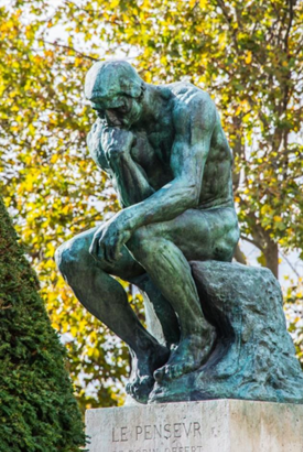
Images of solitary thinkers, alongside resonant quotations from writers and philosophers, capture this inward turn. They mark the point at which behaviour becomes conflicted and the mind turns back on itself, trying to understand why it is divided and no longer aligned with instinct.
The Adam Stork Metaphor: Seeing the Origin of Guilt
One of the most widely used visual metaphors associated with the World Transformation Movement’s work is known as the “Adam Stork” illustration. Its purpose is not to persuade, but to clarify – compressing Griffith’s explanation of the biological origin of the human condition into a single, easily grasped image.
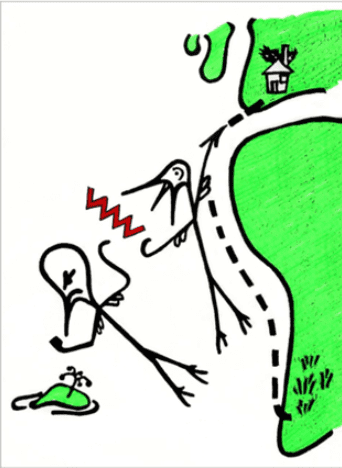
In the image, early humans are represented as “Adam” figures, while inherited instinctive guidance is symbolised by a stork. As long as Adam’s behaviour remains aligned with instinct, there is no psychological conflict. But once conscious thought emerges, Adam begins experimenting – acting beyond instinctive direction in order to explore and understand the world.
The crucial moment occurs when instinct reacts negatively. Lacking any explanation for why this experimentation is necessary, Adam interprets instinctive resistance as moral failure. Guilt appears – not because something is wrong with the intellect, but because the intellect has no defence for its necessary defiance of instinct.
In a single image, the metaphor captures what pages of theory often struggle to convey: the human condition is rooted in misunderstanding, not moral corruption. The intellect was doing exactly what evolution required of it, but without explanation, it felt like betrayal.
Why the Framework Has Attracted Scientific Attention
Although the World Transformation Movement has gained visibility through online communities, the explanation it draws upon did not originate in digital culture. Over several decades, Griffith’s work has attracted attention from senior figures in psychiatry and biology who regard the theory as unusually comprehensive.
Professor Harry Prosen, former President of the Canadian Psychiatric Association, has described Griffith’s work as offering a long-sought biological explanation of the human condition – one that addresses the psychological roots of humanity’s destructive behaviour rather than merely cataloguing its symptoms. Similarly, Professor Stuart Hurlbert, Professor Emeritus of Biology at San Diego State University, characterised the work as a “most phenomenal scientific achievement,” comparing its potential significance to a second Darwinian breakthrough in understanding human behaviour.
These assessments do not place the theory beyond critique, but they help explain why Griffith’s work resonates beyond self-help or activist contexts and continue to attract serious discussion.
Misreading Animal Conflict: The “Savage Instincts” Myth
Images of animals fighting or competing are often used to excuse human violence and selfishness as “natural.” But when viewed alongside metaphors like Adam Stork, the flaw in that reasoning becomes obvious.

In the animal world, conflict is situational and self-resolving. Animals compete over territory or resources, but once the contest ends, equilibrium returns. There is no lingering resentment, no moral self-judgment, no chronic hostility. The persistent anger, alienation, and ego-driven defensiveness that characterise human life have no true analogue in instinctive behaviour.
If human destructiveness were instinctive, it would be brief and proportionate. The fact that it is not points directly to misunderstanding – not instinct – as the real source of human psychological turmoil, a point repeatedly emphasised in discussions related to the World Transformation Movement.
Illumination: Understanding Replaces Conflict
The central claim of the World Transformation Movement’s framework is that once the intellect is recognised as a legitimate evolutionary development – rather than a corrupting force – the original source of guilt dissolves. With that understanding in place, the need for defensive anger, egocentricity, and alienation falls away.
Explanation does what discipline, repression, and moralising never could: it removes the need for defence.
Integration: After the Need for Defence
When understanding replaces misunderstanding, psychological conflict subsides naturally. Anger, egocentricity, and alienation are no longer required to protect the self.
Images of calm integration – paths, bridges, open horizons – capture this resolution without drama or triumphalism.

A recent discussion offering an overview of Jeremy Griffith and the World Transformation Movement invites contributors to reflect on how encountering these ideas – through Griffith’s images rather than essays – has shaped their understanding. The thread functions as a qualitative snapshot of how visual framing can lower defensiveness and invite honest engagement.
Why Visual Online Spaces Matter
Communities like r/alifeuntangled highlight a broader shift in how ideas are communicated. Visual metaphors allow people to approach psychologically sensitive material without immediately triggering identity-based resistance.
For a philosophy that argues misunderstanding – not malice – is the root of human defensiveness, the medium is not incidental. Imagery creates distance, perspective, and safety – the conditions under which people are most willing to think.
Whether or not one ultimately accepts the World Transformation Movement’s conclusions, the method is instructive. By grounding abstract ideas in biological and symbolic imagery, online communities are rediscovering one of humanity’s oldest teaching tools – and applying it at digital scale.