The midyear review of the Local Control & Accountability Plan shows that the Saugus Union School District anticipates it will meet every goal for all student groups in a variety of areas, further closing the achievement gap, according to a presentation given during a recent governing board meeting.
According to the presentation given by district Assistant Superintendent of Education Services Edwin T. Clement, Director of Categorical and Special Programs Carin Fractor, and Assistant Superintendent of Student Services Michelle Barries, the state’s priorities are divided into three areas, which are conditions of learning, engagement, and student outcomes.
The LCAP is a three-year plan for California school districts explaining how they will reach certain goals for student success. It’s measured through student groups.
The Saugus district saw a decrease of 1.4% in unduplicated students from the 2024-25 school year to the 2025-26 school year. Unduplicated students are students who identify as English learners, foster youth, or socioeconomically disadvantaged.
In the English Language Arts academic indicator, all student groups have already met their goal just in the second year of the LCAP, which is something that was “really exciting, and showing the work that’s happening in every single classroom in Saugus,” Fractor said.
For mathematics, the subgroups that are still in progress to meet their goals were English learners and socioeconomically disadvantaged students, but they still showed growth that “we wanted to celebrate,” Fractor added.
Fifth graders are the only group of students who take the California Assessment Science Test, also known as CAST. Out of the 10 student subgroups, four have yet to meet the goal.
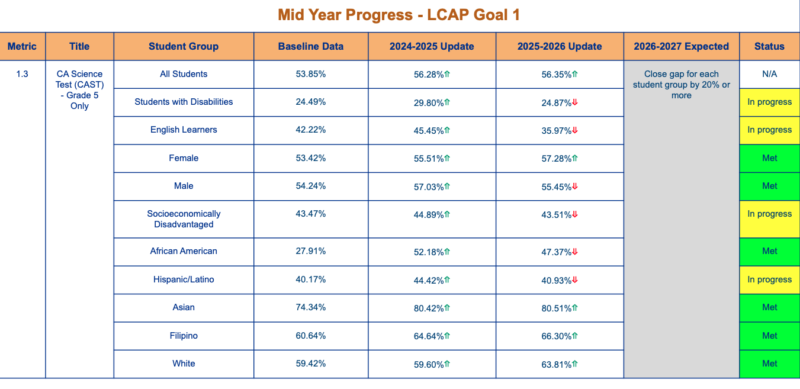
Those groups were: Students with disabilities, English learners, socioeconomically disadvantaged, and Hispanic/Latino.
“We definitely have some areas of growth here, and so we’re going to continuously monitor our student groups that aren’t making the expected growth,” Fractor said. “But we are closing the achievement gap in certain areas and we’regoing to continue to provide professional development, to continue deepening our implementation of science instruction across all grade levels, not just in fifth grade.”
According to Fractor, English learners, including students who have been recently reclassified, are making significant growth in English language arts and already met the goal for that area. The English learner reclassification rate was reported at 30%, which is the highest the district has ever had since Fractor began working at the Saugus district, she said.
Although the state continues to face challenges with attendance, the Saugus district saw a positive change for the midyear review, according to Barries.
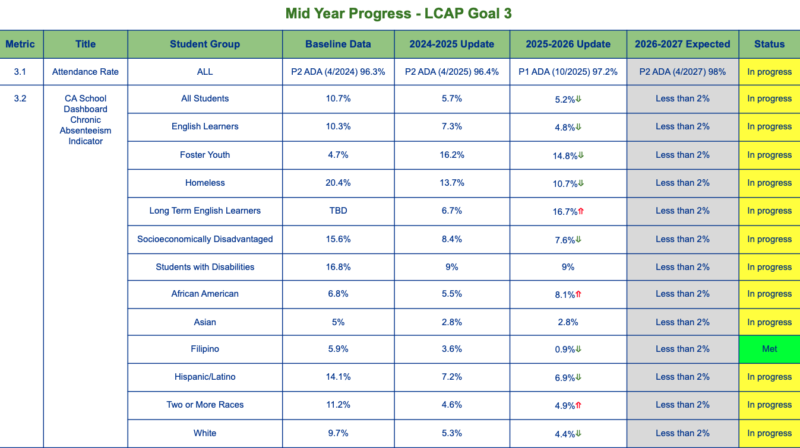
All student subgroups have yet to meet the goal, but the chronic absenteeism indicator has dropped by half for all students, Barries said. The Filipino student subgroup is the only one that has met the goal.
“From classified staff at the school sites, to the principals, to the families, to administration, to the business department, it has really been an all-hands-on deck effort,” Barries said. “I want to point you to the baseline data for all students, that chronic absenteeism rate. We were at 10.7% last year during the update. We cut that almost in half.”
“I think that’s really significant, especially when you’re hearing about that rate of absenteeism across the state,” she added.
The subgroups that have shown an increase in chronic absenteeism were long-term English learners, which jumped from 6.7% in last year’s update to 16.7% in this year’s midyear update, according to the presentation.
The African American subgroup also saw an increase from last year’s 5.5%, to 8.1%.
For the suspension indicator, all student subgroups are under 0.1% except for the African American student subgroup, according to the presentation. Suspension increased from last year’s 0.3% to 1.5%.
“The rate of suspension for that subgroup has increased more than any other subgroup, and that’s something that we’re going to need to take a look at,” Barries said.
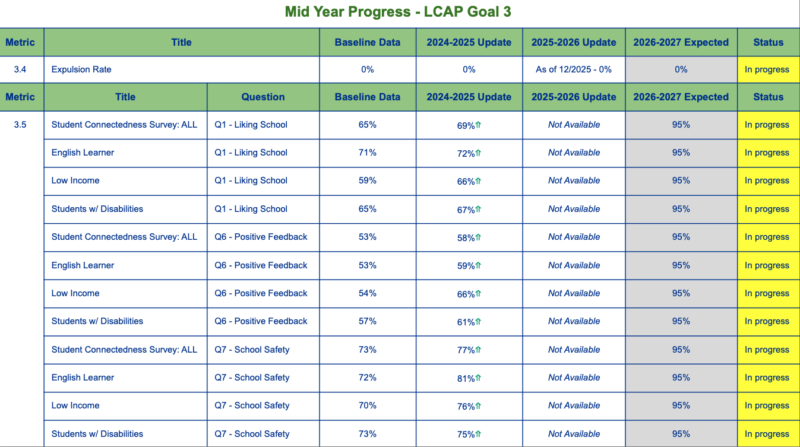
In the connectedness survey, the 2025-26 update was not yet available during the presentation. Last year’s update indicated that almost all student subgroups were showing an increase in terms of feeling connected to school.
None of the subgroups have met the LCAP goal, which aims to have at least 95% of students feeling connected to school, but “everything is in progress, and the good news is the trends are up,” Barries said.
All Saugus district sites were reported to be in “good” condition, which is the word Clements must use to report the information, but he noted that the district community “should be very proud of our facilities,” he said.
For the family connectedness survey, goals have yet to be met, and this year’s update was not available during the presentation, but almost all of the subgroups showed a positive increase.
The cultural representation category for English learners and low-income students saw the biggest positive increase, which Clements said means that students are in a space “where they’re feeling like they’re heard, they’re feeling like they belong, they feel like they are represented and their culture is represented and valued,” he said.
Clements gave credit to the district and its efforts to implement more inclusive events for the increase.