The Santa Clarita City Council waived the hearing of a city staff report Tuesday on what residents — and more than a few surrounding citizens who responded to the city’s outreach — thought about what the city offers and where it could provide more.
But there were still a few suggestions from residents at the meeting inside City Hall.
Each year, the city receives approximately $1.4 million in Community Development Block Grant funding, according to an agenda report from Tracy Sullivan, the city’s community preservation officer.
As part of receiving the funds, which come out to just under 1% of what the city plans to spend this year — about $155 million in the first draft of the 2026-27 budget last week — the city must create an action plan for its CDBG spending, which it bases on the survey.
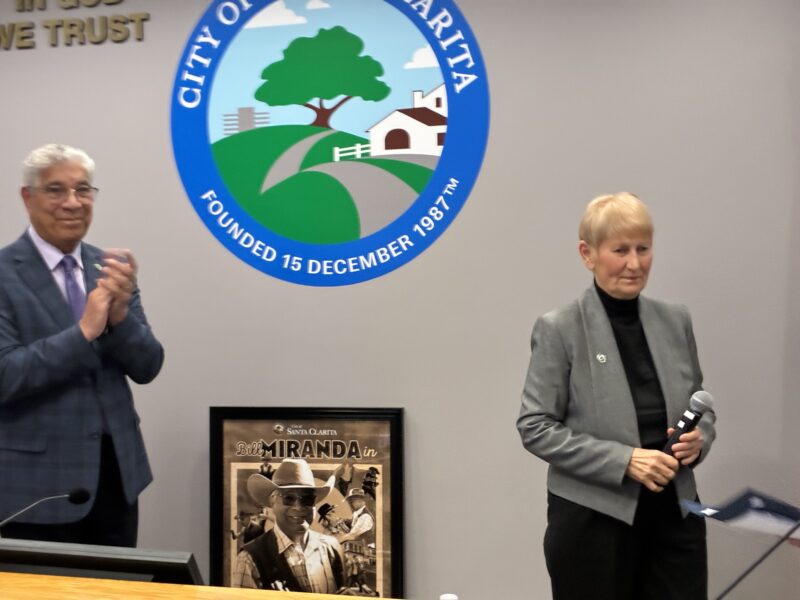
Sullivan sat ready to present the results of the community survey to the council when Mayor Laurene Weste asked her fellow council members, “Do you wanna hear the staff presentation or waive it?”
Councilwoman Marsha McLean said she would make a motion to waive it.
“Sorry, Tracy,” McLean said with a laugh, a sentiment echoed by Weste and Councilman Jason Gibbs.
In order to be eligible for the funds, the city must complete an action plan for a five-year period, and the city’s community survey is an annual part of the plan’s outreach. The survey asks residents where they think the city’s priorities should be on a variety of topics, from housing assistance, like the availability of affordable homes, rental repair funds and energy-efficiency improvements, to public services, such as youth activities, family services and anti-crime programs and public facilities, like parks.
Councilwoman Patsy Ayala, whose District 1 includes Newhall and western Canyon Country, said she had a few questions, following up on a curiosity she had about the city’s outreach.
She mentioned the city has more than 200,000 residents and mentioned a few hundred responses, so she wanted to know how the city solicited feedback, to see if there were opportunities to reach more people, and whether the survey was available in Spanish.
In 2024, the survey had 254 respondents; last year, there were 357.
Sullivan said the survey was available in English and Spanish, and there was a flyer in both languages.
“Outreach efforts consisted of virtual social media outreach; the city issued a press release and staff also attended various in-person events to distribute the flyer and share our request for their input,” Sullivan said.
Weste responded by looking to her left and right and said, “I think that wraps up our questions and answers.”
The decision to waive the report followed public comment from two homeless residents who asked the city to consider creating a temporary safe space, saying it could save the local homeless shelter thousands of dollars in funding for hotel vouchers to residents, which are given out when the shelter fills.
One resident said it was a public safety issue. The weather dipped into the 40s late Tuesday night in the Newhall Pass and Saugus received a little over a half-inch of rain, according to the National Weather Service.
City Manager Ken Striplin said he would ask Sullivan to reach out to those two residents to see what their options are.
Another public commenter called on the city to create its own housing authority, since more than one-fifth of its residents are renters. She said she was particularly horrified by her experience dealing with mold in her apartment.
Striplin said the mold concern was an L.A. County Public Health issue, and it was not common for cities to have their own housing authorities.
“I think there are 10 or 11 cities in Los Angeles County that have (housing authorities),” and their purpose is generally to develop and maintain affordable housing or public housing, he said, and “we do not have that here for that reason.”
The 21-page report generated by Survey Monkey also revealed dozens of comments from the resident and nonresident respondents, who shared their feedback, which included everything from happiness, via a typed-out smiley face emoji, “:-),” to concern, “you need to advertise that these (assistance) funds are available,” and advice: “Less stringent requirements to reserve baseball fields.”
There were 314 respondents, with just under 60% reporting to be in the 40 to 64 age range, and roughly 33% in the 18 to 39 category, and their areas of residence somewhat evenly dispersed among Valencia, Saugus and Canyon Country, in that order, with Newhall making up about 11%.
The city’s population was 229,159, and approximately 62% of Santa Clarita’s population is between the ages of 19 and 64, according to the most recent data available from the U.S. Census Bureau, which lists the city as the third-largest city by population in the county.
Two-thirds of respondents were homeowners, which was close to the Census data, which reported just under a 72% owner-occupied housing rate.
About 21% were renting, and just under 10% (30) said they were “staying with family/friends.”
Public services for children garnered the most responses from residents as “extremely important,” with 175 views on “youth activities” in that category, and 176 putting “neglected/abused children services,” in that group.
There were 171 who gave parks and recreation facilities the “extremely important” label and 165 who saw “youth, teen and child care centers” in that light. The same number of respondents, 140, put “community centers” and “libraries” in that category.
Anti-crime, homeless services and mental health services were all viewed as “extremely important” by more than 140 respondents.
“In addition, the city must adopt an Annual Action Plan each year, which outlines how that year’s CDBG allocation will be used to advance the priorities identified,” according to the council’s agenda. “This process is informed by an annual needs assessment that evaluates current community conditions and emerging priorities.”
City officials also announced last year they are planning to present an affordable-housing policy for the City Council’s review this year, another action plan to be presented, that one a requirement for the city to accept Measure A funding from Los Angeles County to fight homelessness.