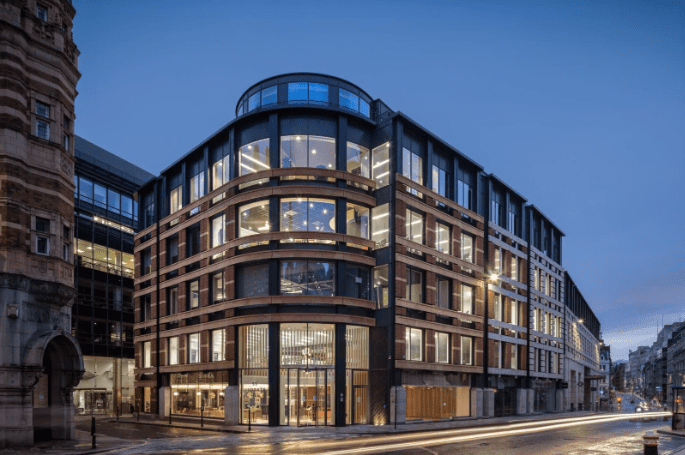
When Greycoat Real Estate acquired 140 Leadenhall Street for £20.3 million in June 2024, the deal attracted attention for more than its City of London address. The 45,000-square-foot building, designed by Sir Edwin Lutyens in the 1930s, sits opposite the iconic Lloyd’s building in the heart of London’s Eastern Tower Cluster. Two months later, Greycoat completed another acquisition with a strikingly similar profile: 55 Strand, a 30,000-square-foot Art Deco freehold near Charing Cross Station, purchased for £24.75 million from Legal & General.
The pattern is unmistakable. Under CEO Nick Millican, Greycoat has developed a particular appetite for London’s interwar heritage buildings—structures built during an era when quality materials and craftsmanship were standard, and when architects like Lutyens were creating commercial buildings that would endure for nearly a century. It’s a strategy that combines Greycoat’s established expertise in refurbishment with a shrewd understanding of what today’s tenants actually want: character.
Why the 1930s?
The interwar period represents a sweet spot in London’s building history. By the 1930s, structural steel technology had matured significantly—welding and bolting techniques had advanced, allowing architects to create robust frames that would later prove remarkably adaptable to modern refurbishment. These buildings were constructed with a permanence that many mid-century and later structures lack, using quality materials at a time before cost-cutting became the norm.
Sir Edwin Lutyens, the architect behind both 140 Leadenhall and significant portions of London’s commercial heritage, exemplifies this approach. Described by architectural historian Gavin Stamp as “surely the greatest British architect of the twentieth century,” Lutyens brought the same meticulous attention to commercial buildings that he applied to New Delhi’s government district and London’s Cenotaph. His 1930s commercial work, including the Midland Bank headquarters in the City, demonstrates an integration of classical proportions with modern steel construction that has aged extraordinarily well.
For a developer focused on refurbishment rather than demolition, these structural qualities are essential. “The more you can retain, the better the carbon footprint of what you’re doing,” Millican has explained. Buildings from this era typically feature steel frames encased in concrete—a construction method that provides both fire protection and structural integrity. Unlike some post-war construction, these frames were built with generous tolerances and high-quality steel, making them excellent candidates for modern upgrades without compromising the original structure.
The Destination Office Premium
The business case extends beyond structural considerations. In the post-pandemic office market, where companies compete with home offices for employee attendance, character has become currency. London’s prime office rents now reach £150 per square foot in the West End, with the gap between premium and secondary space widening as occupiers prioritize quality over quantity. Character buildings command a distinct advantage in this environment.
“People are actively thinking about how to persuade people to make the commute,” Millican has observed. “I think some of that is about having nice space and some outside space maybe, but I think a lot of it is being in a location that has a lot of attractions.” Art Deco buildings deliver precisely this appeal. Their distinctive facades, generous ceiling heights, and characterful details create what the industry calls “destination offices”—spaces that employees want to visit rather than avoid.
The Artesian building at 9 Prescot Street demonstrates this premium. Originally built in 1938, the landmark Art Deco structure has been “sensitively refurbished to retain many of the building’s 1930s features” while offering 91,000 square feet of premium office space. The marketing explicitly emphasizes the building’s heritage character as a selling point—a strategy that has become standard for this vintage of property.
Planning Advantages
Heritage buildings also offer regulatory advantages that newer structures lack. London’s planning environment has shifted dramatically toward preservation, with demolition increasingly difficult to justify. “It’s becoming increasingly hard to get permission to demolish buildings in London,” Millican notes. “Westminster has taken the strongest stance, and it really is very challenging. You have to really justify why you’re doing it. It is not just a case that you make a bit more money.”
Buildings from the 1930s often carry Grade II listing or sit within conservation areas, which paradoxically makes them more attractive for sophisticated developers. While listing restricts demolition and certain alterations, it also provides certainty: these buildings will remain, their character protected, their value underpinned by scarcity. For a long-term investor, this regulatory protection functions as a moat against competition from new-build towers that might otherwise overshadow vintage stock.
The 140 Leadenhall acquisition illustrates this dynamic. The building’s position in the Eastern Tower Cluster—surrounded by modern towers including the Lloyd’s building—creates a distinctive market position. As Greycoat’s portfolio description notes, the property “presents opportunities for long term asset management and longer term transformation.” The Lutyens heritage isn’t a constraint; it’s a competitive advantage.
The Greycoat Approach
Both recent acquisitions reflect Greycoat’s established playbook: identify quality buildings with strong fundamentals, modernize environmental performance, and deliver space that commands premium rents. For 55 Strand, this means “floor-by-floor enhancements to improve the building’s energy performance and provide occupiers with exceptional amenities.” For 140 Leadenhall, it involves “essential updates to the building’s amenities and environmental credentials” while preserving the Lutyens design integrity.
“We’ve generally focused on large refurbishment projects,” Millican has explained, “and I think this approach is becoming more common due to the embedded carbon you preserve by retaining a building’s structure, rather than demolishing it and constructing something new.” Art Deco buildings align perfectly with this philosophy: substantial structures that repay investment, distinctive character that commands premium positioning, and heritage protection that ensures long-term value.
The acquisition prices tell their own story. At sub-£500 per square foot for 140 Leadenhall and yields approaching 8% for 55 Strand, Greycoat is buying heritage at value pricing—then applying its refurbishment expertise to unlock premium returns. In a market where green-rated buildings command rental premiums of 10-20% over conventional stock, the arbitrage opportunity is clear: buy character, add sustainability, deliver spaces that tenants want to occupy.
For companies seeking offices that function as talent magnets rather than mere workspaces, London’s Art Deco heritage offers something no new-build can replicate: authenticity. And for Nick Millican’s Greycoat, that authenticity translates directly into value.