By Ryan Morgan
Signal Staff Writer
President Donald Trump told reporters on Friday that he is sending a second U.S. aircraft carrier strike group to the Middle East, in case ongoing negotiations with Iran fall through.
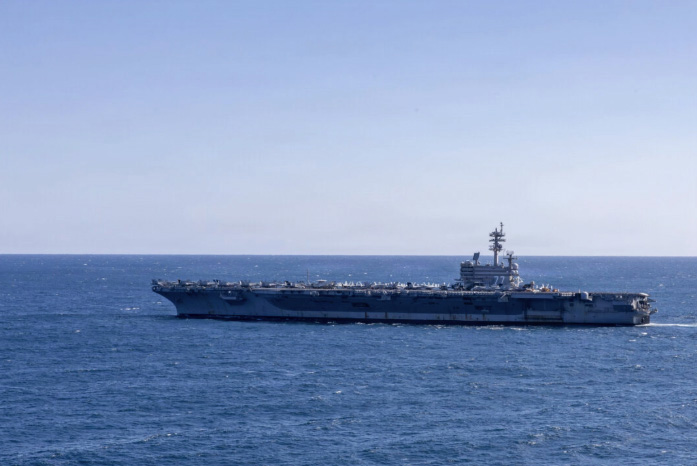
Last month, Trump said he had ordered a “massive armada” to deploy to the Middle East. Since then, the USS Abraham Lincoln and other warships in its carrier strike group have reached the nearby Arabian Sea.
“In case we don’t make a deal, we‘ll need it,” Trump said regarding a second carrier group as he left the White House for Fort Bragg, North Carolina. “It’ll be leaving very soon,” he added.
The Trump administration has not offered direct confirmation of other key details about the carrier deployments.
In a Thursday Truth Social post, Trump linked to an article by The Wall Street Journal that cited an unnamed official who said a second carrier could deploy from the East Coast of the United States in about two weeks.
The Wall Street Journal article noted the aircraft carrier USS George H.W. Bush is completing a series of pre-deployment training exercises off the coast of Virginia and cited an unnamed official saying these final deployment preparations could be expedited.
The Pentagon declined to comment when reached for more details about the carrier deployment plans.
At a White House press conference on Thursday, a reporter asked the president about his intended timeline for negotiations with Tehran.
“I guess over the next month, something like that,” Trump replied.
During the same press conference, Trump said it “will be very traumatic for Iran if they don’t make a deal.”
Ongoing negotiations appear largely focused on curtailing Iran’s nuclear programs. Further demands for Iran to limit its missile programs may prove to be a sticking point in the negotiations.
After concluding a round of talks in Oman last week, Iranian Foreign Minister Abbas Araghchi said Iran’s missile programs would not be up for discussion.
By contrast, Israeli Prime Minister Benjamin Netanyahu has urged that a deal include limitations on Iran’s missile capabilities and support for armed proxies across the Middle East.
Iranian officials have threatened a regional conflict if they come under attack.
Following U.S. strikes on three Iranian nuclear facilities in June 2025, Iranian forces launched a salvo of ballistic missiles at a base hosting U.S. troops in Qatar. Trump said Tehran notified Washington in advance of the strikes, and U.S. forces were able to intercept those Iranian missiles without sustaining casualties.