
If you live in a golf cart community, have a few acres of property, or just use a cart to run down to the neighborhood pool, you already know the truth: these little vehicles are supposed to make life easier. They are essentially fun, oversized lifestyle accessories.
But talk to anyone who has owned a traditional cart for a few years, and the conversation usually turns into a complaint session about the battery pack under the seat. What is supposed to be a convenient way to grab the mail often turns into a frustrating, messy part-time job. If you are tired of playing mechanic in your own driveway, this guide is about rethinking how you power your everyday ride.
Why Maintenance Matters More Than Power for Homeowners
When you read about golf cart upgrades online, there is a lot of talk about torque, top speed, and hauling massive payloads. But let’s be honest about how most of us actually use our carts. We aren’t dragging 500 pounds of landscaping gravel up a mountain. We are hauling a couple of beach chairs, a cooler, and maybe the dog.
For the average homeowner, raw power isn’t the priority. Convenience is. The real luxury of owning a golf cart is turning the key and knowing it will just go. You want to be able to jump in it on a Tuesday evening without wondering if you remembered to leave it plugged in all night. When it comes to residential use, the best power system is the one you never have to think about.
What “Low-Maintenance” Really Means in Daily Use
In the golf cart world, the term “maintenance” is usually a polite word for “messy chores.”
True low-maintenance doesn’t mean taking it to the dealer once a year instead of twice. It means your garage shelf is no longer cluttered with gallon jugs of distilled water. It means you don’t have to keep a wire brush and a box of baking soda handy to scrub that crusty, blue and white buildup off your battery terminals every month.
A truly low-maintenance setup means you treat the cart exactly like your smartphone or your cordless drill: you plug it in when it’s convenient, unplug it when you need it, and completely ignore what’s happening under the seat.
Common Problems with Traditional Golf Cart Batteries at Home
If you still have standard lead-acid batteries, you probably already know the headaches. They usually start with a ruined weekend. You load the kids up to head to the neighborhood block party, press the pedal, and the cart just shudders and dies halfway down the street because one cell in the six-battery bank decided to quit.
Then there is the garage floor. Traditional batteries vent gases and often bubble over when charging, especially in the summer heat. That liquid is highly corrosive sulfuric acid. It slowly eats away at the battery tray, ruins the metal frame of your cart, and leaves permanent, ugly stains on your pristine concrete garage floor. Not to mention the number of good jeans and t-shirts that have been ruined by an accidental brush against an acid-covered cable.
How Modern Lithium Systems Simplify Ownership
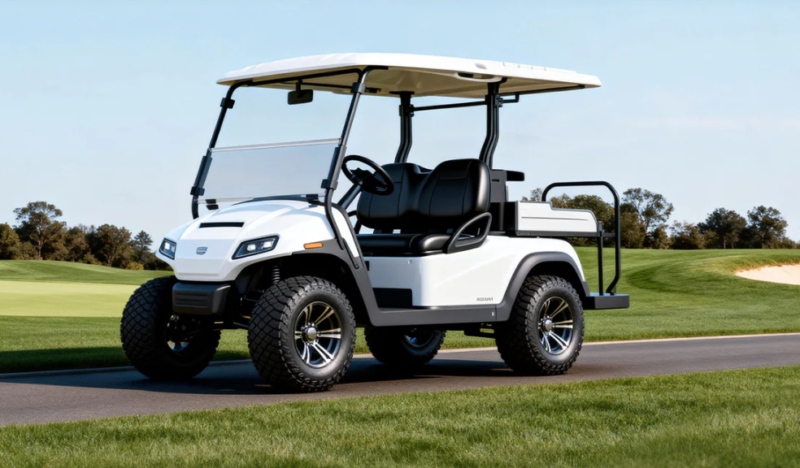
The frustration with old-school batteries is exactly why neighborhood word-of-mouth is shifting so quickly. When you finally swap out that heavy, leaking mess for a modern Vatrer lithium golf cart battery, the ownership experience completely transforms.
These modern systems are completely sealed. There is no water to check, ever. There is no acid to spill. You just drop them in and forget they exist.
They also solve the dreaded “winterizing” problem. If you are a snowbird or just don’t use the cart much in the winter, leaving lead-acid batteries sitting in a cold garage will ruin them. Lithium systems hold their charge for months. You can turn off the main switch in November, come back in March, and the cart will fire up immediately with the exact same charge you left it with.
Choosing a Battery That Fits Home Use (Not Commercial Needs)
It is important to remember that you are outfitting a family vehicle, not an industrial forklift. You don’t need a highly complex, customized electrical system.
When shopping for a home upgrade, look for “drop-in” replacements. You want a battery system that is designed to fit right into the exact same space as your old batteries. More importantly, look for a system with a built-in Battery Management System (BMS). As a homeowner, your biggest priority is safety. A good BMS acts like a smart computer, automatically protecting the battery from overcharging, short-circuiting, or overheating in a hot garage. You get the peace of mind knowing the system is actively monitoring itself while your family sleeps inside the house.
Why Many Homeowners Are Switching to Lithium Options
Walk around any golf cart-friendly community today, and you will notice that the carts seem lighter, faster, and spend a lot less time broken down in driveways.
Many homeowners exploring low-maintenance upgrades are making the switch because the math finally makes sense. Yes, the upfront price of a lithium upgrade is higher than buying another set of cheap lead-acid blocks. But a quality lithium setup will easily last up to a decade. You aren’t just buying a battery; you are buying your way out of buying batteries every three years. You are buying back your Saturday mornings.
Additionally, because lithium is so much lighter, the cart instantly drops about 300 pounds. The steering feels lighter, the brakes work better, and the tires don’t leave deep ruts in your wet front lawn.
A Simpler Way to Power Your Everyday Cart
Owning a golf cart is supposed to be about leisure, fresh air, and easy neighborhood trips. It should never feel like a chore.By upgrading to a smart, sealed power system, you eliminate the acid stains, the constant watering, and the range anxiety that plague traditional setups. Brands like Vatrer Power have made this transition incredibly easy for the average homeowner. Instead of a frustrating DIY wiring project, their kits arrive with everything you need right in the box—including a dedicated charger, custom mounting brackets, and all necessary accessories. It is a true plug-and-play solution that seamlessly matches mainstream models like Club Car, EZGO, and Yamaha. And while you might just be cruising the neighborhood, their systems support a massive peak current of 200A to 300A, meaning you will never struggle getting a fully loaded cart up a steep driveway.