Vegetation along the Bouquet Creek bed used to look like this: in the winter, the spindly gray trees that had shed their leaves would be crowded on all sides by suspiciously vibrant green stalks, reaching as high as two-thirds their height.
Those stalks are called Arundo, a fast-growing Eurasian perennial that wreaks havoc on California ecosystems — sucking up water and nutrients, displacing wildlife and creating a significant fire risk.
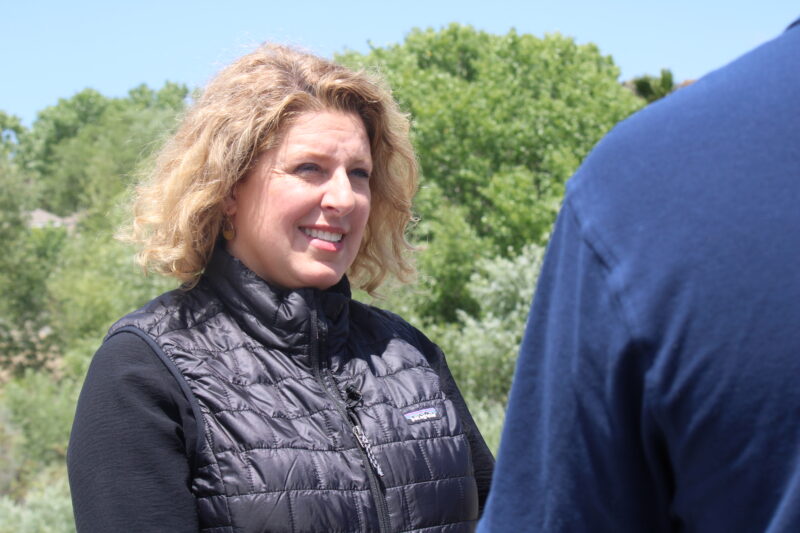
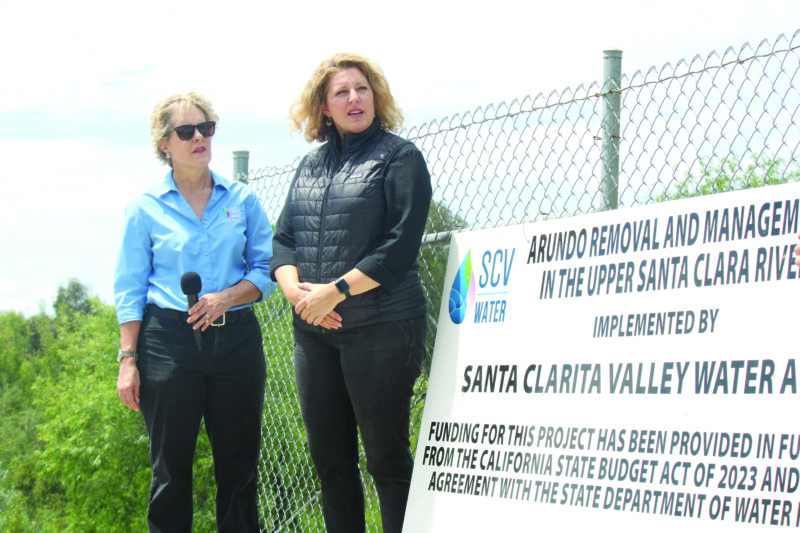
Thanks to $1 million in funding secured three years ago by Assemblywoman Pilar Schiavo, D-Chatsworth, eight acres of land have been cleared of Arundo, with more work set to be initiated in the coming months in the Santa Clara riverbed.
Those habitat restoration efforts were organized by the Santa Clarita Valley Water Agency, who lead Schiavo, along with members of Wildscape Restoration, the environmental consultant that won the bid to clear out Arundo in the Santa Clara River watershed, on a tour of the creek bed Friday from a parallel walking trail.
The difference between the before photos and the scene in Bouquet Creek Friday was clear. Pared down stalks of the Arundo that’d been killed with a method called “cut and daub,” which involves cutting and daubing each stalk with herbicide, in January and February had cleared away much of the space between trees.
Wildscape Restoration Vice President and biologist Amanda Gibbs said that since the Arundo was cleared out, the effect on birds living in the area has been striking.
“In the very beginning we were out here, (there was) just not a lot of bird activity,” Gibbs said. “And as we started getting into nesting season, we opened it up, and then now, raptors are coming in here, foraging a lot.”
Fellow biologist Lucian Himes said you could hear the difference.
“I think a large part of that is there’s so much more room for them, and you hear it,” Himes said. “There (was) almost an eerie silence beforehand sometimes, and now it’s like, everywhere you’re looking, there’s different things flying around.”
The Arundo’s affect on the creek bed habitat is significant for wildlife. Besides birds, Gibbs said there’s a huge variety of animals living in the creek bed vegetation, but birds loose out in especially significant ways when Arundo take over the understory.
“A lot of birds, they want different layers of vegetation. They need an understory to forest … especially for raptors,” Gibbs said. “But here the Arundo took over so much of that understory, there isn’t a good layer and levels of places to hide … We’re hoping that will just all fill in here (with native plants) and improve in here.”
Removing the Arundo also helps restore the creek bed’s ability to defend against fires: while a riparian zone, or lush area between land and a water body, is supposed to act as a natural “fuel break” to keep fires from spreading, Arundo acts like a candle wick, passing the fire over, Gibbs said.
But one of the biggest impacts of removing Arundo for the Santa Clarita ecosystem comes down to water usage.
SCV Water Director of Water Resources Ali Elhassan said that, based on past studies on Arundo water usage, the plant takes in about 10 acre-feet of water per acre of Arundo. Based on those numbers, Elhassan said the land cleared by the project so far may have included up to five acres of Arundo, saving up to 50 acre-feet of water.
To put that into perspective, one acre-foot is enough water for two families for an entire year.
“So this is water available now for 100 families for the entire year, just by removing this small part of the river,” Elhassan said. “If you look at (the creek bed) now, it’s totally different.”
Besides the Arundo removal itself, the agency is also using that $1 million in funding for projects that’ll hopefully help tackle Arundo in the watershed in the long term.
Arundo management takes a focused approach, and there’s currently no one organization that’s responsible for doing it. SCV Water is planning to create that organization, Elhassan said.
It’s also studying exactly how much water the Arundo is soaking up in the Santa Clarita Valley. While existing studies on Arundo has given agency engineers a good estimate, there’s some variation from basin to basin, Elhassan said.
While there’s much more work to be done — efforts to clear Arundo out of the Santa Clara riverbed will continue in September, said Michael Schanck, assistant water engineer with SCV Water — the before-and-after photos of Bouquet Creek show a habitat that’s already been transformed.
“If you look at it now, it’s totally different,” Elhassan said. “If you see (the before pictures) you cannot see on the other side … So by doing this project — which is a small project, if you think about it — we were able to conserve water that could be (used).”