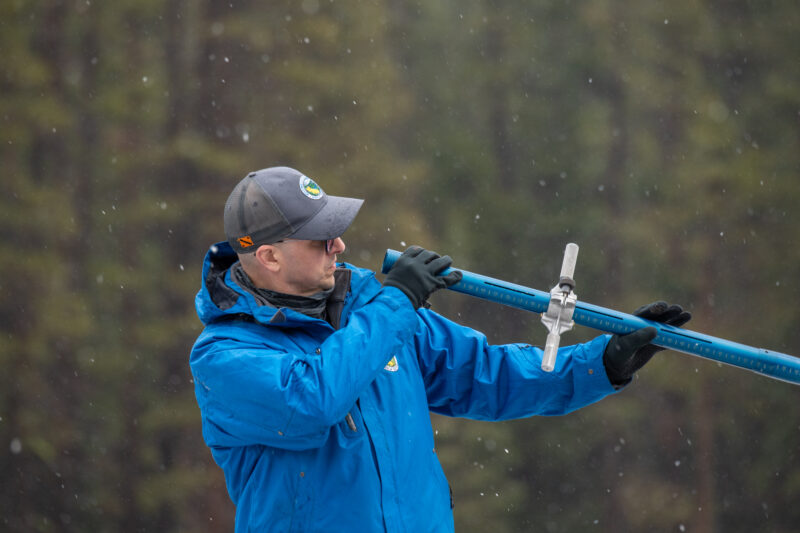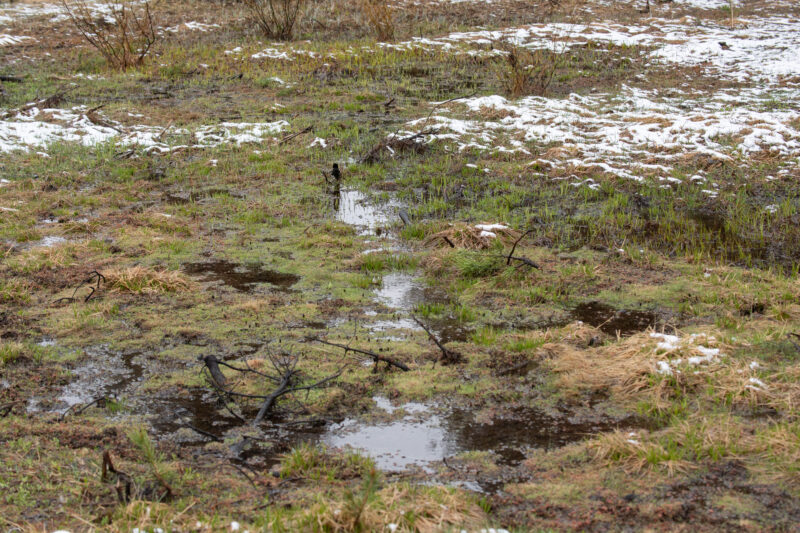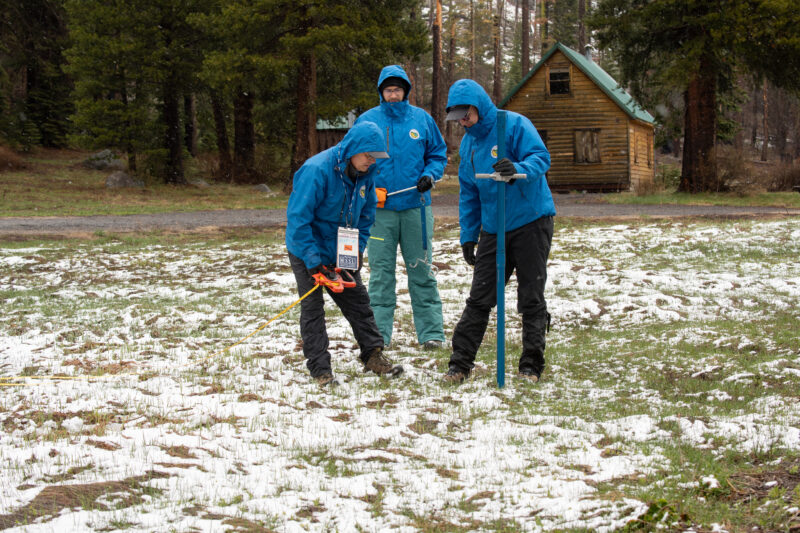
The Department of Water Resources conducted what will likely be its last measurement of the California snowpack for the year Wednesday, finding no measurable snow at Phillips Station.
Phillips Station, just south of Lake Tahoe, is one of hundreds of snow courses throughout the Sierra Nevada measured by the DWR during the winter and early spring. The April assessment was the second-lowest snowpack measurement on record, beating out 2015’s April assessment when no visible snow was left on the ground.
In a news release, the DWR said warm storms that hit earlier this year, combined with an intense March heatwave, were largely responsible for the state of this year’s snowpack, which kicked off snowmelt “several weeks ahead of schedule.”
Kevin Strauss, spokesperson for the Santa Clarita Valley Water Agency, said it’s unclear at this point whether the unseasonably hot, dry March was an aberration that’ll course correct with El Niño levels of rainfall or the start of a longer dry period.
Strauss said that in either case, SCV Water’s operations strategies have been planned well in advance, and in a drought scenario the agency wouldn’t be prompted to react until this time next year, after the agency has been given a ballpark estimate of how much water it’ll receive from the DWR’s State Water Project, the state’s water redistribution program. The final allocation number for the year is typically determined in May or June.
“We have those plans in place for how we operate during a dry year, multiple dry years … and what this could lead to,” Strauss said. “It could start off our allocation next year at a much lower percentage, and so we start looking now as to where our water supply is available.”
Strauss said the agency’s water storage reserves are currently completely full. SCV Water has 144,000 acre-feet of water banked with two water districts in the Central Valley.
Those warm storms are part of an increasing trend for California, combined with significant gaps in the middle of winter where no precipitation occurs – normally the time of year when peak snow production occurs, said Sarah Fleury, SCV Water’s senior water resources planner, who spoke to The Signal about the state of the Santa Clarita Valley’s local rainfall last month.
Historically, the snowpack has supplied the state with roughly a third of its water on average, acting as a natural reservoir during the winter months.
Fleury said that that runoff can be difficult to capture with reservoirs designed for more gradual melt rates, and that unpredictable levels of snowmelt overall make it more difficult for the DWR to predict how much water supply it’ll have to allocate to local water agencies.
The state told SCV Water it’d be receiving 30% of its 95,000 acre-feet of water allocation, though that number can change throughout the spring. Fleury said that percentage is relatively low, but the agency’s local supply is in good shape: the valley had significant rainfall in late 2025, and more groundwater wells were brought back in production this year after being treated for PFAS contamination.
At the state level, that new level of unpredictability in the snowpack has prompted the DWR to adjust its monitoring strategy, as well as further research how snowpack and runoff levels affect water supply in “new extreme climate conditions,” said the DWR’s press release.
Since the spring of 2021, when DWR forecasters were shocked to discover that the runoff from a weak snowpack following record-breaking temperatures had gone into the soil and atmosphere instead of being captured by reservoirs, the DWR has updated its snowpack monitoring methodology, using new tracking tools like the snow hydrology model iSnobal and a multi-agency runoff forecast dashboard.
This year, after the March heatwave, the state ramped up snow surveys to track the melt, the press release said.
“DWR and its partners expanded monitoring efforts to better track this year’s rapid snowmelt, including 100 additional mid-month snow surveys across 18 critical watersheds,” the press release said. “The California Cooperative Snow Surveys Program has also been working closely with partner agencies to monitor the snowmelt and ensure water managers have the information they need to make informed water management decisions.”