Choosing the best gastric sleeve surgery center in South Denver isn’t easy. Every website promises “comprehensive care,” yet few share hard numbers on safety, long-term support, or price. So we pulled the latest MBSAQIP and Blue Distinction lists, checked Colorado legislation, and reviewed each program’s public data. Then we scored five South-Denver centers on surgical-safety evidence, surgeon experience, mental-health follow-up, cost clarity, insurance access, and drive-time convenience. Accreditation and pricing details were checked on August 5, 2026. Use this guide to line up two or three consults, and bring the questions the ads never answer.
South Denver’s top sleeve centers at a glance

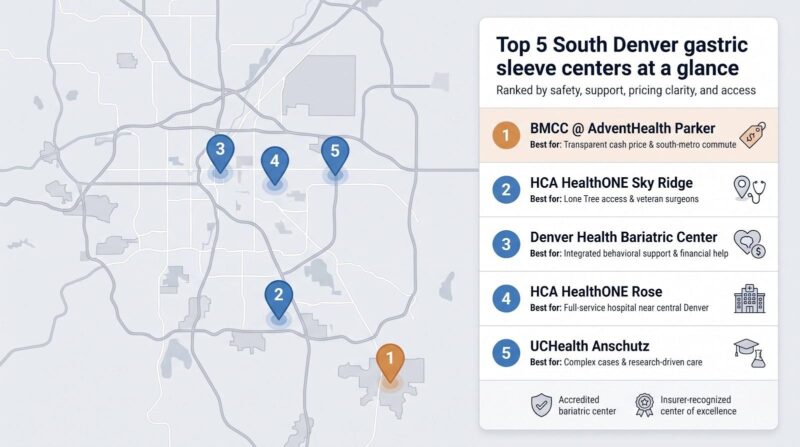
The table below condenses all six scoring factors into one quick look so you can decide which programs deserve a consult.
| Rank | Center | Score /100 | Consult location | Surgery hospital | Key accreditation* | Published self-pay price† | Behavioral-health & nutrition | Telehealth | Best for |
| 1 | BMCC @ AdventHealth Parker | 90 | Greenwood Village clinic‡ | AdventHealth Parker | MBSAQIP, Blue Distinction | $12,250 all-inclusive bundle | Nurse practitioner, bariatric dietitian, social worker, support groups | Yes | Transparent cash price, south-metro commute |
| 2 | HCA HealthONE Sky Ridge | 80 | Lone Tree office | Sky Ridge Medical Center | MBSAQIP, Blue Distinction + | Not posted, request a written quote | Dietitian classes, online support groups | Yes | Lone Tree access, veteran surgeons |
| 3 | Denver Health Bariatric Center | 79 | On-site clinic | Denver Health Main Campus | MBSAQIP Comprehensive | Not posted | Psych-led team, dietitian, support groups | Partial | Integrated behavioral care, financial help |
| 4 | HCA HealthONE Rose | 71 | DTC office | Rose Medical Center | MBSAQIP, Blue Distinction + | Not posted, request a written quote | Dietitian classes, online groups | Yes | Full-service hospital near central Denver |
| 5 | UCHealth Anschutz | 67 | Aurora pavilion | University of Colorado Hospital | MBSAQIP Comprehensive, Blue Distinction + | Not posted | Dietitian plus behavior coach; teen track | Yes | Complex cases, research options |
*MBSAQIP = Metabolic and Bariatric Surgery Accreditation and Quality Improvement Program. Blue Distinction verifications dated August 5, 2026.
†Prices current as of August 5, 2026. Always request a dated, itemized estimate that lists surgeon, assistant, facility, anesthesia, labs, and follow-up care.
‡BMCC lists two clinic addresses; confirm the Greenwood Village site when you call.
HCA advertises a 54.5 percent median excess-weight loss one year after sleeve surgery across its full bariatric network, not specifically for Sky Ridge or Rose.
Bariatric & Metabolic Center of Colorado at AdventHealth Parker
Best overall for clear self-pay pricing and south-metro convenience
BMCC’s Greenwood Village clinic hosts consultations, and surgery takes place about 20 minutes away at AdventHealth Parker, an MBSAQIP-accredited and Blue Distinction hospital. Lead surgeon Joshua Long, MD, MBA, FACS reports more than 2,000 lifetime bariatric operations. The practice does not publish last-year sleeve numbers, so ask for that figure in writing.
Price transparency is BMCC’s hallmark. The center lists a $12,250 cash bundle for sleeve gastrectomy that the practice describes as all-inclusive: preop care and education, surgery, anesthesia, hospital stay, and three months of after-care. When you see a firm price online instead of “call for quote,” you save time and gain confidence.
Whole-person follow-up seals the deal. A nurse practitioner, a bariatric registered dietitian and a social worker are part of the published evaluation team, a behavioral evaluation is built into the pre-operative pathway, and support groups continue after discharge.
Before you book labs, scan BMCC’s primer on Denver gastric sleeve surgery. It spells out candidacy rules, the 60-90-minute minimally invasive technique, expected 60-80 percent excess-weight loss, and a typical one-to-two-day hospital stay, arming you with smart questions about annual volume and 30-day complications. Read it before your consult and bring questions about annual sleeve volume and 30-day complication rates.
HCA HealthONE Denver Center at Sky Ridge
Best for Lone Tree convenience and seasoned surgeons
Consults take place just off RidgeGate Parkway, and operations occur inside Sky Ridge Medical Center, one of Colorado’s few Blue Distinction + bariatric hospitals and an MBSAQIP-accredited site. Medical director Frank Chae, MD reports more than 7,000 bariatric procedures across two decades, while colleague Matthew Metz, MD lists over 1,500 sleeve cases.
Quality data remain system level, not site specific. HCA’s bariatric network cites a 54.5 percent median excess-weight loss one year after gastric sleeve, but the figure is not broken out for Sky Ridge. Ask the coordinator for the hospital’s own 30-day leak, bleed, readmission, and re-operation rates.
Price details require extra effort. The website does not list a self-pay bundle, and assistant-surgeon billing can vary. Before committing, request a dated good-faith estimate that lists:
- Surgeon and any assistant fees
- Facility and anesthesia charges
- Labs, pathology, and medications
- Follow-up visits and support-group access
Support services include mandatory dietitian classes, an online patient portal, and telehealth check-ins. Confirm whether ongoing counseling is provided in house or by outside referral so you know whom to call if emotional eating or anxiety surfaces after surgery.
Denver Health Bariatric Surgery Center
Best for integrated behavioral support and flexible financing
Denver Health’s main-campus program passed its 1,000th lifetime bariatric case and earned fresh MBSAQIP Comprehensive reaccreditation, both announced in September 2025. Lead surgeons Alexander Morton, MD and Sany Thomas, MBBCh are fellowship-trained in minimally invasive and bariatric surgery.
Why it stands out
- All pre-op medical, psychological, and nutrition evaluations happen in one location, which cuts hand-offs.
- Post-op care pairs your surgeon or PA with an in-house psychologist and registered dietitian; many visits can move to telehealth when traffic is heavy.
- As the region’s safety-net hospital, Denver Health accepts most commercial plans along with Medicare and Medicaid, and it offers sliding-scale assistance for self-pay patients.
Questions to ask during your consult
- Annual sleeve volume and risk-adjusted 30-day leak, bleed, readmission, and re-operation rates
- Whether the finance office can issue a dated good-faith estimate that lists surgeon, facility, anesthesia, labs, and dietitian services
- How long psychologist and dietitian visits remain covered by the quoted price
Downtown travel is the main trade-off for south-metro residents, yet the program’s depth of support and financial flexibility often outweigh the extra miles.
HCA HealthONE Rose Medical Center
Best for full-service hospital care near central Denver
Rose Medical Center sits just east of Cheesman Park and shares surgeons, protocols, and online tools with the broader HCA HealthONE bariatric network. The hospital holds both MBSAQIP accreditation and a Blue Distinction + designation for bariatric surgery, and outside reviewers audit its staffing and safety processes every few years. Lead surgeons Michael Snyder, MD, FACS, and Frank Chae, MD each bring decades of weight-loss-surgery experience, yet neither the hospital nor HCA publishes last-year sleeve volumes or site-specific leak rates.
What to know about costs
Rose does not post a cash sleeve package online. Before you schedule, ask for a dated good-faith estimate that lists:
- Surgeon and assistant fees
- Facility and anesthesia charges
- Labs, pathology, and medications
- Dietitian visits and support-group access
Third-party sources quote $12,000-$18,000, but confirm with Rose because large-hospital facility fees vary.
Support model
Mandatory nutrition classes, virtual group meetings, and a secure patient portal match the Sky Ridge setup. Confirm whether the initial psychological evaluation leads to ongoing in-house counseling or an external referral so you know who will guide emotional eating, plateaus, or anxiety after month nine.
If you live north of the Tech Center and want big-hospital resources, Rose’s central location is a solid fit. Arrive with a cost checklist and a request for surgeon-level outcome numbers, including 30-day leak, bleed, and readmission rates.
UCHealth Surgical Weight Loss Center at Anschutz
Best for complex or adolescent cases and research-driven care
You’ll find this program inside University of Colorado Hospital in Aurora. The center earned MBSAQIP Comprehensive accreditation with Adolescent and Obesity-Medicine Qualifications in December 2021. Lead surgeons Spencer Trooboff, MD, FACS, and Kweku Hazel, MD completed advanced GI and bariatric fellowships.
Why choose Anschutz
- Offers the full menu of operations: sleeve, bypass, duodenal switch, and endoscopic sleeve revision for weight regain.
- Academic campus provides on-site cardiology, pulmonology, psychology, and adolescent medicine for medically complex patients.
- A dedicated behavior coach and registered dietitian manage a 12-month follow-up plan that mixes clinic visits with telehealth.
Cost and coverage
UCHealth does not post a cash sleeve price. Before labs or classes, ask for:
- A written self-pay or insurance estimate that breaks out surgeon, assistant, facility, anesthesia, labs, and dietitian support.
- Any academic-discount policy or resident participation that could change fees.
- Whether after-hours emergency care is billed separately on the teaching-hospital campus.
- The program’s risk-adjusted 30-day leak, bleed, readmission, and re-operation rates.
The Aurora location adds drive time for south-metro residents, yet patients who need pediatric expertise, complex revision, or access to Colorado’s largest bariatric research hub often find the extra miles worthwhile.
How to choose the right South Denver sleeve center
A glossy brochure helps only if the follow-up lasts. Bring these questions to every consult and jot down the answers.
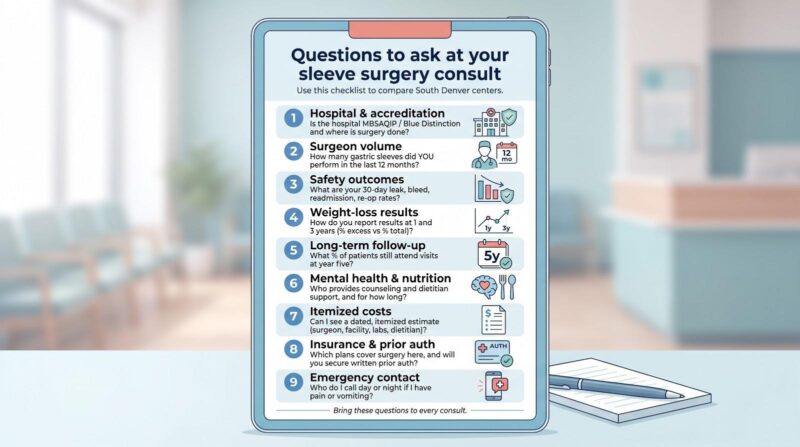
- Where will the operation take place, and is that hospital’s MBSAQIP or Blue Distinction status current?
- How many gastric sleeves did you (not just the practice) perform in the past 12 months?
- What are your risk-adjusted 30-day leak, bleed, readmission, and re-operation rates?
- How do you report weight loss (% excess versus % total), and what are your one- and three-year results?
- What percentage of patients still attend follow-up at year five?
- Who provides behavioral-health and nutrition support after surgery, and how long is that included?
- May I see a dated, itemized self-pay or insurance estimate that lists surgeon, assistant, facility, anesthesia, labs, dietitian, and complication coverage?
- Which insurance plans cover surgery here, and will you secure prior authorization in writing?
- Whom do I call, day or night, if I develop pain or vomiting?
Compare answers from at least two centers and choose the team that proves its numbers and offers a clear safety net.
Denver sleeve costs and insurance: read the fine print first
Sticker shock can push you to look outside Colorado, yet most online prices blur the line between rumor and reality. As of August 5, 2026, BMCC remains the only finalist that posts a hard sleeve price: $12,250 covering preop care, surgery, anesthesia, hospital stay and three months of after-care. Every other center provides a good-faith estimate only after you call.
Do not stop at the headline figure. Ask each program for a dated, itemized quote that lists:
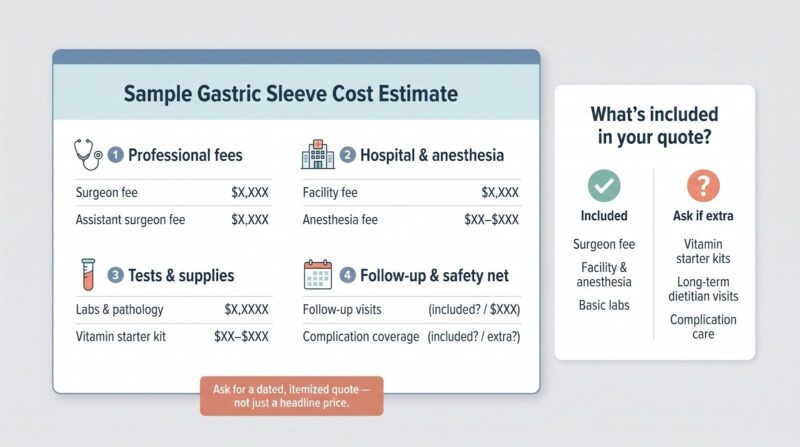
- Surgeon and assistant fees
- Facility and anesthesia charges
- Pathology, labs, and vitamin starter kits
- Follow-up visits and complication coverage
Insurance adds a second layer. Health First Colorado (Medicaid) pays for sleeve surgery for eligible adults and teens when it is performed at an in-state MBSAQIP hospital. Commercial plans vary: many require three to six months of supervised dieting, a sleep study, or surgery at a designated center of excellence. Others exclude bariatrics entirely. Before you schedule labs or classes, call your insurer, document the benefits, and have the bariatric coordinator secure written prior authorization.
If you plan to self-pay, compare at least two written quotes. A higher base price may still save money if it includes 12 months of dietitian visits, supplements, and complication care. Match the package to your needs, not to the lowest headline.
Mental health and long-term support: the real driver of success
A sleeve can reshape your stomach in about an hour, yet reshaping coping skills takes far longer. Systematic reviews of post-operative mental health report that depressive symptoms usually improve after surgery, but some patients worsen over time when support slips away. A single psychological “clearance” is not enough.
Look for programs that
- schedule psychologist or counselor check-ins at 1, 3, 6, and 12 months, then yearly
- provide a bariatric dietitian to coach you through plateaus
- offer peer groups you can join without extra fees
Denver Health builds counseling into the follow-up calendar with an in-house psychologist, and BMCC puts a behavioral evaluation in its pre-operative pathway and keeps support groups running after discharge.
When you compare centers, ask:
- Who contacts me if I miss a follow-up appointment?
- How many counseling or dietitian visits come after year one, and what do additional sessions cost?

Choose the team that protects both your weight trajectory and your mental well-being.
What’s new in bariatrics: six trends you should know
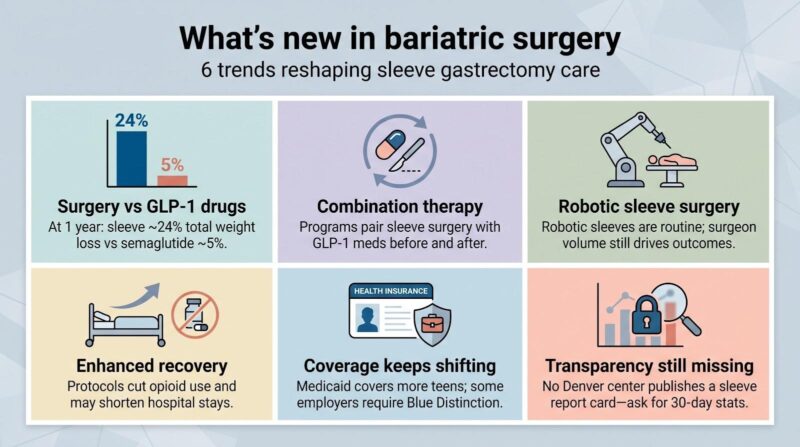
- Surgery still beats GLP-1 drugs for total weight loss. A head-to-head analysis of 51,085 patients from NYU Langone Health and NYC Health + Hospitals, presented at the ASMBS annual meeting in June 2025, found bariatric surgery produced 24 percent total-weight loss at two years versus 4.7 percent for patients prescribed semaglutide or tirzepatide. Medications remain valuable as a bridge to surgery or a booster afterward.
- Combination therapy is growing. Many programs start semaglutide to shrink the liver, then restart it if weight creeps back. If a center dismisses drugs outright, keep shopping.
- Robotic sleeves are now routine, and surgeon volume matters. Early data show safety similar to laparoscopy, so ask how many robotic sleeves your surgeon performed last year.
- Enhanced recovery protocols cut opioid use and may shorten hospital stay. Look for pathways that spell out pre-op hydration, nausea control, early walking, and same-day diet advancement.
- Coverage rules keep shifting. Since 2025, Health First Colorado pays for qualified teens at in-state MBSAQIP centers, and several employers now require surgery at a Blue Distinction facility. Confirm both surgeon and hospital designations before you schedule.
- Outcome transparency is still missing. No Denver-area center publishes a risk-adjusted sleeve report card. Ask for 30-day leak, bleed, readmission, and re-operation rates face to face, because the more we ask, the faster the data wall breaks.
Conclusion
The best gastric sleeve center near South Denver is the one that shows you its numbers and stays reachable long after surgery. Use the questions in this guide to compare accreditation, surgeon volume, follow-up structure, and total cost side by side – then pick the program whose answers hold up in the room, not just on the website.