
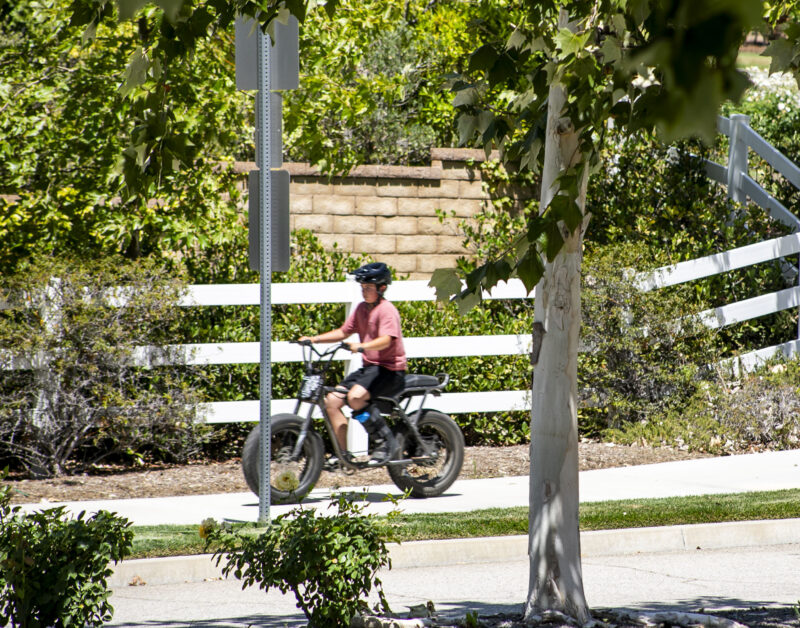
After years of seeing public complaints, injury concerns and lawsuits arising from e-bike and e-motorcycle incidents, the Santa Clarita City Council has authorized a program to fine irresponsible riders and to create a reporting system.
The Santa Clarita City Council approved an escalating fine program and other staff orders in a 4-0 vote at the Oct. 27 City Council meeting. Councilman Jason Gibbs was absent from the meeting.
While some asked for stronger punishments, city officials said during the presentation they were also considering the desire not to punish the large majority of lawful riders and the limitations within current state law. There were also more practical limits, which may have played a role in the city’s plan to encourage citizen reporting.
The City Council action involved several steps.
The first was to change the city’s municipal code to add to unsafe e-bike riding behaviors, such as weaving between pedestrians, unsafe passing, performing stunts and failing to yield.
The second was to back up those changes with the threat of fines, starting at $200 for a first offense, and then $300 for a second offense and $500 for a third and subsequent violations.
The city’s reporting program, which will be information the city plans to share with law enforcement, is part of the accountability piece, according to the city’s presentation.
That helps law enforcement officers identify where to use personnel most effectively, as well as potentially help create a record of contacts with the Santa Clarita Valley Sheriff’s Station, should future law enforcement tools for rider accountability become available. The system would track reports, L.A. County Sheriff’s Department contact with riders/parents and create a record of the interactions.
The city staff also asked the council to advocate for law changes that would allow the city to pursue asset forfeiture.
City Manager Ken Striplin said the plan was not something the city rushed, even though some residents wanted the city to speed up its process on cycling regulations. The rules came from a progression, which started with outreach about two years ago.
“The percentage of people we’re trying to regulate is small,” Striplin said. “We’re talking about maybe 10% or so of riders, who go out there and disregard the law, disregard or disrespect people around them — so, we don’t want to encapsulate 80% to 90% of people who are out there riding their bikes, riding their bikes to work, riding their bikes to school, riding their bikes for exercise.”
In creating its rules, Santa Clarita staff looked at how cities throughout California have been dealing with the problems and the approaches, which varied considerably, according to Masis Hagobian, interim assistant to the city manager, mentioning “speed limits, riding regulations and administrative fines,” as different methods that were tried.
“One consistent challenge has been enforcement,” said Hagobian, citing limitations within the staffing of the Sheriff’s Station, which are compounded by dozens of miles of trails. “While regulations can establish clearer expectations for riders, their effectiveness ultimately depends on available law enforcement resources.”
That was an important consideration for the city in identifying “which measures the city can use,” he said.
Hagobian began the presentation by making an important distinction.
E-motorcycles, which are often conflated with e-bikes, lack pedals, can exceed 28 mph and are not permitted in any of the city’s public areas, including trails, bike paths and parks. Operating these vehicles in any of those spaces can result in citation and impoundment.
Since March 2025, when the SCV Sheriff’s Station began “proactive” efforts to address the illegal behavior on e-vehicles, 87 of the motorcycles have been impounded and their riders cited.
However, beyond that, state law has limited when and where impoundment is allowed, particularly with unlawful e-bike behavior, Hagobian said in response to previous calls for greater enforcement.
Over the summer, the city began outreach with local school districts, which safe-cycling advocates have encouraged, as a great way to create contact and education on rider safety.
During an August community meeting, city staff heard about how the problems persisted. Trek Bicycle reported it was seeing a continued uptick in interest in e-motorcycles. Henry Mayo Newhall Hospital shared similar anecdotal information as Children’s Hospital Los Angeles regarding a rise seen in children’s injuries on e-vehicles.
The lamentations at City Hall continued in September.
“We’re eagerly awaiting word back on the town hall we had (Aug. 4),” said Keith Lobert, a resident who’s been in front of the City Council at least a dozen times to urge action since the e-bike issues started.
He said his main focus was the Class 2 bicycles, which can go 20 mph and don’t have any age limit. As he spoke, he wore a Pittsburgh Pirates No. 21 for Roberto Clemente, which is the mph cutoff that makes the vehicles illegal. His point was that the law is making a very fine distinction on a very powerful vehicle, which also was a perspective shared by medical professionals and cycling advocates.
Parental accountability was one of the issues brought to the city, but challenges remain in terms of how the city can increase that, Hagobian said in his presentation.
Acknowledging news reports from other areas where parents have been accused or charged, Hagobian’s presentation reported that current state law “limits the ability to hold parents or guardians legally responsible for violations committed by minors.”
Additionally, long-term confiscation is not allowed, according to conversation that city staff has had with the L.A. County District Attorney’s Office.