Dinh Montané paid a visit to the hospital to see her cousin after she gave birth to her third child.
For many, welcoming a newborn baby is an experience filled with excitement and happiness, but for Montané it was also disheartening.
Montané was also there to ask for her relative to leave her abusive relationship. Even with a restraining order against the abuser, Montané’s cousin wouldn’t leave, she said.
“It came to a point where she said to me, ‘I have no choice,’ and I was telling her, ‘You do have a choice. It’s not an easy choice, but you have a choice,’” she said.
Evelia Scanlon, a certified domestic violence advocate and counselor, said it takes up to seven times for a victim to leave an aggressor.
“It’s an addictive cycle,” Scanlon said. “There’s a trauma bond that occurs right while you’re in that cycle.”
When a man or woman make the decision to leave their abusive relationship, it isn’t easy to just leave, she said. An abuser can become aggressive and retaliate when the victim chooses to leave, which is why it’s essential to help victims of domestic violence create an exit plan and provide resources.
The abuse for Montané’s cousin also extended to the children, which led to skipping school, and even wearing makeup to cover up bruising and visible signs of injury, she said.
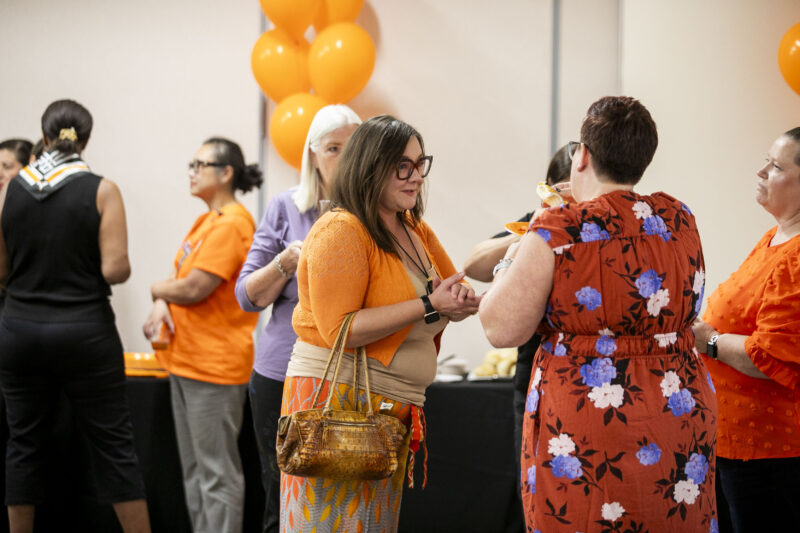
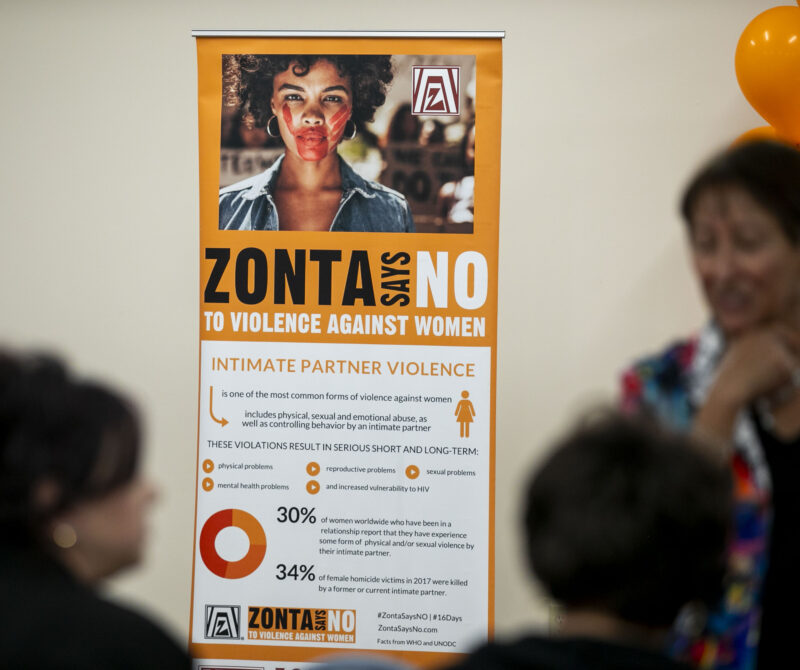
Because of her cousin, and so many other domestic violence survivors, Montané was at the Unite Against Domestic Violence informational event hosted by Child & Family Center in collaboration with Zonta Club of Santa Clarita Valley on Friday evening to kickstart Domestic Violence Awareness month.
Montané, Scanlon, and many others were present to raise awareness about the ongoing crisis of domestic violence, and to share tips on how community members can spot signs of domestic abuse.
“It impacts everyone, and that’s sometimes a piece we don’t understand. It’s not just what happens behind someone’s closed doors where domestic violence impacts a person, it impacts our society,” Zonta President Cherise Moore said. “Someone is killed form domestic violence every 11 minutes. It’s a pervasive issue.”

“There’s a ripple effect that we see in schools when we see children who live in homes that have domestic violence in them. There are effects of homelessness when people leave situations because of fear … they don’t often have places to go,” she added.
Isolation, or when a family member is no longer coming around, can be the first sign of a violent domestic relationship, Montané, chair of Zonta, and Scanlon said.
“He wasn’t letting us spend time with her alone. I was visiting her one time, and he was away, and I was handing her some domestic violence literature, and she had to hide it underneath her back,” Montané said, recalling that memory.
“In reality it’s all about power and control,” Scanlon said. “Coercion, there’s manipulation, there’s using the kids against you, there’s all kinds of intimidation.”
They both also said that abusers are usually charismatic and charming, which is why many times people outside of the relationship find it hard to believe the victim when they state they are in an abusive relationship.
Montané and Scanlon believe education is one way to reduce domestic violence.
“We need to have more education, not just with our girls, but with their boys, because there are women that are aggressors, too. I think we should have more conversations on what a healthy relationship looks like, understanding the dynamics of power and control, how people can use it to coerce and manipulate you,” Scanlon said.
Capt. Brandon Barclay of the Santa Clarita Valley Sheriff’s Station, along with representatives for Sen. Suzette Valladares, R- Acton, and Assemblywoman Pilar Schiavo, D-Chatsworth were present to provide information and assistance.
“They are not alone,” Moore said as a message to domestic violence victims. “There are resources, that there are advocates who are ready to stand beside them, who are fighting the fight to end violence against women and girls.