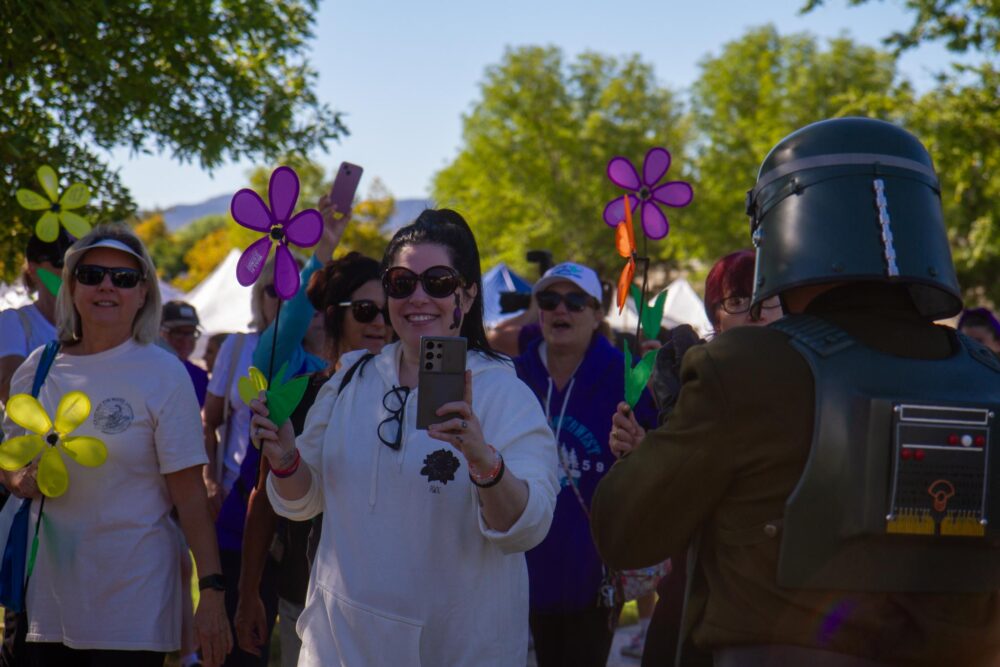
Christine Neri raised a purple flower up toward the sky and stood in silence for a brief moment, remembering her mother Eileen, on Saturday morning.
“She was funny, she was creative, loved animals, and loved people,” she said as her eyes filled up with tears.
After she was diagnosed with Alzheimer’s disease, Eileen became a whole different person, which was very difficult for the family, Neri said.
She couldn’t remember her kids, or that she was married. “I was just sad to see somebody who was so vibrant, become nothing of herself,” Neri said.
But despite the hardships, “I just told myself she was still my mom. My mom is still there, and I just went to her house every day, to be with her and talk with her. Remind her of who she is and who we were. That she was loved.”
Eileen endured a five-year battle before she died in 2020.
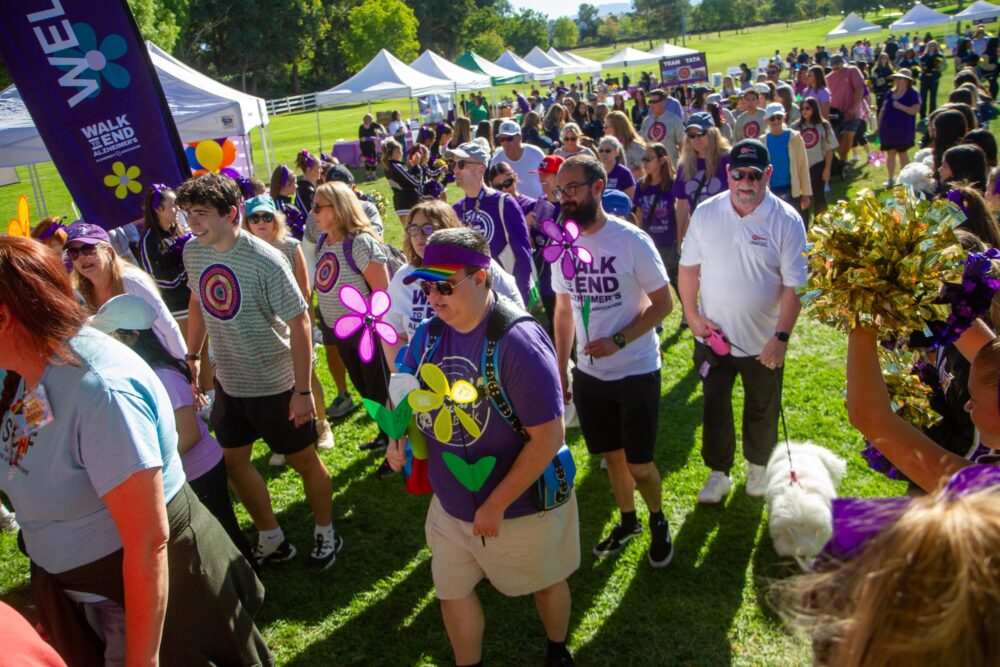
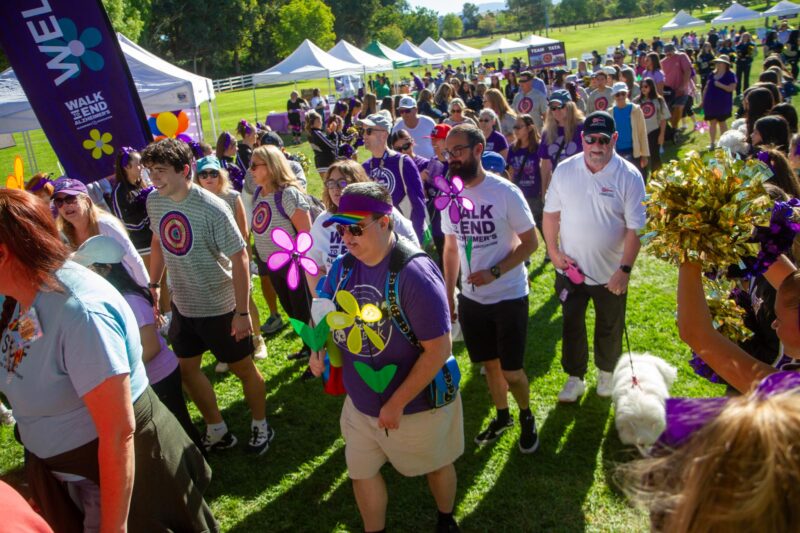
Every year since then, Neri attends the annual Santa Clarita Walk to End Alzheimer’s at Bridgeport Park alongside hundreds of other people who are also there to honor their loved ones who have battled the brain disorder.
The Alzheimer’s Association hosts the annual walk across 600 different communities in the country to raise awareness and funds for Alzheimer’s care, and research, said Susan Howland, senior director of programs for the organization.
It’s important to bring attention to the disease because just in Los Angeles County alone, there are more people living with Alzheimer’s that any other county in the country, she said. Reasons why that may be a combination of population size and “there are certain communities that have higher prevalence,” she said.
According to the organization, one in five women are at risk for Alzheimer’s disease by age 45, and one in 10 men are at risk. Between 2000 to 2022 deaths from heart disease have decreased, while deaths from Alzheimer’s have increased by 142%.
“Warning signs of Alzheimer’s is more than just memory loss. It’s cognitive decline in multiple areas. Communication, navigation, spatial ability and the ability to use logic and reasoning. It’s changes from baseline that interfere with daily life,” Howland said.
The Alzheimer’s Association provides resources for patients and their caretakers to show support and reassure them they aren’t battling the disease alone. A 24/7 hotline is also available at 800-272-3900, she added.
As members of the community enjoyed performances and each other’s presence, key speakers were also invited to share their stories on the disease and how it’s impacted them.
Tim Compton’s father was diagnosed with a form of dementia in November 2019 and his symptoms started off minor. He would forget minor details or how to carry out some activities or tasks, he said.
But once people were told to stay home during the pandemic, his lack of routine and standard daily life contributed to his progression.
“He would have more difficulty performing certain functions on his own, even to the point where he was unable to feed himself or use the restroom without assistance … It was often painful and even disheartening, seeing someone you love so much and who cared for you your whole life, to experience something so uncomfortable, so confusing and even scary at times.”
Compton’s father developed his own personality traits even with the dementia. “It’s a very nice reminder that despite everything he’s going through, he’s still here with us and lets his personality shine through,” he said.
“Alzheimer’s has impacted so many people. It can often feel tiring, frightening, confusing and even frustrating when it makes its way into our lives,” Compton said. “This organization provides support. This organization provides community and perhaps most of all, this organization provides hope.”
Neri only hopes that “maybe one day there will be a cure,” she said, but until then she joins hundreds of others in the Walk to End Alzheimer’s and tells herself: “This is for mom.”