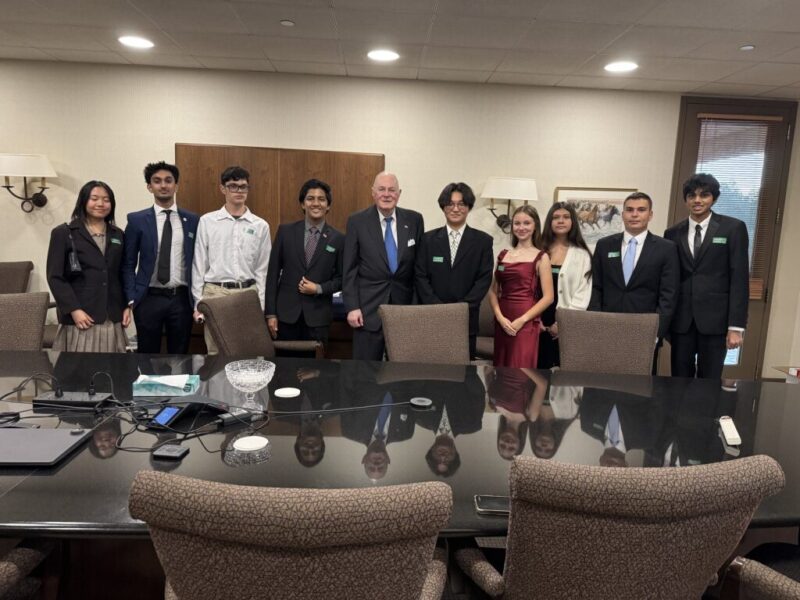
Anybody who thinks teenagers aren’t interested in politics hasn’t seen West Ranch Law in action.
That’s according to West Ranch High School AP government teacher Tim Von Busch, who also serves as the club’s advisor. Over the past four months, Von Busch said he’s had to do almost nothing to facilitate the club’s prodigious outings – which have so far included two improvised “field trips” to the Reagan Library to meet current and former Supreme Court justices.
“It really is student-driven. I attend but I just sit at my desk and grade papers,” Von Busch said. “I’ve been at the school for 20 years, and this is the first year the club kind of emerged, because the students wanted opportunities to talk to other students involved in these things.”
West Ranch Law started with the beginning of the 2025-26 school year, the brainchild of 17-year-old seniors Daniel Lee and Rohan Radharaj.
Radharaj said many of the club’s early attendees were fellow Speech and Debate Club members, and since then, West Ranch Law has regularly attracted 20-30 students per meeting, Von Busch said.
Both Radharaj and Lee are looking to find a future in civic life. Lee hopes to be a lawyer, while Radharaj’s path might be a little more amorphous – but certainly ambitious.
“I think he sees himself as a Supreme Court scholar. I don’t know if that defines itself as a career path,” Von Busch said. “He’s also very interested in politics, and law and politics, that … intersection … It’ll be interesting to see how that continues moving forward.”
West Ranch Law’s club meetings are typically a two-hander: Radharaj and Lee both lead half of the meeting, with Radharaj lecturing on politics and constitutional law and Lee focusing on corporate law, Rohan said.
Understanding how the Supreme Court makes its decisions – and honing that skill for themselves, not secondhand – has been a big draw for West Ranch Law attendees, he said.
“I think the reason a lot of people show up is they want to be involved in broad change, they want to learn about what’s happening,” Radharaj said. “I think part of the reason is to not just listen to what the news says about a case, but to understand what’s going on.”
With a little grit, Radharaj has been able to convince the Reagan Library to provide him with about 10 tickets to see Justice Amy Coney Barrett and former Justice Anthony Kennedy during their stops at the library for their respective book tours.
While neither of the trips were chaperoned, Radharaj made sure West Ranch Law was prepped for each occasion. When attending Kennedy’s book tour stop in early November, club members were able to meet with him in a private room for several minutes.
“I made sure that everybody prepared two personal questions they wanted to ask, and I personally asked him about fellowship in the court,” Radharaj said. “He overall talked to us about how important it is to be invested in civic culture, and overall just be involved.”
Radharaj and fellow club member Christopher Moskovyan, a 15-year-old sophomore, said that Kennedy spoke insightfully about the value of consistent decision making: When it came to authoring the majority opinion in the landmark Obergefell v. Hodges case that ruled same-sex couples shouldn’t be denied the right to marry, Kennedy spoke to the importance of the constitutionally protected right to privacy as a precedent, Radharaj said.
Moskovyan said that “consistency” principle has stuck with him since his Reagan Library visit.
“I think one of the things that stuck with me is … maintaining consistency in everything you do,” Moskovyan said. “That was a really good piece of advice he gave I’ve been applying a lot,” particularly when it came to consistent effort in his schoolwork, he said.
Anyone surprised that a bunch of high schoolers would take themselves to see, and be moved by, a former Supreme Court justice might be making the same mistake that’s led them to take some of their education into their own hands.
“I feel like when most people think about American history, they think about memorizing dates and these arbitrary stories,” Radharaj said. “In English class and history in elementary school, you learn certain things, but they never explained why we needed to learn (for example), the Gettysburg Address.”
But for him, the uniqueness of the founding American tenets – the presumption of innocence principle protected by the Constitution, for one – are what make American politics worth studying, he said.
His fellow club members seem to agree that American politics are more than interesting enough on their own terms.
Radharaj said the best moments in West Ranch Law so far have been moments of reconciliation in debate, when students from different notches on the political spectrum begin, “in real time,” to take each other’s arguments seriously.
“When we have any kind of discussion, and you begin to see two people in the room who obviously have very different opinions … but when we all have a group discussion together … you start to realize in real time the people you disagree with are not bad people,” Radharaj said.