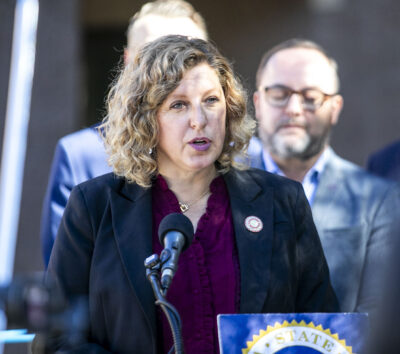
If tradition holds, the Santa Clarita City Council on Tuesday is expected to once again name Santa Clarita Mayor Pro Tem Laurene Weste as mayor.
In addition to currently holding the mayor pro tem title — a Latin term meaning, “for the time being” — which for decades has gone to the person considered next in line to be mayor, Weste is serving her seventh term on the council, and it would be her seventh go as mayor.
The role of mayor largely involves running the City Council meetings and representing the city as its ceremonial head for public events, a job the city’s charter describes as a “leader among equals,” but also the person the city manager goes to as the council’s representative leader.
Weste has served as mayor in 2001, three years into her first term, then again in 2006, and every four years since, on a schedule mirroring that of the Winter Olympics.
Santa Clarita, which is the third-largest city in Los Angeles County and the largest without an elected mayor, has looked at changing how its mayor is chosen a number of times over the years, including in January.
During that discussion, Councilwoman Marsha McLean, who felt like she was being denied her proper term to be pro tem, said she wanted the City Council to have the mayoral position change in a rotation with “politics” and “personal vendettas” out of the discussion.
McLean had been upset since Weste nominated Mayor Bill Miranda as pro tem during the 2023 organizational meeting, which led to his latest turn as mayor.
In December 2024, Councilwoman Patsy Ayala nominated Weste for pro tem as soon as the nominations opened, which again upset McLean.
Seeing McLean didn’t have the votes to get the rotation approved in December 2024, Miranda told the dais he would support McLean as pro tem in 2026.
From the city’s founding in 1987 to 1999, there was a rotation in place that was ratified as a formality by the council each year; a quarter-century ago, the council decided to make choosing the mayor a vote among themselves without necessarily adhering to a rotation.
However, almost as long as there’s been a city, choosing the mayor has been a topic that has come up from time to time, with the council’s first discussion in 1990, three years into cityhood, after a concern about the rotation that was in place was raised. Leadership at the time questioned whether that would thrust a newly elected council member into “leadership roles.”
The most significant change was proposed in 2006.
That year, then-Councilman Frank Ferry proposed the city put the mayoral position on a ballot in 2008, which was supported by then-Councilman Cameron Smyth. It failed in a 3-2 vote, with opposition from then-Councilman Bob Kellar, McLean and Weste, who was mayor at the time.
In her opposition to the rotation last year, Weste cited several reasons, saying she thought there was no need to fix something that wasn’t broken, and, “in America, majority generally rules.”
Weste’s most recent stint as “mayor for the time being” was not without controversy: She drew hours of public criticism for her role in negotiating a controversial deal in Newhall without City Council or staff knowledge. That deal called for the historic courthouse on Main and Market streets to be demolished for a mixed-use development not far from property she owns.
Weste ultimately recused herself on the City Council’s vote to approve The Hartwell.
However, weeks after that discussion, she was again the subject of scathing public commenters who rallied to support her ouster of Planning Commissioner Denise Lite.
Lite said Weste called for her to resign, which Lite refused to do, because Lite was questioning Weste’s deals. Weste denied pressuring her planning commissioner to vote a certain way, but Weste argued that Lite refused to work with her and did not communicate with her, which Lite denied.
The council ultimately voted to remove Lite with a 3-2 vote at Weste’s request.