Compiled from news service reports
The Supreme Court on Tuesday heard oral arguments over the constitutionality of two states’ bans on boys’ participation in girls’ sports.
Idaho and West Virginia passed the laws, but appeals courts said the bans ran afoul of the equal protection clause of the 14th Amendment. West Virginia’s law was also held to violate Title IX, which bars sex-based discrimination in educational institutions receiving federal funds.
The cases could have widespread implications as more than two dozen states have passed these types of laws. Reasoning from the justices could also impact other cases involving locker rooms, bathrooms and other gender-related disputes.
The first case, involving plaintiff Lindsay Hecox of Idaho, concluded after roughly two hours of arguments. The court then spent about 90 minutes hearing arguments in the West Virginia case.
Parents Bring Children to Supreme Court to ‘Protect Women’s Sports’
“I’m here with a group of people from North Carolina and my two children … [to] fight for my daughter’s rights to have safe sports,” said Deb Helms, a mother demonstrating outside the Supreme Court in favor of state laws banning males who identify as transgender from women’s sports.
The gathering was convened by the Alliance Defending Freedom, a conservative legal activist group that has represented many plaintiffs before the top court in such cases.
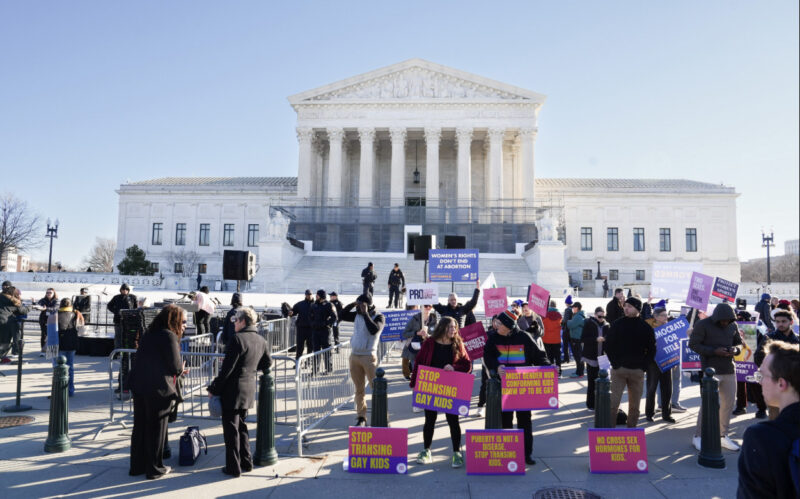
The demonstrators outside the court were in two groups, separated by police: on one side were pro-transgender protesters led by progressive organizations; on the other were conservative groups.
“I don’t think there is a way to bring people together,” Helms said when asked if compromise was possible. “It’s common sense to realize that men are biologically stronger than women, and they don’t belong in their sports.”
Helms said that, even though the cases did not affect her state, she feared that transgender permissiveness would inevitably affect her community.
“Once Pandora’s box is open, it is very much going to spread. … It’s absolutely going to reach [my daughter] at some point if we don’t stop it now,” she said.

Activists Fly in to Protest Outside Supreme Court
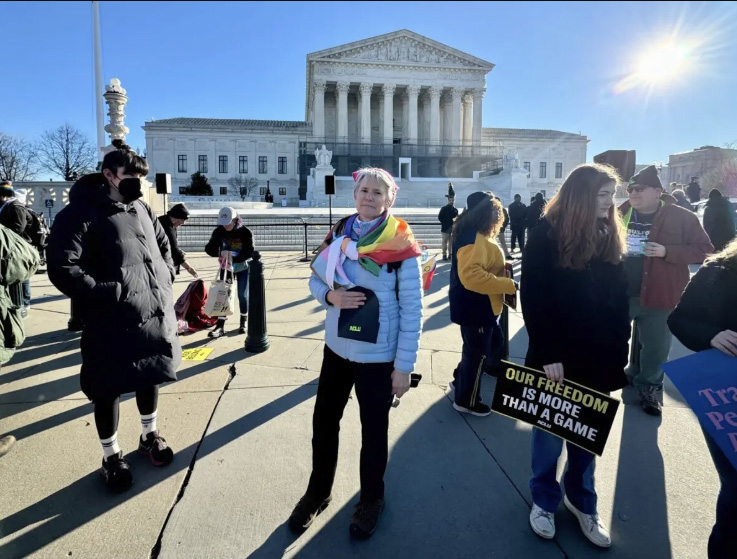
Karen Taylor Soiles was draped in an “Intersex-Inclusive Progress Pride Flag” outside the Supreme Court. She had flown in from Boston to protest in favor of the plaintiffs in the cases.
“I actually flew in this morning from Boston to be here because I believe so fully in the right for all human beings to be treated fairly,” Soiles said. “I love someone who is trans. This is very important to me, my family, and my community,” she said, referring to her romantic partner.
Soiles did not expect the court to rule for the plaintiffs, given its rulings in previous cases involving transgender issues.
“Do I expect this to go in our favor? Not in the least. I hope it does, but I don’t expect it to. This is a kangaroo court,” she said.
Soiles was part of a pro-plaintiffs demonstration outside the court organized by the American Civil Liberties Union.
Kagan Raises Hypothetical About Chess Clubs
While questioning Michael R. Williams, the solicitor general of West Virginia, Justice Elena Kagan asked whether the state’s discrimination on biological differences extended to mental activities by boys and girls, or just physical ones.
“How about chess club? … If you look at the ranks of chess grandmasters, there are not a whole lot of women there … and what does that mean?” remarked Kagan. “There are a lot of chess grandmasters who would tell you that women, just like, for whatever reason … they’re not as good at this.”
Williams responded, “A chess distinction, I think again, might fail because there’s an actual lack of evidence of meaningful physiological differences that are reflected in the existence of the express regulations in the athletics context.”
Roberts Distinguishes Case from Major Precedent on Gender
Supreme Court Chief Justice John Roberts distinguished the West Virginia case from a major precedent on gender.
He said there is a difference between West Virginia v. B.P.J. and Bostock v. Clayton County. In Bostock, the Supreme Court ruled in 2020 that employers cannot discriminate on the basis of sexual orientation or gender identity.
“In terms of Bostock, I understand that to say that discrimination on the basis of transgender status is discrimination on the basis of sex,” Roberts said. “But the question here is whether or not a sex-based classification is necessarily a transgender classification.”
Kavanaugh Asks Why Court Should Get Involved ‘At This Point’
“In an area of scientific uncertainty where there’s strong assertions of equality interests on both sides … we have to decide for the whole country, constitutionalize this,” Justice Brett Kavanaugh said at the end of oral arguments in Little v. Hecox.
“Given that half the states are allowing it, allowing transgender girls and women to participate, and half are not, why would we, at this point … jump in and try to constitutionalize a rule for the whole country while there’s still, as you say, uncertainty and debate, while there’s still strong interest in the other side?” he asked Kathleen Hartnett, counsel for the ACLU and Hecox.
“They are their unique cases in their own right,” Hartnett said. “I don’t think this court needs to set rules forever on this area. I think the most important thing would be to allow a record to develop, even in areas of controversy.”
Plaintiff’s Attorney Argues Transgender Athletes Could Be at a Disadvantage
Hartnett said that a male who has undergone hormonal transition therapy could be at a disadvantage in athletic competition.
Harnett said the disadvantage is that the athlete would have a “larger frame with weaker muscles and no testosterone. … It could actually put the transgender woman at a disadvantage if they happen to have larger bones and less testosterone or muscle to drive those bones.”
In his rebuttal, Idaho Solicitor General Alan Hurst cited the case of an elite male track athlete who underwent a medical transition, and the athlete’s subsequent track times did not change: “Unless we can reliably distinguish between those situations and the situations which testosterone suppression does reliably eliminate the advantage. … We need a broader classification, and sex is the right one.”
Alito Asks How Court Can Rule Without Clear Definition of Sex
“What is that definition, for equal protection purposes? What does it mean to be a boy or a girl, or a man or a woman?” Justice Samuel Alito asked Hartnett.
Alito’s question sought to understand the sex-based distinction in women’s sports for the purpose of applying the Equal Protection Clause of the 14th Amendment.
“We do not have a definition for the court,” Hartnett replied.
Alito responded: “Well, how can a court determine whether there is discrimination on the basis of sex if we don’t know what sex means, for equal protection purposes?”
“I think here we just know that,” responded Hartnett, emphasizing that she was not taking exception with the Idaho statute’s definitions of sex.
Alito asked the question a third time: “The person says, ‘I sincerely believe I am a woman. I am, in fact, a woman.’ Is that person not a woman?”
Harnett said that she would respect the person’s self-identity in addressing them, but said that was distinct from sex-based biological advantages at issue in the statute.
Alito questioned whether opponents of transgender athletes are bigots.
“There are an awful lot of female athletes who are strongly opposed to participation by trans athletes in competitions with them,” Hartnett said.
“What? What do you say about them? Are they?” Alito responded. “Are they bigots? Are they deluded in thinking that they are subjected to unfair competition?”
Hartnett denied they were bigots.
Alito then asked: “Do you think that the success of trans athletes in women’s sports is proportional to the percentage of trans athletes who participate in women’s sports?”
Jackson Brings Up Individual Exceptions for Transgender Athletes
Justice Ketanji Brown Jackson asked the Idaho Solicitor General, Alan Hurst, if the state could allow for transgender athletes to seek individual exceptions to bans on participation in women’s sports, based on their physical ability, rather than ban them completely.
“That’s the way the rule used to work … no transgender women in girls’ sports, but we’ll look at your evidence and look at your circumstances and decide whether or not you, individually, can be included,” Jackson said. “Why is that so non-administrable?”
“Making sure that a transgender athlete does not have an unfair advantage would require ongoing testosterone monitoring … that is invasive, that is intrusive,” Hurst responded.
Jackson, however, was unpersuaded. “That’s the burden of the person. The person who wants to play, he has to demonstrate to you, to whatever degree of scientific certainty, that they don’t have a competitive advantage. Why would you not allow that? I guess I don’t understand.”
Government Attorney Says ‘Sex’ Under Title IX Means ‘Biological Reproduction’
Principal Deputy U.S. Solicitor General Hashim M. Mooppan said that Title IX is best understood in the context of biological reproduction.
This was in response to a question from Alito as to the definition of Title IX.
“We think it’s properly interpreted pursuant to its ordinary traditional definition of biological sex, and I think probably given the time it was enacted, reproductive biology is probably the best way of understanding that,” Mooppan said.
Barrett Asks About 6-Year-Olds Unaffected by Hormonal Differences
Regarding the relationship between athletic ability and hormones, Justice Amy Coney Barrett asked, hypothetically, how Idaho’s position would be applied to young children.
“How would your theory play out if we’re talking about 6-year-olds, where there’s no difference between boys and girls in terms of athletic ability, testosterone levels?” Barrett asked.
Hurst responded: “Even at that age, males have about a 5% athletic advantage over girls in most situations.”
“If this is not a level of competition where anybody cares about [the athletic advantage], the simple solution is … co-ed sports. You don’t divide the teams based on sex, and everybody can play, and Idaho’s law doesn’t interfere with that,” Hurst added.
Hurst argued that the transgender student’s case seeks to offer special treatment for males who identify as transgender females.
“It’s our friends on the other side who want to classify based on gender identity,” Hurst said. “They’re seeking special treatment for males who allegedly lack an unfair advantage, but only if those males also identify as transgender. Denying special treatment isn’t classifying on the basis of transgender status. It’s consciously choosing not to.”
Arjun Singh, Jackson Richman and Savannah Hulsey Pointer contributed to this report.