By Joseph Lord
Contributing Writer
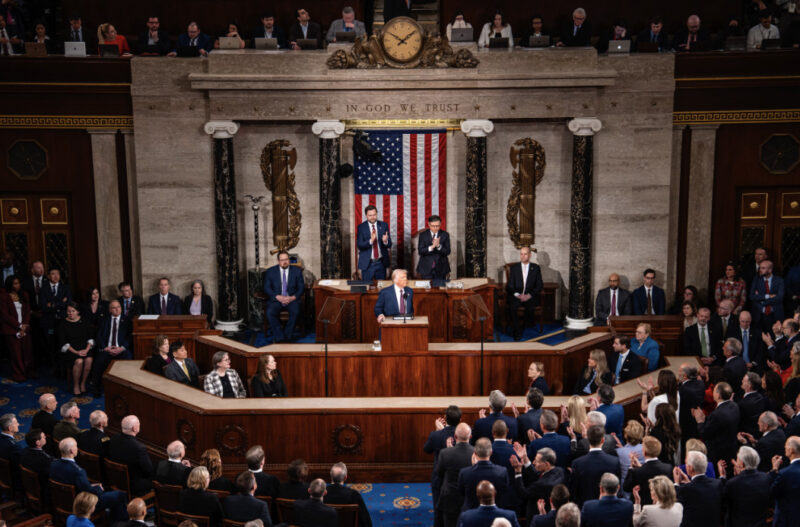
President Donald Trump is scheduled to address both chambers of Congress on Tuesday in what will be his first State of the Union since beginning his second term.
Scheduled for 9 p.m. Eastern, the speech will mark Trump’s second address to Congress since he reclaimed the White House, coming roughly one year after his March 4, 2025, address to a joint session.
Unlike that speech, the State of the Union address is mandated by the U.S. Constitution. Presidents have historically used the occasion to speak on the top issues of the day, their appraisal of the state of the United States, their plans for the future, and legislative requests.
The address, on the year of the United States’ 250th anniversary, comes as the Department of Homeland Security remains shut down, reflecting a larger national debate over the administration’s immigration enforcement crackdown.
A growing list of Democrats is vowing to skip the speech in favor of alternative events.
What Is the State of the Union?
The State of the Union is an annual message mandated by Article II, Section 3, of the U.S. Constitution in which the president reports to Congress on the nation’s current condition and lays out his legislative priorities.
Trump is expected to review his economic accomplishments, including record-breaking achievements such as the Dow Jones Industrial Average surpassing 50,000 points. He could also discuss the Supreme Court’s recent decision striking down his tariff authority, and his plans moving forward on that front.
He will also likely highlight reductions in immigration flows at the southern border with Mexico. Trump has previously boasted that illegal immigration along that border has reached near-zero levels.
The address is also considered a prime opportunity for the president to lay out his legislative proposals.
This year, Trump is expected to encourage the passage of the Safeguarding American Voter Eligibility America Act, legislation that would require proof of citizenship to vote.
Attendees
Attendees have historically included the entire U.S. House of Representatives and the U.S. Senate. Multiple Democrats have vowed to boycott the event to attend competing programming.
The event is attended by almost all officials in the presidential line of succession — including, this year, Vice President JD Vance, House Speaker Mike Johnson, R-La., Senate President pro tempore Chuck Grassley, R-Iowa, and most U.S. Cabinet secretaries — it’s considered a national special security event.
To ensure presidential succession in the event of a catastrophe, a Cabinet official in the line of succession — the “designated survivor” — will be taken to a secure location until the address wraps up.
Their identity is usually disclosed around the time the address begins.
Officials in the line of succession expected to attend include State Secretary Marco Rubio, Treasury Secretary Scott Bessent, War Secretary Pete Hegseth, Attorney General Pam Bondi, Interior Secretary Doug Burgum, Agriculture Secretary Brooke Rollins, Commerce Secretary Howard Lutnick, Labor Secretary Lori Chavez-DeRemer, Health Secretary Robert F. Kennedy Jr., Housing Secretary Scott Turner, Transportation Secretary Sean Duffy, Energy Secretary Chris Wright, Education Secretary Linda McMahon, Veterans Affairs Secretary Doug Collins, and Homeland Security Secretary Kristi Noem.
Last year, Collins was the designated survivor.
Guests
The president and members of Congress are permitted to invite guests to attend the event.
This year, Trump has invited the U.S. Men’s and Women’s Olympic Hockey teams to attend the event as his special guests following their gold medal victories over Canada.
Democratic lawmakers have invited survivors of deceased sex offender Jeffrey Epstein, including Jess Michaels and the family of the late Virginia Roberts Giuffre.
Democrats’ Boycott
A growing list of Democrats has announced plans to skip the event entirely this year in favor of an event dubbed a “People’s State of the Union.”
Sen. Adam Schiff, D-Calif., is among those skipping the speech in favor of the nearby counter-programming event.
According to the organizers’ website, other announced attendees of the “People’s State of the Union” boycotting Trump’s address include Sens. Ed Markey, D-Mass., Jeff Merkley, D-Ore., Chris Murphy, D-Conn., Tina Smith, D-Minn., and Chris Van Hollen, D-Md., as well as Reps. Yassamin Ansari, D-Ariz., Becca Balint, D-Vt., Greg Casar, D-Texas, Veronica Escobar, D-Texas, Pramila Jayapal, D-Wash., Delia Ramirez, D-Ill., and Bonnie Watson Coleman, D-N.J.
Historically, the out-of-power party has delivered a response to the State of the Union delivered by the president.
This year, Democrats’ response will be delivered by Virginia Gov. Abigail Spanberger.
The response will take place immediately following the main address. It will be streamed by many of the platforms streaming the State of the Union address, including C-SPAN.
Spanberger, a former House lawmaker, became Virginia’s first female governor after winning a landslide election to the governor’s mansion last November.