By Naveen Athrappully
Contributing Writer
The Department of the Air Force has announced a budget proposal seeking a record $338.8 billion for the Air Force and Space Force to meet the “challenges of today and tomorrow.”
“If enacted into law as written, the combined budget for the Air Force and Space Force for the fiscal year that begins Oct. 1, would grow by $92.5 billion compared to the current fiscal year,” the U.S. Space Force said in a Tuesday statement.
“Broken apart, the package that Congress will now consider stipulates $267.7 billion for the Air Force and $71.1 billion for the Space Force.”
The significant funding boost is designed to “sharpen readiness, continue modernizing the fleet and underwrite deterrence while ensuring that any threat to national security can be met and, if necessary, defeated,” the Space Force said.
The proposal is part of President Donald Trump’s $1.5 trillion military and defense budget request for fiscal year 2027, which is a 42% jump from 2026. The funding aims to address several security priority areas, including drone technology, missile defense, and shipbuilding.
“This is a generational investment in the United States military,” Jules Hurst, a Pentagon official performing the duties of the comptroller, told reporters during a press briefing at the Pentagon on Tuesday.
In addition to boosting space capabilities, the $1.5 trillion package calls for the largest-ever investment in drone warfare capabilities. It also contains the biggest shipbuilding request since 1962.
The Space Force said that the budget request seeks a 124% jump in funding for the agency compared to the current fiscal year.
Chief of Space Operations Gen. Chance Saltzman, the highest-ranking officer in the Space Force, said the increase aligns with current needs and reflects how the domain is now seen as an invisible frontline in conflicts.
“Space is more vital than ever to our economic prosperity, our national security, and the lethality of the Joint Force,” Saltzman said in a statement.
“The proposed budget represents a generational opportunity to position the Space Force to win against the growing threats and demands our nation faces today and tomorrow.”
Budget Items
For the Air Force, the budget allocates an additional $3 billion to speed up the development of the country’s newest fighter, F-47, according to the Space Force statement. The proposal calls for spending $7.4 billion to buy 38 F-35s and $3.9 billion on 15 new KC-46A tankers.
In addition, the budget request sets aside $2.7 billion for a semi-autonomous aircraft effort and $7 billion to continue building the B-21, a new-generation long-range bomber. It also includes a “notable investment” to upgrade Sentinel, the United States’ ground-based nuclear deterrent.
For the Space Force, the defense request seeks a 158% increase in space control systems. “Space Control is one of the service’s three core functions and comprises the activities required to contest and control the domain,” the statement reads.
The proposal calls for “spending $6.7 billion (a 60% increase) for satellite communications ‘to ensure our forces have a secure, reliable’ link in any environment.” In addition, “the Space Force would also receive an additional $2.9 billion over current funding for National Security Space Launches. That boost in funding will procure 22 launches.”
Moreover, the budget seeks an additional $2.5 billion in spending to boost the Air Force workforce by 9,900 and Space Force personnel by 2,800.
Military Budget Approval
Trump’s $1.5 trillion military budget request faces challenges in Congress.
Deficit hawks from both parties are expected to object to the spending increase. Lawmakers have previously criticized the Pentagon for repeatedly failing annual audits. The Pentagon has said that it expects to pass an audit by 2028.
In January, Rep. Chip Roy, R-Texas, told reporters that “we’re all wanting to have the best defense we can have in the world, but you know, we’ve also got to be fiscally prudent.”
Earlier this month, Democratic co-chairs of the Defense Spending Reduction Caucus called the $1.5 trillion budget request a “draconian proposal,” according to an April 8 statement from Reps. Ilhan Omar, D-Minn., and Mark Pocan, D-Wis.
The lawmakers criticized the spending as the most “egregious waste” of taxpayer dollars.
“This would be a larger military budget than the next 34 countries combined. At a time when families are paying more to put food on the table, gas in the car, and get the health care they deserve, this budget proposal is a giveaway to defense contractors at the expense of the American people,” they said.
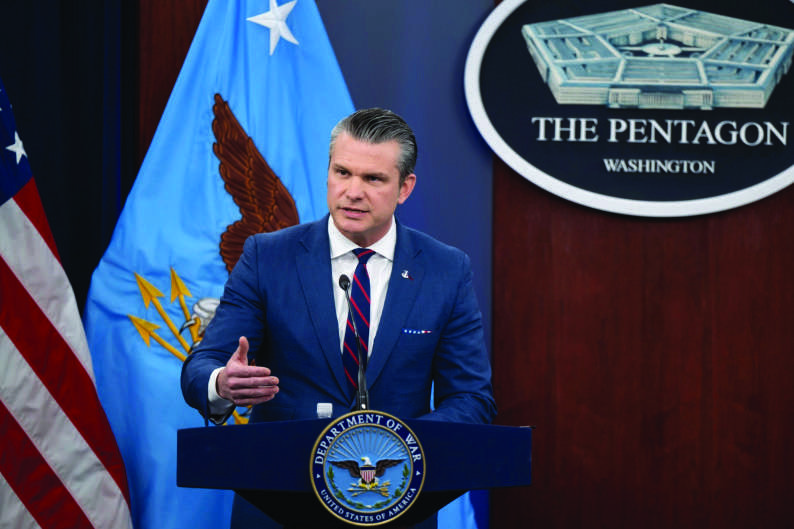
In a Tuesday statement from the Department of War, Secretary of War Pete Hegseth highlighted the need for increased military spending.
“Previous administrations underinvested in our military while our enemies grew stronger and more dangerous, so we are now changing the game. This budget builds this arsenal without compromising readiness that will ensure we remain the world’s premier fighting force, we protect the homeland, and we create peace through strength now and into the future,” Hegseth said.
“We are delivering on President Trump’s commitment to expand American military dominance for decades to come.”
In a Jan. 7 Truth Social post announcing the $1.5 trillion budget, Trump said that Americans are facing “very troubled and dangerous times” and that such large spending is necessary to establish a military that will keep people safe.