By Jack Phillips
Contributing Writer
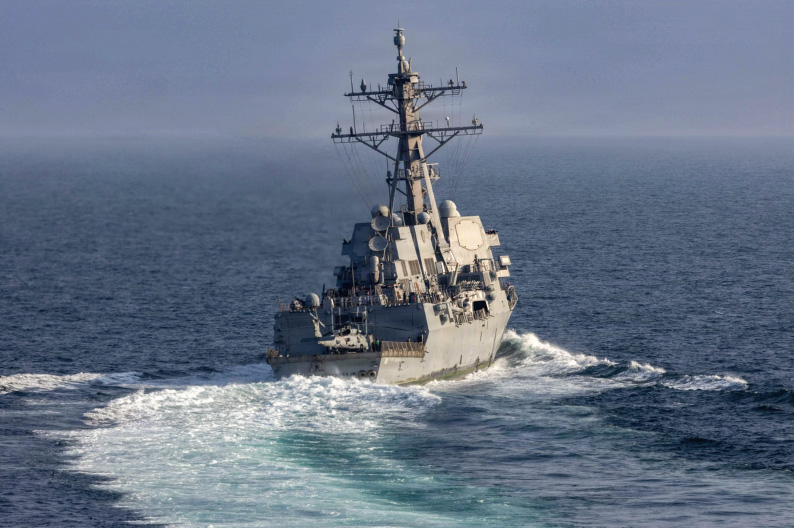
A scheduled U.S. naval blockade of the Strait of Hormuz and nearby waters started at 10 a.m. ET on Monday amid a tenuous ceasefire between the United States and Iran, coming after talks in Pakistan fell through, according to a maritime trade group.
The UK Maritime Trade Operations agency said on Monday it has been informed that effective from 2 p.m. UTC, or 10 a.m. ET, maritime access restrictions were being enforced, affecting Iranian ports and coastal areas, including locations along the Persian Gulf, Gulf of Oman and Strait of Hormuz.
“Access restrictions apply without distinction to vessels of any flag engaging with Iranian ports, oil terminals, or coastal facilities,” UKMTO’s advisory said.
It added that “transit passage through the Strait of Hormuz to or from non-Iranian destinations is not reported to be impeded by these measures; however, vessels may encounter military presence, directed communications, or right-of-visit procedures during passage.”
U.S. Central Command, the military force overseeing operations in the Middle East, said it would implement the blockade at 10 a.m., a decision confirmed by President Donald Trump on Sunday evening.
According to the command, U.S. forces would start the blockade of ship traffic going to and from Iranian ports, with the blockade to be “enforced impartially against vessels of all nations entering or departing Iranian ports and coastal areas, including all Iranian ports on the Arabian Gulf and Gulf of Oman.”
CENTCOM said it would not direct the U.S. military to “impede freedom of navigation for vessels transiting the Strait of Hormuz to and from non-Iranian ports.”
Speaking to reporters on Sunday evening, Trump said on several occasions the blockade would be imposed at 10 a.m. the following day, adding that “other nations” will be involved so that “Iran will not be able to sell oil, and that will be very effective.”
After the blockade went into effect, Trump said in a Monday post on Truth Social that 34 ships have transited through the waterway, the highest figure since the conflict began.
Iranian officials on Monday issued warnings about the blockade threat and have suggested the country’s military would attack ports belonging to Gulf Arab states as well as ports in the Sea of Oman.
Iran’s military has declared that the “security of ports in the Persian Gulf and the Sea of Oman is either for all or for none,” a spokesman for Iran’s Islamic Revolutionary Guard Corps said in a statement through state-run news agency Tasnim News.
“Furthermore, given the continuation of enemy threats against the Iranian nation and the national security of our country even after the end of the war, the Islamic Republic of Iran will firmly implement a permanent mechanism to control the Strait of Hormuz,” the Iranian official also said.
But Trump issued a warning Monday that Iran’s force of small boats “will be immediately ELIMINATED” if those vessels approach the U.S. naval blockade. The United States would use “the same system of kill that we use against the drug dealers on boats at sea,” he said. He was referring to military strikes on suspected drug dealers in the Caribbean Sea and Eastern Pacific Ocean in recent months.
Since the war started on Feb. 28, Iran has effectively shut the strait to all vessels except its own, saying passage would be permitted only under Iranian control and subject to a fee. Iran has attacked civilian ships in the region, including ships belonging to Gulf Arab states.
Last week, before a two-week ceasefire was announced, Trump warned that the United States would strike Iranian power plants and bridges in a bid to get the waterway reopened. With the uncertainty about the strait’s safety, oil and gas prices have surged worldwide, with Brent and WTI crude oil hitting around $100 per barrel again on Monday morning.
A U.S. delegation led by Vice President JD Vance went to Pakistan over the weekend for hours of negotiations with top Iranian officials. They were the highest-level discussions between the two nations since Iran’s 1979 revolution that installed the current clerical regime in power. But the talks failed to produce a lasting agreement, Vance said.
Iran has brought new demands, including recognition of its control of the waterway, lifting of sanctions and the withdrawal of forces from U.S. military bases across the Middle East.
NATO Won’t Join Blockade
NATO allies including Britain and France said they would not take part in the blockade, stressing instead the need to reopen the waterway, through which about one-fifth of the world’s oil normally passes.
“We’re not supporting the blockade,” British Prime Minister Keir Starmer told the BBC. “My decision has been very clearly that whatever the pressure, and there’s been some considerable pressure, we’re not getting dragged into the war,” he added.
France will set up a conference with the United Kingdom and other countries to create a multinational mission to aid with navigation in the strait, French President Emmanuel Macron wrote in a Monday post on X.
“This strictly defensive mission, separate from the warring parties to the conflict, is intended to be deployed as soon as circumstances permit,” he said.
The initiative announced by Macron aims to establish rules for safe passage and the coordination of military vessels to escort tankers, Starmer said in parliament on Monday.
“Let me be very clear, this is about safeguarding shipping and supporting freedom of navigation once the conflict ends. Our shared aim here is a coordinated, independent, multi-national plan,” the UK prime minister said.
The strait should be reopened by diplomacy, Hakan Fidan, the foreign minister of Turkey, also a NATO member, said on Monday. He added that creating an international force to oversee it would be complicated and called on NATO to reset its ties with Trump at a summit in Ankara in July.
Trump initially said the United States would work with other countries to block ships passing through the Strait of Hormuz, but the U.S. military later specified that the blockade would only apply to ships going to or from Iranian ports.
Ahead of the blockade, Trump criticized NATO on Sunday during remarks to reporters and indicated that the U.S. government would re-examine its relationship with the military alliance.
Reuters contributed to this report.