The Castaic Area Town Council heard a presentation Wednesday on a FivePoint housing development called Entrada North, a plan for 1,150 homes west of The Old Road and south of State Route 126.
The town council had reviewed the project because a little over half the homes are proposed to be in Castaic’s Community Standards District, the southern border of the Valencia Commerce Center, which is also part of the standards district despite the Valencia moniker.
The town council, an advisory body to the L.A. County Board of Supervisors, voted to hold off taking a stance on the plans until questions about landfill proximity, parking, a potential grocery store and traffic are answered.
The western border of the project starts where Commerce Center Drive hits the state route, then along Henry Mayo Drive until it reaches The Old Road, and then south along that road to Magic Mountain Parkway.
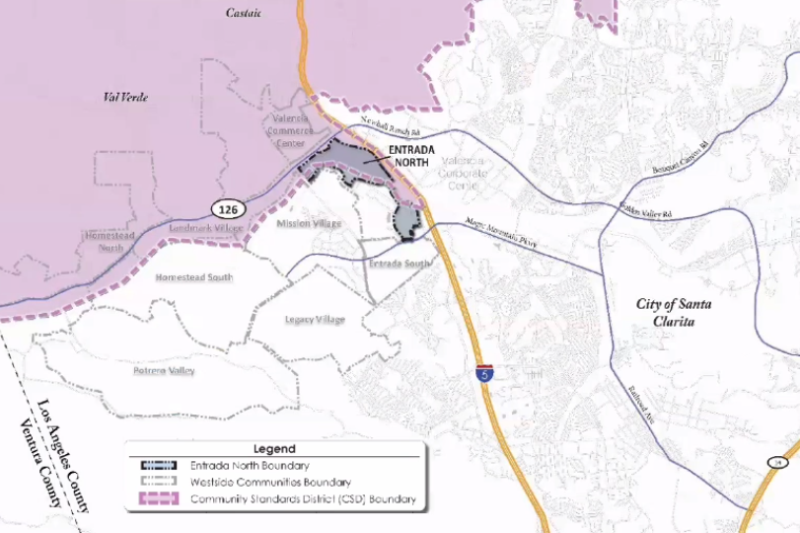
In addition to 1,150 total homes, the 441-acre parcel is expected to have about 7 acres of commercial space and 276 acres of open space, which is a little over 60% of the project area.
The homes on the southern portion of the project, which is about 528 homes, based on Wednesday’s presentation, would sit just east of Six Flags Magic Mountain, with Entrada South and Magic Mountain Parkway on its southern border.
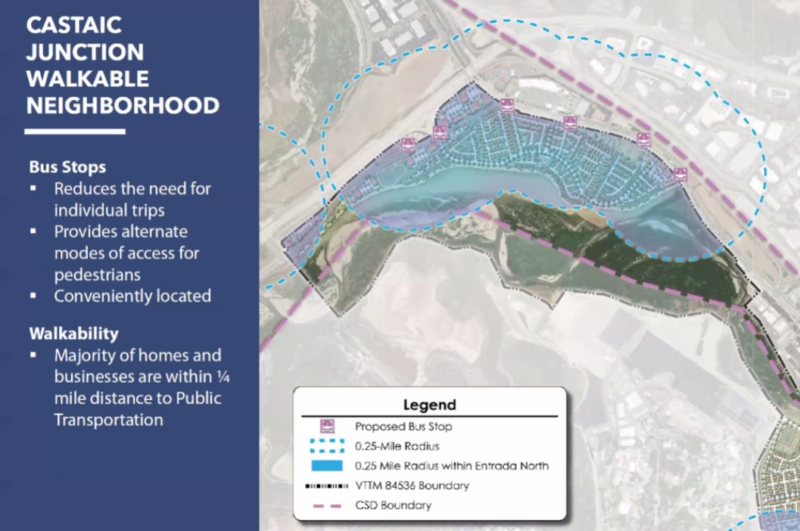
Due to the split boundaries, the presentation focused on the northern half of the project, which Alex Harrell, FivePoint vice president of entitlements, referred to as the Castaic Junction portion in his presentation.
The homes are expected to be a mix of single-family detached homes, single-family attached homes and multifamily attached units, which would all be for-sale housing units. The roughly 3 acres of commercial space is expected to be “local-serving retail,” as well as some office space, primarily along Henry Mayo Drive.
The goal is a walkable neighborhood with the majority of homes and businesses within a quarter-mile from public transportation, Harrell said.
James Stephens, one of two council representatives for Region 1, said the plan was “well thought-out from what I’m seeing,” before passing to Cher Arabalo, the other representative, who expressed concerns about the project’s proximity to the Chiquita Canyon Landfill.
“That’s been studied by the company, and we feel that we’re far enough away that there’s not going to be any impact to the residents,” Harrell said.
Arabalo asked about the project’s buffer from the landfill. The landfill has drawn thousands of complaints, including regularly from the Valencia Commerce Center, and Harrell responded, “over a half-mile.”
“You’re gonna smell it,” Arabalo and Stephens said, almost in succession. Arabalo said she was about 2 miles away, “and it’s almost a daily thing,” referring to landfill smells that have drawn tens of thousands of complaints and multiple lawsuits.
Chiquita Canyon Landfill, which is west of the development site on State Route 126, has had an underground fire burning dozens of feet underground for years, which is both creating a million gallons of nauseating leachate per month and causing the landfill to sink. Officials are no closer to being able to put out the fire, which appears to be spreading, based on reports from regulators.
“Well, we’re all hoping this situation gets better with the landfill,” Harrell said.
Jennifer Elkins, a member of the Val Verde Civic Association, called in to comment that it would be “completely irresponsible” to continue building homes near that environmental disaster.
Roberta Newton, a Region 2 representative, asked about a grocery store for that part of Castaic, as the nearest one is a bit of a drive down The Old Road.
Harrell said that was identified as a possible desire for the area, but not one the developer could necessarily control. He also said the northern portion of the Entrada South project would contain commercial space, including retail options for residents.
That project has been approved and entitled, and the developer is currently working on final design.
Council member Daniel Polo raised questions about the project’s parking, as the homes did not have traditional driveways. Harrell said the parking was following the county’s standards for two spaces per home, as well as incentives in the development’s plan meant to encourage fewer cars and more public transportation.
Also, in line with county requirements, 10% of the project’s homes, or 115 units, will be affordable housing, which would be built by a partner builder with that specialty. Those homes would be alongside the borders of Six Flags Magic Mountain and Magic Mountain Parkway, which is near a planned transit station, Harrell said.