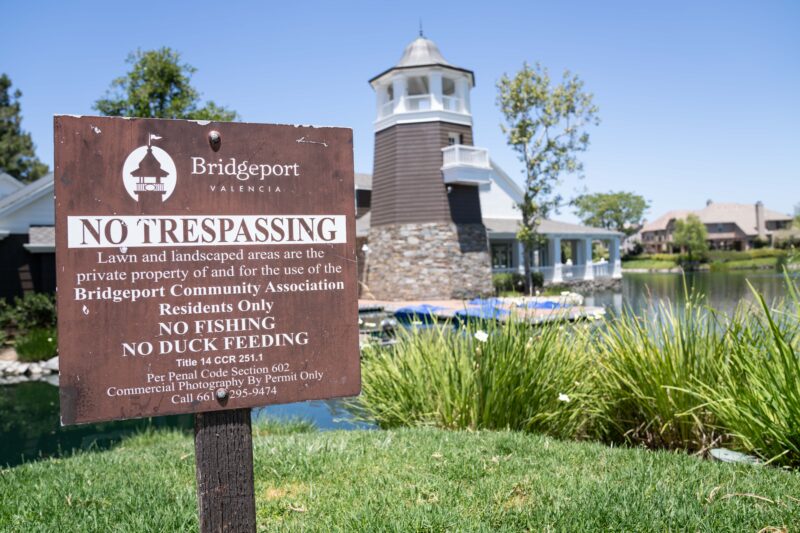
City of Santa Clarita officials said Tuesday they’re hopeful that more signage and a bigger presence from code-enforcement officers can help make a difference in and around Bridgeport’s serene waters.
But there are other avenues to explore if that doesn’t work.
Recently, e-bikes and e-motorcycles have disrupted the tranquility there, according to residents, who have also used public comment at City Council meetings in recent months to gripe about e-bike and e-motorcycle activity throughout the city’s trails, paths and paseos.
The latest lake activity drawing residents’ ire at City Hall has been a combination of the e-vehicles and fishing, which is reportedly a frequent occurrence now.
“I live in Bridgeport. It’s a beautiful lake, but we are troubled by these teens — that (are present) at all hours of the day and night,” a resident named Debra Volk told the council. She said she confronts the same group over and over again, and one of them claims to have family in law enforcement.
“I work a night shift. There they were (Monday) night, fishing on the bridge again,” she said in frustration. “I’m tired of chasing them off. I’m tired of having profanities thrown at me. That’s not safety.”
Since the situation at Bridgeport Park is unique — it requires a similarly “creative” solution, according to city staff.
Kelsey Peoples, community association manager for the lake’s property owners’ association, Valenca Management Group, declined to comment Tuesday and referred questions to the association’s board president. The board president’s contact information was not made publicly available, and the person did not respond to a request for comment as of this story’s publication.
Masis Hagobian, Santa Clarita’s intergovernmental relations manager, said the city staff has been directed to look at all answers, but where it had to start was the rulebook, due to the lack of precedence with this problem.
“We’re looking at any and every option to address this issue,” Hagobian said Tuesday, adding some of the concerns were nuisances and others represented a public safety issue. “Obviously, education and enforcement have been the two areas that we could initially pursue.”
Technically, the city’s previous ordinance with respect to fishing in municipal limits only addressed open spaces, he said.
The Bridgeport Lake, technically a private space maintained by its property owners’ association, has a condition of Bridgeport’s approval in the late 1990s that grants public access to its park, paths and even the lake. The latter has been a time-honored portrait spot. The city code categorizes it as a “public park lake,” according to Hagobian.
Several residents have requested its public access be reviewed, also.
At last week’s council meeting, Amy Hovsepian said she’d been at several meetings because she felt like their beautiful lake was under a “24-7 attack” due to what she also acknowledged as a unique problem.
City Manager Ken Striplin has the authority to create rules and regulations with respect to operating the city’s park spaces. So, the city’s first move was an ordinance to ban fishing at Bridgeport Park and its surrounding waters, Hagobian said.
He said once the signs are posted, which is a requirement for enforcement, people should expect to see an increased city presence to address the issue.
There was a more severe solution brought up by Bridgeport residents at their meeting, which was mentioned by Striplin at last week’s council meeting: privatizing the lake.
Hagobian said Tuesday such a move would require a change to the city’s municipal code that the City Council approves, as public access was part of the project’s conditions.
He said there’s been no direction to draft such an ordinance at this time. Whether that’s a necessary step could be something that’s looked at after the city’s next step in the process: signage and enforcement.
“We won’t necessarily know that until we … go through the full extent of the process,” he said, “to see if new enforcement actually does help the situation.”
Last week, Striplin said he also was directing staff to meet with residents and find the times when the bikes are most problematic, so that can be communicated to the Santa Clarita Valley Sheriff’s Station for a more effective response.
“We’ve sent deputies out several times,” Striplin said. “And unfortunately, we’ve missed the kids in question. But if we have more specific times, we can certainly work with the Sheriff’s Department to do more continued spot patrols.”