The Santa Clarita City Council on Tuesday approved the latest milestone for a project expected to transform the landscape of the Santa Clarita Valley and add thousands of homes.
The council approved the contract that would cover the environmental impact report on the proposed Sunridge, a 990-acre Saugus property once known unofficially as the city’s “doughnut hole,” centrally located south of Soledad Canyon Road, east of Railroad Avenue and west of Golden Valley Road.
The report could end up costing developer New Urban West up to $1.24 million based on the initial estimates. The city pays for the studies, and those funds are then reimbursed by the developer.
After the Department of Toxic Substances Control released its hold on the property in 2021, following a decades-long, $175 million cleanup, development plans could begin in earnest.
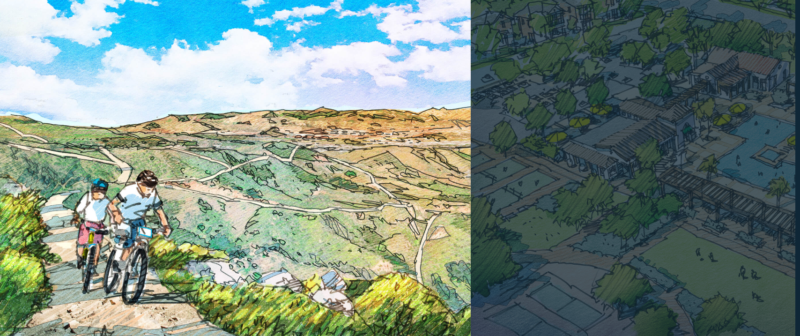
Now, New Urban West, the developer behind the Belcaro projects and MetroWalk at Vista Canyon, is looking to turn that once-troubled asset into 5,750 homes, including affordable units, about 67 acres of commercial development and roughly 330 acres of parks and recreation.
Adam Browning, president of New Urban West, called the moment “another key milestone” in the project, a planning effort he’s worked on with the city since 2023, in an email sent Wednesday from John Musella, a spokesman for the project.
“Sunridge is a unique opportunity to think big and create an exceptional mixed-use community that better connects Santa Clarita and becomes a lasting point of pride,” he wrote. “Our goal is to build a community that reflects the very best of Santa Clarita.”
The site was polluted for decades by a series of owners, according to a DTSC website created for the project.
“From 1934 to 1987, the Whittaker-Bermite Corp. manufactured, stored and tested explosives on 996 acres now considered to be prime real estate in the city of Santa Clarita, north of Los Angeles. The explosives included ammunition rounds, flares, detonators, signal cartridges and pyrophoric pellets (fragments that spark spontaneously) and ignitors,” according to the website. “The cleanup is considered one of the biggest perchlorate cleanups in the nation with about 394,000 cubic yards of soil on 226 acres.”
The plan also is proposed to include: a championship youth sports facility on adjacent city property; a community/cultural center on the adjacent city property; and open space dedications, including new trails.
Due to the land’s history, the EIR, which also includes traffic studies for the area, is likely to come under close scrutiny.
During a study of an outline for the plan, a concern has already been raised by a council member over a circulation element.
The original plan called for thousands fewer homes and the connection of three roads: Magic Mountain Parkway, Santa Clarita Parkway and Via Princessa.
The latest proposal adds several thousand more homes and only connects Via Princessa and Santa Clarita Parkway.
Councilwoman Marsha McLean said that, based on all the homes, the failure to extend Magic Mountain Parkway doesn’t make sense, during a discussion of the city’s initial agreement with New Urban West.
“People were extremely vocal about adding over 3,000 homes that were planned for that area, but a saving grace was the roads that were going to be built,” McLean said. “Now, we are asked to sign an MOU for 6,500 homes and eliminate a road. I think that before we sign any MOU, we need to have complete due diligence as to what will work there and what won’t.”
A New Urban West official said it would provide a traffic study with the project’s EIR that would justify only extending two roads.