Despite L.A. County voters’ approval of a half-cent sales tax, the Board of Supervisors received a budget update that L.A. County 5th District Supervisor Kathryn Barger called “sobering” in a statement Tuesday.
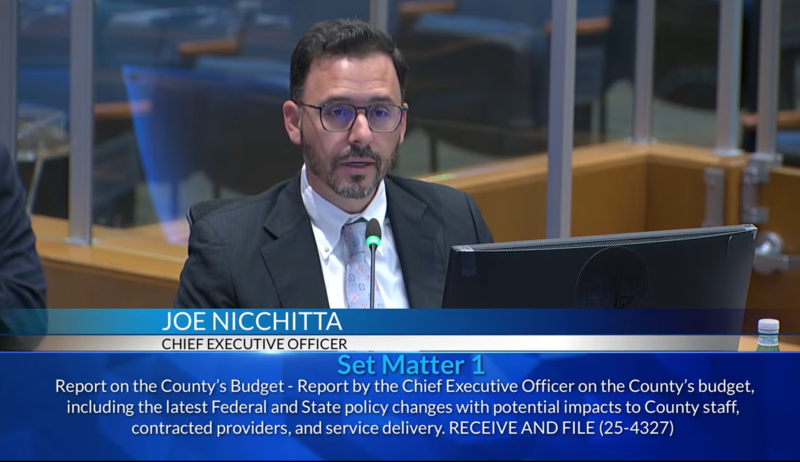
L.A. County CEO Joe Nicchitta said the organization is looking at billing consolidation and possible fee hikes under evaluation by working task forces, among the county’s major efforts to shave costs and increase revenue.
Nicchitta described a picture of “extreme uncertainty” in a difficult county landscape where the demand for services continues to grow as federal and state investments “slow or stop altogether.”
The uncertainty has been one of the greatest challenges, Nicchitta said, particularly regarding the changes to federal health care funding — despite the fact that 50.6% of voters approved raising the county sales tax “to generate about $1 billion annually to support health care and other essential services,” according to L.A. County Public Health.
“Even though we’re coming up on the anniversary of HR 1, the agency rule-making to fully implement the bill continues. Not all of the details are fully spelled out at this point in time,” Nicchitta said, noting there are more cuts expected. “In this context, we’re forced to continue to focus on financial stability and taking a long view, and even giving new funding sources like Measure ER, the year ahead will require financial discipline to prioritize critical safety net services over less immediate needs.”
The “heart” of his presentation had to do with explaining a “hiring freeze” expected to take place through the end of the current fiscal year in June 2027, he said, comparing the county’s budget outlook in November 2025 versus March 2026.
Nicchitta described the county’s current picture, and discussed how the state and federal picture is expected to further impact the county’s current funding picture.
“How we close the fiscal year affects what funding is available to pay for costs and services in next fiscal year’s budget,” he said. “In fact, excess fund balance is the primary source of available one-time funding in the subsequent fiscal year.”
In the slides presented Tuesday, the excess fund balance shifted from negative $313 million to negative $402 million, according to the presentation.
Approximately $300 million of that funding is the county’s to pay its annual obligation for Assembly Bill 218, Nicchitta said, which is the law that allowed childhood survivors of sexual assault to sue as adults.
Approved in April 2025, the county reached a $4 billion settlement of legacy claims regarding sexual assault stretching back decades in its foster homes and juvenile facilities. Another $825 million settlement was approved specifically for abuse victims at juvenile detention centers.
The L.A. County District Attorney’s Office is now investigating allegations of fraud among the more than 7,000 claimants, but the budget impacts remain severe and expected to be for years.
“And if nothing else changes, we won’t have sufficient fund balance to pay for our projected commitments,” Nicchitta said, “and if that were to happen, we would have to work with the board to reduce carryover and fund balance requirements to an amount equal to our year-end fund balance that would likely result in the discontinuation of funding for programs, services and projects that are funded with one-time dollars and an inability to finance some new, expanded needs.”
Nicchitta said a silver lining is that there are some projected actual expenses that may not come to fruition, which happens every year.
This year in particular, he said, there are two atypical factors: The first is that the county has more departments than usual projecting year-end deficits. The Sheriff’s Department, for example, is projecting a $148 million deficit, and Public Health is projecting a $30 million deficit.
While the agencies are working to reduce their costs, he said, any of that outstanding deficit must be repaid before any “one-time funding” can be assessed.
The second factor is that there’s been no growth in the fund balance between the fifth and the ninth month, and where growth is typically seen between the regular revenue reports, between November of last year and this March, the projected revenue declined by $14 million, from $3.27 billion to $3.26 billion, which Nicchitta called an “aberration” the county was keeping its eye on.
He also said the county has been taking a cautious approach to the forecast, with an “all hands on deck” effort to cut costs and generate revenue. Some of the proposals have included central billing agency optimization; fee adjustments that “would look to offset the actual cost of county service”; naming rights; and “civil service reforms,” which were not explained.
Nicchitta said residents were most likely to see increased fees as part of their effort to offset the budget concerns, as well as consolidating the county’s billing efforts.
Civil service reform, or updating the county’s hiring practices, is something that Nicchitta considered “ultimately essential to maximizing effective service delivery.”
There were still a number of uncertainties from the state’s budget picture, with negotiations likely to continue until the last day of the fiscal year, June 30, according to county officials. At Tuesday’s meeting, county officials said the Legislature-approved priorities moved closer to the county’s rather than the governor’s office, although that’s part of the ongoing negotiations.
After the report, Barger called the report “a sobering assessment” in a statement issued via email.
“I agree that our board must make decisions grounded in discipline and long-term sustainability. I recognize that maintaining the county’s financial stability may require difficult steps, including ensuring that fees more accurately reflect the actual cost of services,” said Barger, whose district includes the Santa Clarita Valley. “However, we must move forward with an even hand. Small business owners, property owners, and working families are already facing significant economic pressures, and those realities must be part of our decision making.”