The L.A. County Regional Planning Department’s efforts to redraw boundaries to protect open spaces and wildlife habitats drew concern from residents at Wednesday’s Castaic Area Town Council meeting.
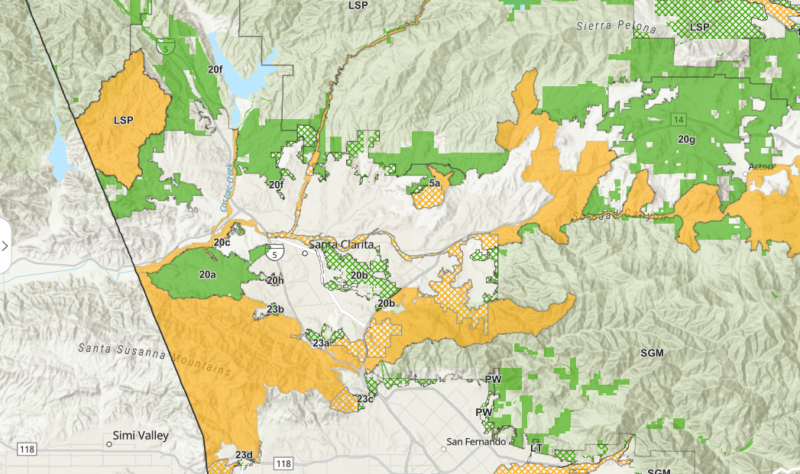
The county’s efforts prompted confusion about what would and would not be allowed on residents’ properties, ranging from fire hazard mitigation to perceived restrictions on routine landscaping, as the county revises its maps of Hillside Management Areas and Significant Ecological Areas.
Residents within the new boundaries proposed for those areas received letters that prompted a lengthy discussion about what could and couldn’t be done on such lands.
County planning officials told residents it had to redraw the lines to stay compliant with a pair of bills — Senate Bill 1425 by Sen. Henry Stern, D-Calabasas, and Assembly Bill 1889 from then Assemblywoman Laura Friedman, D-Glendale.
The laws require a city or county to update its conservation element, which L.A. County designates through its SEAs. The policies are meant to look at how an area can maximize wildlife connectivity and potential crossing sites, as well as mitigate developmental impacts on the environment and policies to ensure habitat protection.
An SEA is considered land that has “irreplaceable biological resources” and an ability to support sustainable populations of the wildlife that lives there. These are basically undisturbed or lightly disturbed lands, as well as lands that serve as links or corridors between these areas, according to Iris Chi, a senior planner who led the presentation.
“The overlay map includes private properties — if there are any developments proposed within SEAs, it means that we’ll have to require a biological review, and also there may be some mitigation requirements, based on how much of those bio resources are being impacted,” Chi said.
Part of the concern raised prior to the meeting involved a letter residents were sent earlier this month.
“You are receiving this notice from L.A. County Planning because you own property in unincorporated Los Angeles County and your property is proposed as a Significant Ecological Area. Please be advised that this is the only letter you will receive during this project. and it is important to use the contact information below to learn how your property may be affected,” according to the letter, which also instructs that one should contact a planner or watch the county’s lengthy video presentation on the topics if they have questions.
Residents’ initial reaction to the letter ranged from ire over the changes to confusion over what it meant for their property. Some believed they would no longer be able to conduct fire mitigation. Another questioned whether he would still be able to pave his driveway when it rained.
The letter sent to residents indicated that anyone whose land was in an SEA would need permits to remove plants/trees, grading, fencing or any property structures.
That was one of the first concerns Chi sought to address.
“An SEA designation doesn’t mean your property, or a property, is considered a ‘protected area,’” she said. “It doesn’t convert it into a preserve,” and the development rights are retained, she added.
A frequently asked questions addendum online indicated that fire mitigation would not be something that required a permit.
The letter appeared to create more questions than answers ahead of Wednesday’s meeting, leading to plenty of feedback that L.A. County 5th District Supervisor Kathryn Barger was made aware of, according to Helen Chavez Garcia, her assistant chief deputy.
“Supervisor Barger is aware of the varying concerns that have been raised about the draft SEA ordinance and proposed map expansion, and shares the community’s frustration,” Chavez Garcia wrote in a text message Thursday. “She expects community input to be thoughtfully considered as the review moves forward.”
Chi said the SEAs have been studied for decades by L.A County, with their first look in 1976, and then a second one in 2000. Each one took years of extensive research, with the first ordinance being approved in 1982, and the second in 2019.
The letter sent out to residents mentioned a timeline, with the notices sent out indicating that public hearings could begin in the fall.
Chi also said the selection criteria largely has remained unchanged since the initial 1976 study, with the exception of adding a criterion that recognizes the connectivity and corridors that had been added as a priority.
The county has created a website to let people know whether their parcel is impacted by the proposed SEA boundaries. While Castaic is not an incorporated city, Chi said there were SEAs created within those as well, including Santa Clarita; however, enforcement would be up to that city’s jurisdiction.
Carrie Lujan, the city’s communication director, said the city is “reviewing the report and drafting comments in response.”
Chi said that while creating legally required defensible space is allowed, the SEA ordinance otherwise bans native-vegetation removal, grading undisturbed areas, farming and exploratory wells.
The ordinance ban does not apply to existing developments for things like tree pruning, nonnative tree removal, driveway maintenance, brush/weed abatement or fencing replacements, she added.
Where the ordinance is most likely to have impact is new construction in vacant parcels, and new additions or modifications to existing development, according to Chi.
The ordinance would also include fencing guidelines, avoiding invasive species and lighting guidelines meant to be less impactful to nature.
Darcy Stinson, a town council member who represents Castaic east of Interstate 5 and south of Lake Hughes Road, asked why developers were being offered exemptions in the new SEA, but under the guidelines he was told at the Acton meeting, he could end up having to pay $25,000 for a conditional use permit for a 121-square-foot shed, and another $25,000 to grade his driveway after it rains, due to the proposed language in the code changes.
Someone is permitted to have a shade structure for horses under Title 22, Stinson said, but shade structures aren’t exempt from the pricy proposed CUP process.
Edgar De La Torre, principal planner for the project, thanked Stinson for his feedback,
“Things like that, we could definitely take a look at, to see how this would impact it, to avoid scenarios like that, because I see your frustration if that was the case,” he said.
Abigail DeSesa, who represents Val Verde on the council, shared concerns about how, under the new proposal, she’d have to hire a biologist for a preconsultation before she even began the expensive permit process.
James Stephens, who represents Region 1, called for a grandfather clause that would let people use their property as it’s allowed today, until the land is transferred.
He also expressed his frustration at the fact that county officials were spending this time, money and effort to protect the habitat of the butterfly — “but we can’t get the support that we need from the county, the state and the federal government to take care of this (Chiquita Canyon) landfill issue, because it’s not being taken care of.”
Mike Minor, a representative of Region 3, said he was almost at a loss for words, because he didn’t see any room for feedback.
Minor said he felt like the options were going to be to go around the county, for fear of tens of thousands of dollars in costs or putting the land in a land trust and promising not to touch it.
“We moved up here to be left alone,” Minor said. “And now we’re getting a microscope on weed abatement, and I need to get … approval to build a shed.”
De La Torre said the process was created to get feedback and to see whether the changes were supported.
He also said that, as of now, the fall timeline mentioned in the letter is being reassessed, because county planning officials realize what an impact the changes could potentially have on county property owners.
The mapping website is available here: https://bit.ly/3SlYvjB.