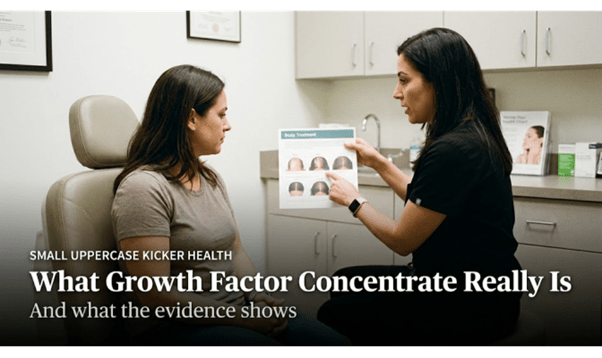
Non-surgical hair-loss treatments have multiplied over the past few years, and one term now turns up on more clinic menus than it did even recently: growth factor concentrate, usually shortened to GFC. Patients are asking about it. Clinics are offering it. The science behind it, though, is younger than the marketing around it, and that gap is worth understanding before anyone signs up for a course. What follows is a plain account of what GFC is, how it differs from the treatment it grew out of, and what the research does and doesn’t yet show.
Built on the same idea as PRP
GFC is a refinement of platelet-rich plasma, or PRP, a treatment that has been used for hair loss for well over a decade. PRP involves drawing a small amount of the patient’s blood, spinning it to concentrate the platelets, and injecting that concentrate into the scalp. Platelets carry growth factors, proteins that signal cells to repair and regenerate, and the working theory is that delivering them to struggling follicles can encourage regrowth.
Growth factor concentrate takes the idea a step further. Instead of reinjecting whole concentrated platelets, the processing isolates the growth factors themselves and strips away the red cells and other blood components. What remains is a purer, more concentrated preparation, still drawn from the patient’s own blood, which keeps the risk of an allergic reaction low.
What sets it apart in practice
The day-to-day differences are modest but real. Preparation runs a little longer, roughly 25 to 35 minutes against 15 to 20 for standard PRP, because of the extra extraction steps and the proprietary kits involved. Those kits also push the per-session price higher. Set against that, GFC courses tend to be shorter, often three or four sessions rather than four to six, and some patients report visible change arriving sooner. None of it is a one-time fix. Maintenance sessions are usually part of the plan.
What the research shows so far
This is where caution belongs. The published evidence for GFC is still limited, drawn mostly from small studies and direct comparisons with PRP rather than the large, controlled trials that tend to settle questions in medicine. A 2021 randomized trial in the International Journal of Trichology, along with several smaller reports, has pointed in a positive direction: reduced shedding within roughly two months, improved hair density at follow-ups some months later. Dermatologists generally call the early results encouraging and in line with what PRP has long shown. They also tend to attach the same caveat. Promising is not the same as proven, and larger trials are needed before GFC can be treated as established.
Who it tends to suit
Clinicians position GFC for early-to-moderate pattern hair loss, the stage where follicles are shrinking but still alive, and it is used in both men and women. It is not a rescue for follicles that have already died, which is the territory of surgical hair transplantation. Nor is it generally framed as a replacement for PRP, which remains a lower-cost, well-studied option in its own right. In practice, a Growth Factor Concentrate Treatment is most often recommended for moderate thinning, for patients seeking faster visible results, or for those who finished a PRP course without the response they had hoped for.
The practical takeaway
For anyone weighing it up, the useful questions are simple ones: what is driving the hair loss to begin with, whether the follicles are still viable, and how GFC stacks up against the alternatives for that particular case. Hair-restoration providers such as Kibo Clinics typically start with a diagnosis and an assessment of follicle and donor status before recommending any single therapy, on the principle that the treatment should follow the cause.
Growth factor concentrate is a real advance in how growth factors are isolated and delivered, and for the right candidate it may offer a faster, cleaner version of an approach clinics already rely on. It also sits early on its evidence curve. This article is general information rather than medical advice, and the appropriate next step for anyone considering it is an assessment by a qualified dermatologist or hair-restoration specialist.