This is a paid post sponsored by accessiBe.
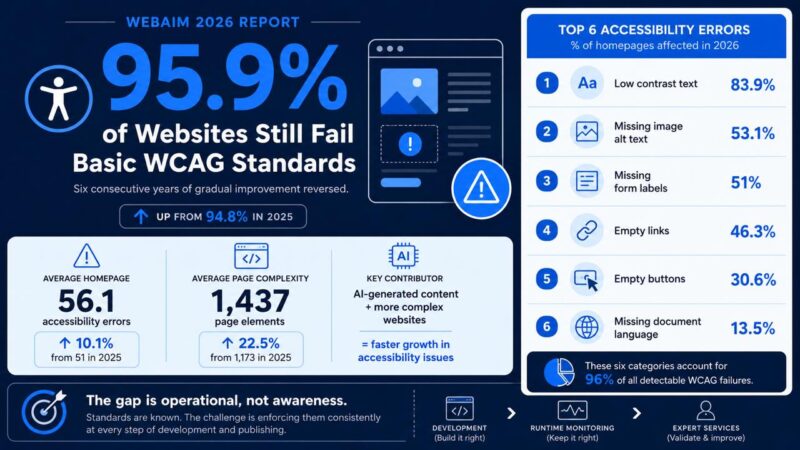
For the eighth consecutive year, WebAIM analyzed the accessibility of the top one million websites on the web. The February 2026 report found 95.9% of home pages had detectable WCAG 2 failures, up from 94.8% in 2025. Six consecutive years of gradual improvement reversed. The average home page carried 56.1 distinct accessibility errors, a 10.1% increase from 51 errors per page 12 months prior. Home page complexity grew 22.5% in a single year, reaching an average of 1,437 page elements, nearly double what it was in 2019.
These numbers represent more than a failed benchmark. They document a pattern: the web is getting more complex, development teams are shipping more code, and accessibility failures are accumulating faster than the industry’s existing approaches can address them.
The rise in generative AI content output is an additional contributor. AI-generated assets like images, documents, and copy are not accessible by default, and as development teams incorporate AI-generated material into their workflows, inaccessible content is entering the web at a faster rate than ever.
The Department of Justice explicitly named this trend in its rationale for extending the ADA Title II digital accessibility compliance deadlines by one year. According to accessiBe’s analysis of the rule change, the DOJ cited “the growth of AI-generated content as an emerging accessibility risk” among its factors, alongside resource constraints and questions about WCAG’s supplementary materials, as reasons why covered entities needed more time to comply.
The Six Errors That Define the Problem
The failures themselves are not new or difficult to understand. For seven consecutive years, the same six error types have topped the WebAIM analysis. Low contrast text appeared on 83.9% of home pages in 2026, up from 79.1% in 2025. Missing alternative text for images was present on 53.1% of pages. Missing form input labels appeared on 51% of pages. Empty links were found on 46.3%, empty buttons on 30.6%, and missing document language on 13.5%. Together, these six categories account for 96% of all detectable WCAG failures across the one million pages analyzed.
Each failure type originates in a development decision. A button without accessible text requires one additional HTML attribute. An image missing alt text requires a single tag. A form input without a label requires two lines of markup. The failures persist because no one in the build process checked, not because the fixes are technically difficult.
Seven consecutive years of the same six failure types at the top of the list is evidence of a structural problem. Organizations know what WCAG 2.1 level AA requires. The errors appear anyway because awareness of a standard and having a process to enforce it consistently are different problems. The gap between organizations’ awareness of accessibility obligations and their operational capacity to fulfill them consistently is where most failures originate.
Complexity Is Accelerating the Failure Rate
Home page complexity has nearly doubled in seven years: the average page had 782 elements in 2019 and 1,437 in 2026. ARIA attribute usage increased 27% in a single year and is more than six times higher than it was in 2019. Pages with ARIA present averaged 59.1 detectable errors, compared to 42 errors for pages without ARIA.
That correlation is not what most development teams expect. ARIA (Accessible Rich Internet Applications) exists to improve accessibility for users of assistive technology. When its presence correlates with more errors, the likely explanation is implementation gap: teams add ARIA to signal intent, but the underlying components are not being built or reviewed for correct semantic behavior.
According to WebAIM, the JavaScript library data reinforces the pattern. Across the most popular front-end libraries, the presence of nearly every one correlated with higher error counts than average. Sites using Swiper averaged 74 errors per page, 31.8% above the overall average. Sites using FancyBox averaged 90 errors, 60.3% above average. Sites using SweetAlert2 averaged 101.6 errors per page. These libraries handle visual and interactive complexity, but they abstract away implementation details that include accessibility attributes. The framework renders the component. Accessibility labels remain the developer’s responsibility. Without tooling that checks at build time, those labels don’t get added.
Page complexity is not slowing down. Average page elements increased 22.5% in the last year alone, driven in part by AI-assisted development practices that generate more code faster. The WebAIM analysis observed that these patterns “likely reflect broader shifts in web development including increased reliance on 3rd party frameworks and libraries and automated or AI-assisted coding practices.” More code, produced faster, through tools that don’t default to accessible patterns, by teams without accessibility checks in their build pipeline. The combination produces exactly the failure rate the data shows.
The Systematic Gap
What seven years of WebAIM data make clear is that awareness of accessibility standards has become widespread across enterprise organizations. Legal exposure from ADA Title III litigation, European Accessibility Act enforcement, and Section 508 compliance requirements have made web accessibility a documented obligation across most of the industries whose websites appear in the WebAIM sample. The failure rate persists because awareness of an obligation and having the processes to fulfill it consistently are separate organizational capabilities.
The research identifies the systematic gap as the primary variable separating organizations that maintain lower accessibility error rates from those that don’t. Development teams produce code without accessibility checks in their workflow. QA processes don’t include accessibility validation as a standard step. Content gets published with missing table markup or improper heading structure. Third-party scripts modify the live site DOM outside any development oversight. Each of these is a process gap. Any one of them can produce the same six failure types that have appeared at the top of the WebAIM list since 2019.
The pattern in the data matches this diagnosis. The WebAIM report documented gradual improvement from 2019 through 2025, then a reversal in 2026. The sites that had been improving weren’t philosophically different from the ones that reversed. They had built processes that caught failures before they shipped. The reversal corresponds with a period of accelerating page complexity and AI-assisted development that outpaced those processes.
What Structural Coverage Requires
The WebAIM report’s conclusion identified the same implication: “improving accessibility at scale will require both better practices and simpler systems.” For organizations trying to close the gap, this translates to three distinct coverage points in the development and deployment cycle.
The first is development. The six dominant failure types are all made in code. Catching them requires accessibility checks at the point where code is written and reviewed. CI/CD pipeline integration runs accessibility tests with each commit, so failures appear in a pull request the same way a failing unit test does. IDE-level guidance provides feedback inside the coding environment as a component is being written. Project management integrations route findings into Jira, Asana, and Azure Boards so accessibility tasks join the same sprint backlog as any other development work. Together, these tools shift accessibility from a post-deployment audit to a build-time quality gate.
The second is runtime. Code changes, content updates, and third-party script modifications all alter the live site after the development cycle closes. Continuous automated monitoring on the live catches issues introduced by ongoing updates that development tooling may deprioritize. A site that passed accessibility checks at deployment can accumulate new failures within days through content management or third-party script changes.
The third is expert services. Automated scanning tools are good at catching what can be measured: missing labels, color contrast failures, empty buttons. Some accessibility problems can’t be caught that way. Complex PDFs, interactive components, multimedia content, and the relationships between page elements need expert review. For organizations with formal compliance obligations under Section 508, the European Accessibility Act, or ADA Title II, that means audits, accessibility templates, and testing with real users with disabilities.
How accessiBe’s Platform Addresses the Failure Surface
The accessiBe platform was designed around this three-layer architecture. accessWidget scans live sites every 24 hours and applies real-time accessibility adjustments at the runtime layer. accessFlow integrates accessibility testing into CI/CD pipelines, provides IDE-level guidance in the developer’s coding environment, and routes findings directly into Jira, Asana, and Azure Boards at the development layer. accessServices covers the expert services layer with human auditing, VPAT preparation, and user testing for organizations that need accessibility guidance and formal compliance documentation.
No single layer covers the full failure surface. An organization relying only on runtime monitoring catches errors on the live site but not during development, where the same failures will be reintroduced in the next release cycle. An organization relying only on development tooling catches build-time failures but not regressions from content changes or third-party scripts. Expert services also identify issues that automation can’t catch, giving organizations a detailed roadmap of what needs to be fixed to reach compliance. The three layers are designed to work together, though organizations can and do deploy them in different sequences depending on where they are in their accessibility maturity.
accessiBe positions this framing as structural rather than commercial. The organizations that have reduced their accessibility failure rates are the ones that built accessibility into their operational processes: the development pipeline, the publishing workflow, and the live site monitoring cycle. For the organizations still producing 50 or 60 or 100 failures per page, the gap is operational. Standards awareness has outpaced the infrastructure to enforce them.
Seven years of the same data make a clear case. WCAG standards are documented and widely understood. Legal obligations are established across most major markets. The specific failure types are stable and well-catalogued. The gap is operational. The distance between organizations with lower error rates and those without is whether their processes enforce standards at the points where failures are introduced.