Flock Safety isn’t on Tuesday’s Santa Clarita City Council agenda, but a local group plans to keep pressing the city over its $500,000 contract for 35 traffic-surveillance cameras until the group’s public-safety and privacy concerns are addressed.
At their Aug. 25 meeting, council members gave no indication they’d seriously reconsider the contract. In a phone interview last week, city staff sought to ease concerns raised in public comment, citing the Sheriff’s Department’s safeguards on Flock data.
Asked whether the city has any oversight of the data, officials said the contract gives only the Los Angeles County Sheriff’s Department access, which is regulated by county policy and state law.
That might reassure some, but Flock Safety has drawn reports of abuse nationwide in recent years. Chief among the concerns: sharing data with federal agencies, which is illegal under state law, and using it for unauthorized purposes — both issues that stem largely from agencies policing themselves.
An L.A. County Sheriff’s Information Bureau spokesman said Friday the department complies with state laws barring data-sharing. The agency has reported to the county Board of Supervisors on the topic several times, including at a public forum in May, when it promised to report back on developing independent oversight with the Office of Inspector General and the Civilian Oversight Commission. Officials did not say by publication time whether any complaints about Flock had been filed in Los Angeles County.
What Flock does
All 35 Flock cameras were running in Santa Clarita by March 2025.
The city credits them with helping solve cases ranging from hit-and-runs to kidnappings, said Masis Hagobian, interim assistant to the city manager.
“There have been over 100 arrests that have been made of individuals, everything from attempted murder to hit-and-run resulting in a fatality,” Hagobian said Thursday. “In addition to those 100 arrests, we’ve also located three missing persons and have recovered over 40 stolen vehicles.”
The cameras capture license plates and identifying vehicle features, such as bumper stickers, and relay them to law enforcement in real time. California allows that data to be stored for months — one of the concerns raised by critics.
City officials said last week they’re aware of the concerns raised at the Aug. 25 council meeting. Two senior officials described the safeguards the Sheriff’s Department uses to limit how the technology is used and shared, while acknowledging the city itself has no oversight or ability to track usage.
DeFlock’s campaign
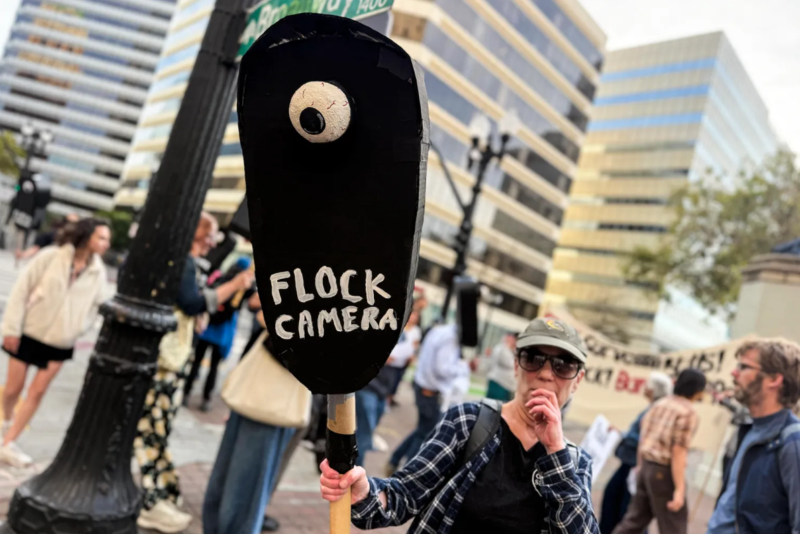
Two members of DeFlock SCV said in a phone interview Friday that timing is a big factor in their protest. They also cited reports of law enforcement officers nationwide bypassing safety checks to use the cameras to stalk people, describing the lack of oversight as a threat to public safety and privacy.
The timing is especially pointed in the Santa Clarita Valley: The city’s 2024 contract is nearing a renewal point, said Charlotte Brown, a Valencia High School student and youth organizer for DeFlock SCV, an online campaign opposing traffic-surveillance cameras.
The contract was signed two years ago. The first of two additional $125,000 annual options begins in November unless the City Council cancels it, Hagobian said in a follow-up Friday.
The campaign also has a political dimension, Brown said: Organizers hope enough pressure before the Nov. 3 election — which involves three council seats — will prompt the council to act.
The discussion at City Hall
DeFlock members said they were unsatisfied with the council’s response to their Aug. 25 protest, and plan to keep showing up.
“We did not feel it was an adequate address,” Brown said, noting that 15 people spoke on the topic. Commenter Omar Reza said he was disappointed that City Manager Ken Striplin held his comments until the end of the meeting — after some speakers had waited more than two hours — and that no follow-up occurred.
“Frankly, we think that the fact that they barely addressed any of our actual points was not great, and we do not appreciate that,” Brown said.
Council members’ reactions were mixed. Jason Gibbs thanked commenters for giving him something to think about. Bill Miranda said he disagreed with their concerns but praised their theatrics: One commenter dressed as Spider-Man, another wore a banana suit, and Brown used news reports to create a fictional deputy eager to mine residents’ personal data with Flock’s tools.
Flock’s growing reach
Flock Safety describes its cameras on its website as technology that helps law enforcement, businesses, schools and communities respond faster and make better-informed decisions. A call to Flock Safety’s media line was not returned this past week.
According to the company, the cameras record vehicle sightings at a specific place and time but don’t identify people by face or track continuously; they’re meant to help authorized users find relevant vehicle evidence. Flock has the technology to capture audio and video, but the city said local units capture only photos.
Amid concerns over data retention, Flock announced in August a new default of seven days for new clients, the company’s CEO said in a blog post last month. LASD officials said in a Friday email that they store data for up to two years, with searches able to reach back five years in certain situations.
Hagobian said any local search of Flock data requires a deputy to enter an incident or case number, generating a record the department can review.
LASD officials did not respond by publication time to questions about past audits or complaints tied to deputies’ use. The city said it has no record of complaints about Flock in the past two years.
“Access to ALPR information is limited to authorized personnel and is strictly regulated by department policies, applicable laws and established security and retention requirements,” Deputy Daniel Dominguez of LASD’s Information Bureau said in a Friday email, calling the cameras “an important tool.” The information is reviewed regularly, the email added.
Carrie Lujan, the city’s communications manager, said the city defers to the Sheriff’s Department on how the cameras are used and overseen. “All of the investigative tools that they have and all the information that they have, that’s their job,” Lujan said, when asked about potential city oversight of the station’s Flock use.
Sheriff’s Department officials cited compliance with Senate Bill 34, a state law that bars data-sharing with outside agencies. “We have been extra vigilant and have ensured that no data sharing has occurred outside California or with any federal law enforcement agencies,” Dominguez wrote. “We monitor this closely and on a continual basis. We do not blanket-share with any law enforcement agency. Data is only shared with agencies that have a signed memorandum of understanding (MOU) and have agreed to comply with our policies and strict requirements.”
Questions about oversight remain, lawmakers say.
Continuing campaign
DeFlock SCV organized most of the 15 speakers who addressed the council Aug. 25.
Reza, also a DeFlock member, called the system “a toxic boyfriend the city needs to dump” during public comment. He cited news reports describing about 50 cases nationwide in which deputies worked around system safeguards — in some instances using fake case numbers — to stalk people.
Two legislative efforts to tighten Flock oversight failed recently. Senate Bill 274, backed by the L.A. County Board of Supervisors in September 2025, would have capped data retention at 30 days. SB 1013, which would have extended that cap and closed federal data-sharing loopholes many believed already closed, died under what the CalMatters news website described as “mysterious circumstances” last week.
That leaves both sides of the debate arguing over whether existing safeguards are enough.
For Valencia High student Gracie Bell, who also spoke at the meeting, it comes down to a basic question of civil liberties. She said she understands how the cameras help law enforcement, but that the city still has a responsibility to protect residents’ rights.
Safety, Bell said, “should never mean giving up the basic expectation that innocent people can’t move through their own city without being tracked.”