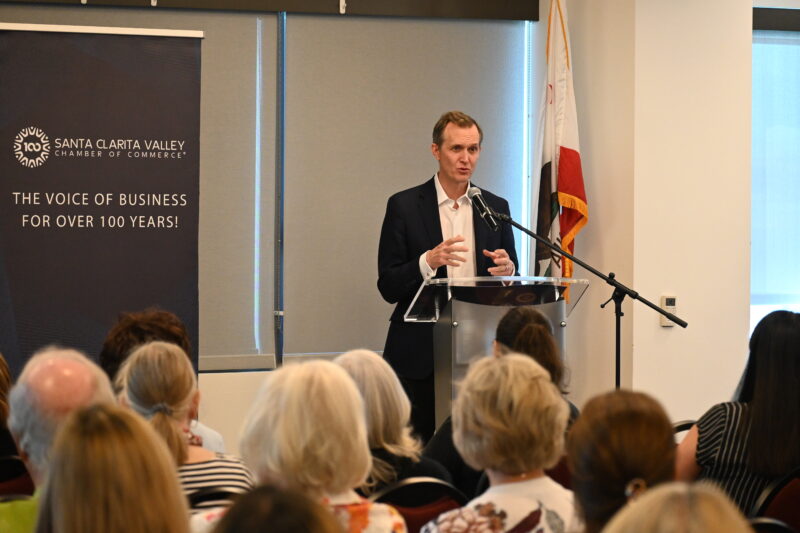
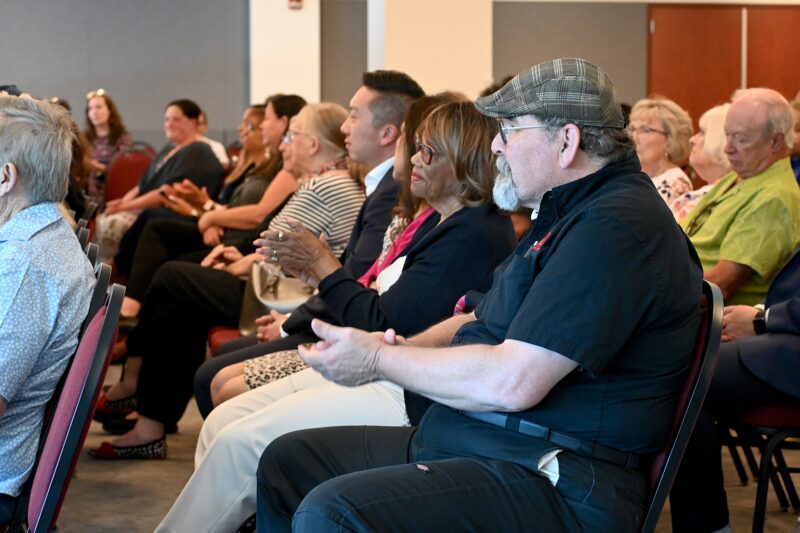
Rep. George Whitesides, D-Agua Dulce, spoke with a room of business leaders and others recently during the Santa Clarita Valley Chamber of Commerce’s annual Congressional Forum at College of the Canyons in Valencia.
The congressman discussed his efforts to support local businesses and workforce development in the Santa Clarita Valley. He also emphasized the need for affordable housing and wildfire resilience, and he addressed the importance of bipartisan collaboration.
“When I joined Congress, I joined two committees that are known for being basically the two most bipartisan committees in Congress,” he said during the event. “One of them is the House Armed Services Committee. The other one is the Science Committee (the United States House Committee on Science, Space and Technology), where I’m the vice ranking member, which is sort of like the No. 2 on the Democratic side, and through both of these assignments, I’ve had the chance to pass some legislation.”
In July, he said he helped pass the National Defense Authorization Act, which supports the local economy, bolsters workforce programs at COC and other institutions in the area, and bolsters wildfire fighting capabilities.
A particular program the congressman is excited about is FireGuard, a National Guard initiative that uses Department of Defense satellites and intelligence to detect and monitor wildfires.
“(The) FireGuard program actually saw the Palisades Fire 15 minutes before anybody else,” he said. “We have now put into legislation a provision that would make this program essentially permanent.”
Whitesides also talked about the Defense Advanced Research Projects Agency and its efforts to assist frontline firefighters with the tools they need to fight fires and put them out quickly.
He stressed the need to give more assistance to the U.S. Department of Agriculture Forest Service.
“These are heroes, too,” he said. “They’re going out there, they’re masticating the wood, they’re doing planned burns … It’s really, really hard work. It’s part-year work, it’s not paid very well, and so we really need to do a good job to make sure that those are positions where people see a future for themselves and their families.”
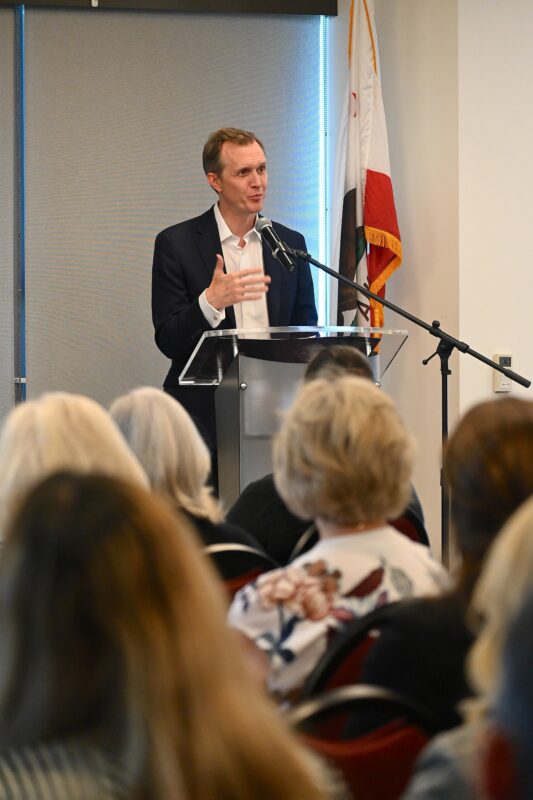
Whitesides also spoke about the need for affordable housing.
He expressed a concern about too many young families moving away because they can’t afford to live in the area. He said he’s working to make it so that people can afford to work and live in the same community.
“Our district is actually better than most parts of Los Angeles County,” he said. “People are moving to our area because we do have somewhat more affordable housing. But, you know, we can do better, and that’s one of the things that we’re really going to be focused on.”
Additionally, Whitesides shared details about the Build America Caucus, which he helped launch this year, that’s aimed at making it “easier to build things in America.”
The group of bipartisan U.S. lawmakers promotes pro-growth policies by cutting bureaucratic red tape, speeding up infrastructure projects and making housing and energy more affordable and accessible.
“Whether that’s permitting reform or it’s, you know, supporting small businesses,” he said, “we’re really focused on things like housing, energy transmission and other areas where we can create an abundance of a good that people need.”
During a Q&A session that was moderated by SCV Chamber of Commerce President John Musella, Whitesides addressed questions about federal support for small businesses, resources for companies investing in on-the-job training, and infrastructure funding aimed at improving traffic flow and goods movement along the Interstate 5 corridor.
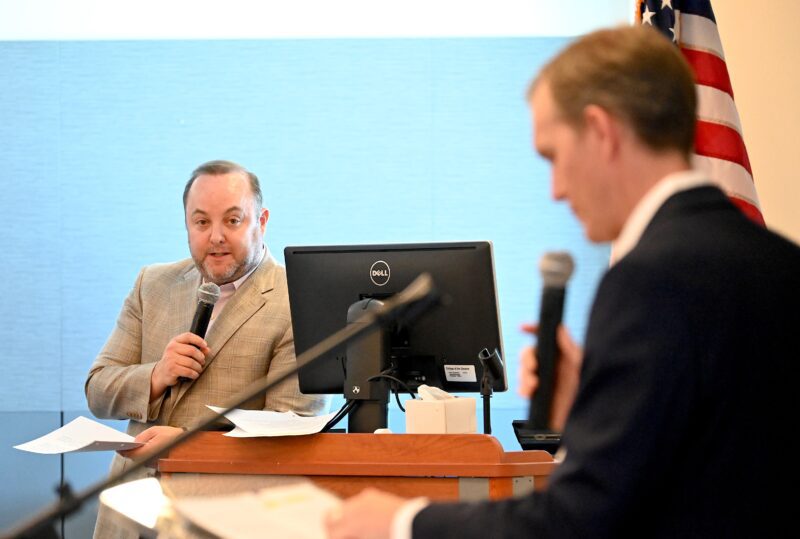
He discussed federal support for small businesses, including the U.S. Small Business Administration’s 7(a) and 504 loans, and the U.S. Department of Agriculture’s Rural Business Development Grants. He also highlighted new legislation to cut paperwork and expand access to capital, including measures promoting research and development partnerships between agencies and small businesses.
In response to a question about workforce development resources for industries like logistics, health care and biotech in the SCV, Whitesides said workforce development support is available through America’s Job Center, which he explained was a one-stop access point for programs through the Workforce Innovation and Opportunity Act, and through local efforts at COC, which tailors training to industry needs, especially in aerospace. He also noted that federal funding has boosted aerospace growth, underscoring the need for skilled workers across the supply chain.
With regard to how federal policy might help support entrepreneurship and innovation hubs, Whitesides stressed the need for federal support, highlighting programs like the Small Business Innovation Research program (a government initiative that provides seed funding through grants), the Small Business Technology Transfer program (an initiative designed to stimulate technological innovation) and local initiatives such as the Mojave Aerospace Accelerator (an initiative to foster aerospace and defense innovation in Eastern Kern County and the Antelope Valley). He emphasized attracting startups to regions like Santa Clarita and the AV.
Asked about how federal infrastructure funding will support traffic and goods movement improvements along the I-5 corridor, Whitesides spoke about how he’s working to secure funding for projects related to The Old Road, Santa Clarita’s traffic and safety upgrades, and rail technology improvements. He emphasized the need to support both road and multimodal transportation, though final appropriations are still pending.

He ended his remarks with a note to his constituents.
“The most important part of my job isn’t in Washington,” he said. “It’s here in the district, and my job is to listen.”
He encouraged those at the forum to be in touch with his office and express to him and his team what they’re feeling.
He wants to know what he called “ground truth.”
“What is the ground truth that you’re experiencing that helps us do our job?” he asked. “We’re going to try to understand your challenges and bring your voices to the halls of Congress. It’s to support you, whether you’re a small business owner trying to make payroll, a student at College of the Canyons looking for a pathway into the workforce, or a family trying to balance a budget while everything seems to cost more.”