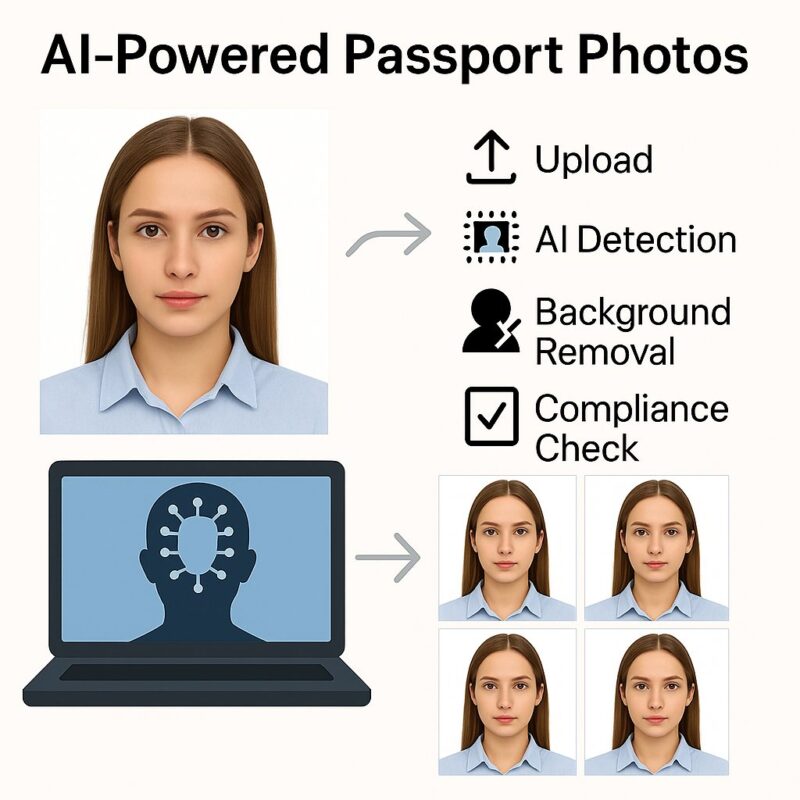
Compliance in identity photography is deceptively complex. Passport and visa photos are not just casual portraits; they must adhere to rules that are codified into international and national law. Governments set these standards to reduce fraud, ensure biometric reliability, and simplify machine-based verification at borders. These rules cover every aspect of the image: fixed pixel dimensions, strict aspect ratios, uniform white or light backgrounds, and tight tolerances for the positioning of facial features. Even small deviations, such as a slight head tilt, off-center framing, or faint background shadows, can trigger rejection.
Traditionally, compliance was ensured by trained photographers, physical studio setups, or manual image editing. Skilled operators measured head-to-frame ratios, corrected backgrounds with lighting equipment, and reviewed details before printing. However, this process was costly, time-consuming, and inconvenient for travelers who needed quick turnaround. Now, online passport photo makers apply artificial intelligence to automate this process, offering a glimpse into how computer vision and rule-based systems are reshaping bureaucratic workflows.
AI Workflow in Detail
The AI-driven pipeline integrates several interlocking technologies. Together, these replace human judgment with standardized computation.
1. Face Detection and Landmarking
The system begins by detecting the face within the uploaded photo. Convolutional neural networks trained on millions of annotated samples identify key landmarks: eyes, eyebrows, nose, mouth corners, jawline, and chin. These landmarks act as anchor points. They allow the algorithm to calculate head size, tilt, and alignment.
This step is critical because compliance rules often specify exact tolerances: for instance, in U.S. passport photos, the eyes must fall within a specific vertical band relative to the total frame height. Landmarking makes such checks automatic.
2. Geometric Alignment and Cropping
Once landmarks are identified, affine transformations correct the orientation. The image is then cropped to standardized dimensions, such as 2×2 inches at 600 DPI for U.S. passports or 35×45 mm for EU documents.
This ensures the face occupies the correct proportion of the frame—neither too zoomed in nor too distant. Without automation, users often struggle to achieve this consistently with smartphone cameras.
3. Semantic Segmentation for Background Removal
A major compliance hurdle is background uniformity. Many governments require a plain white or light-gray background, free from textures, objects, or shadows. AI segmentation models isolate the subject from the environment, pixel by pixel. Non-compliant environments (a colored wall, bookshelves, or patterned curtains) are stripped out and replaced with a uniform fill.
4. Template-Driven Compliance Rules
Different countries apply different rules: photo sizes, pixel densities, face-to-frame ratios, and even cultural allowances for certain head coverings. These are encoded as parameterized templates within the platform. For example:
- U.S. passports require 2×2 inch prints, 600 DPI resolution, eyes positioned between 1.25 and 1.375 inches from the bottom.
- India’s visa photos demand 350×350 pixel JPEGs with less than 1MB file size.
- EU passports use 35×45 mm dimensions and specify that the face must cover 70–80% of the frame.
After geometric adjustments, the AI validates the image against the appropriate template. Any deviations such as insufficient resolution or incorrect eye placement, trigger warnings.
5. Output Generation
The final step produces export-ready files. Users can download digital submissions in JPEG or PNG formats, or printable sheets with multiple copies arranged on A4 or Letter paper. Some platforms even integrate APIs with online visa application systems, reducing manual uploads.
This workflow collapses what once required human expertise into a near-instant computation.
Advantages for End Users
AI-driven photo compliance platforms deliver three main benefits:
- Automation of error-prone steps: Cropping, alignment, and background normalization occur without manual intervention. This removes the most common causes of rejection.
- Scalability across jurisdictions: By swapping compliance templates, the same platform can serve dozens of national standards, supporting travelers worldwide.
- Accessibility: With only a smartphone camera, users in remote or resource-limited settings can produce compliant photos without visiting a studio.
This combination saves time, reduces costs, and minimizes the risk of rejection that could delay travel.
Limits of the System
Despite automation, performance is bounded by input quality. Low-light environments, motion blur, or occlusions (hair covering eyes, glare on glasses, or hats) can confuse segmentation models. While the AI can correct geometry and backgrounds, it cannot create missing biometric information.
Another limitation lies in interpretive discretion. Consular officers and border authorities retain the final say. An image that passes algorithmic checks may still be rejected if an officer deems the expression inappropriate, the lighting uneven, or the headwear non-compliant. For this reason, outputs should be considered “high-probability compliant” rather than guaranteed approvals.
Broader Implications
The significance of AI passport photo makers extends beyond photography. They illustrate how narrow AI can be optimized for a single bureaucratic domain: encoding legal standards into machine-readable templates and pairing them with computer vision.
Unlike frontier projects in generative AI or robotics, this is practical automation—small-scale precision applied to millions of repetitive cases. The economic value comes from scaling down friction: saving travelers time, reducing government rejections, and lowering administrative costs.
Potential Extensions
The same principles could apply across other document-heavy workflows:
- Driver’s licenses: Automated compliance checks for regional photo standards.
- Healthcare documentation: Formatting patient ID images for electronic health records.
- Educational exams: Standardized student photo submissions for identity verification.
- Immigration: Bulk compliance tools for visa processing centers handling thousands of applications per day.
The Core Challenge
The true challenge is not technical. Computer vision and template validation are proven methods. The difficulty lies in regulatory alignment. Governments update standards periodically – adjusting file formats, photo ratios, or biometric requirements. AI platforms must continuously track, codify, and deploy these updates to remain useful.
Human vs. Machine: A Transitional Era
The rise of AI compliance tools does not eliminate human roles entirely. Photographers still provide value in high-stakes cases, such as embassy submissions where rejection has severe consequences. Similarly, manual review is necessary for edge cases – elderly applicants with atypical facial structures, children with rapidly changing proportions, or applicants requiring accommodations.
In practice, AI will likely dominate the first pass of compliance checking, filtering out obvious non-conformities, while humans handle exceptions. This hybrid model mirrors trends in other administrative fields: tax filings, legal document review, and health insurance claims.
Conclusion
Online passport and visa photo platforms represent a quiet but powerful shift in administrative processes. By merging computer vision with rule-based validation, they transform a once-fragmented human task into a scalable service.
The impact is felt in speed, cost, and accessibility. Travelers no longer rely on studio visits or hope that manual edits suffice. Instead, they interact with an AI pipeline that applies measurable, transparent rules across jurisdictions.
The lesson is broader: many bureaucratic workflows (long seen as inherently human) are reducible to codified standards. Once those standards are machine-readable, AI can enforce them reliably. The question is not whether this is possible but how quickly governments and service providers can harmonize regulations with evolving automation.
In the near future, citizens may generate not only compliant photos but also pre-validated visa forms, driver’s license renewals, and healthcare cards directly from their smartphones. Identity will remain human, but its paperwork will increasingly be shaped by machines.