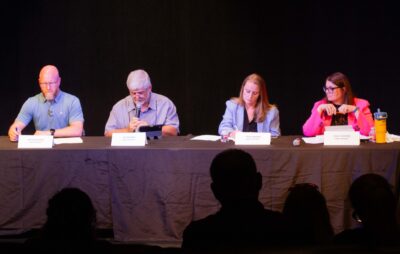
Santa Clarita Valley lawmakers Sen. Suzette Martinez Valladares, R-Acton, and Assemblywoman Pilar Schiavo, D-Chatsworth, discussed the end of the 2025 legislative session and their focus on what’s ahead, following the governor’s deadline to sign new laws.
Martinez Valladares said she hit the ground running for her first term in the 23rd Senate District, with a focus on bills that improved public safety and affordability for her constituents, what she called common-sense legislation with the bipartisan Problem Solvers Caucus.
She highlighted three bills specifically that worked toward those goals, with an effort at “cheaper, cleaner fuel,” another to make communities safer during disasters and another that dealt with sex-offender placement after incarceration.
Schiavo, who’s serving her second term in the 40th Assembly District, mentioned efforts at public safety, health care access and her constituents’ needs as priorities. One of her first bills in the previous session was a successful effort to help residents impacted by the environmental crisis at Chiquita Canyon Landfill, which is part of an ongoing effort from her office.
Martinez Valladares
Assembly Bill 30, a bill in support of the state’s allowance of E15, which Martinez Valladares referred to as a “cleaner and more affordable fuel blend,” was the first signed into law from the recent session.
Gov. Gavin Newsom signed the bill Oct. 2, according to her news release announcing her co-authorship as a member of the bipartisan Problem Solvers Caucus.
“That is cheaper, and it’s going to save about 20 cents a gallon in gas,” she said in a phone interview Monday, referring to the blend of gasoline that represents up to 15% ethanol and 85% gasoline. The law has provisions that could allow for another 5% in the future, she said.
Calling it common sense, Martinez Valladares’ office said California is the only state in the nation not to allow the blend. Schiavo, a co-author, also mentioned the bill in her legislative wrap-up for the session.
A recent Consumer Reports article indicated the blend could cause damage to engines made before 2001, and the fuel economy of E15 generally doesn’t rate the same as unblended fuel.
In terms of emergency response, Martinez Valladares also co-authored Senate Bill 571 in response to the wildfires earlier this year. The bill increases the penalties for offenses committed against disaster victims during a declared state of emergency, such as impersonating a first responder and looting. The inspiration for that bill came from reports of looters and scammers coming in from out of state during the recent disasters, pretending to be firefighters and stealing from people who have already lost so much, she said.
She also successfully worked on SB 380, a law that requires study of state-run transitional housing options to protect the public from sex offenders, saying the north county region was no longer a “dumping ground” for such felons.
Going forward, she said, her focus remains on making things cost less. She said part of that also was an effort to make Sacramento more accountable for what it spends, complaining that she’s heard of at least $190 million in wasteful spending.
“The priorities are not going to change,” Martinez Valladares said Monday, “there is a very clear mandate from my voters that we see across California, which is that it costs too much to live in this state.”
She said she plans to bring back her no taxes on tips bills, which she said never made it out of committee, every year of her term if she has to.
During her break from Sacramento, Martinez Valladares said she would be busy attending community meetings, business organizations and other local groups to talk about her opposition to Proposition 50.
Newsom said the single-issue ballot is an effort to re-section California’s congressional district representation and add four more blue districts statewide in response to a similar redistricting in Texas that added four Republican districts.
Schiavo
Schiavo said her three priorities continue to be housing, homelessness and health care, which was why Assembly Bill 301 was important to her, she said.
“We’ve been trying to figure out every single lever that we can pull to give people some relief and support,” she said of her effort co-authored by Assembly Speaker Robert Rivas. The bill puts pressure on state agencies to accelerate their approval timelines for housing projects.
It also has an affordability impact, she said.
“Any delays in housing mean increased cost, the cost of labor goes up, cost of materials goes up,” she said, adding that “moving these projects more quickly really makes a huge difference in the bottom line.”
She said the Patient Debt Prevention Act, AB 1312, “is a bill that’s going to be really important, unfortunately, considering the federal cut in health care and the increases that people are going to be seeing in their own private insurance as the (Affordable Care Act) subsidies go away in California.”
The bill requires hospitals to prescreen patients for financial assistance before billing, preventing unnecessary medical debt, according to her office.
For people who are unable to afford insurance in the new health care landscape, she said, it will be important that they know about the programs and resources available to them.
The Chiquita Canyon Community Assistance Act, AB 985, is part of several efforts to ensure her office is “pulling every lever it can” to support the 40th District, she said.
This bill requires each property within a 5-mile radius of Chiquita Canyon Landfill to be reassessed so that the full value of the property reflects any decline arising from the elevated temperature landfill event, according to a CalMatters summary of the bill.
The bill provides tax relief, property reassessment, and mortgage forbearance tools for residents impacted by toxic emissions from the Chiquita Canyon Landfill.
Schiavo said Chiquita Canyon is part of an ongoing effort for the next legislative session, mentioning that the mortgage-relief component of the bill she proposed was held up by the Senate’s Banking Committee. She said part of the concern was that the bill requested mortgage relief for a situation that did not have a state of emergency declared, which was part of the established requirement for past programs.
The Click to Cancel 2.0 Law is another effort by the Legislature to keep up with technology. The first version of the bill involved businesses, making it easier for customers to unsubscribe to pay for services.
“In order for people to very easily protect their mental health and their data,” Schiavo said, “this allows people to cancel their accounts and take their data with them.”
Looking ahead, as chair of the Military and Veterans Affairs Committee, she said she’s heard concerns about an alarming and disturbing trend involving veterans and “predatory loan-sharking practices.”