By Guy Birchall
Contributing Writer
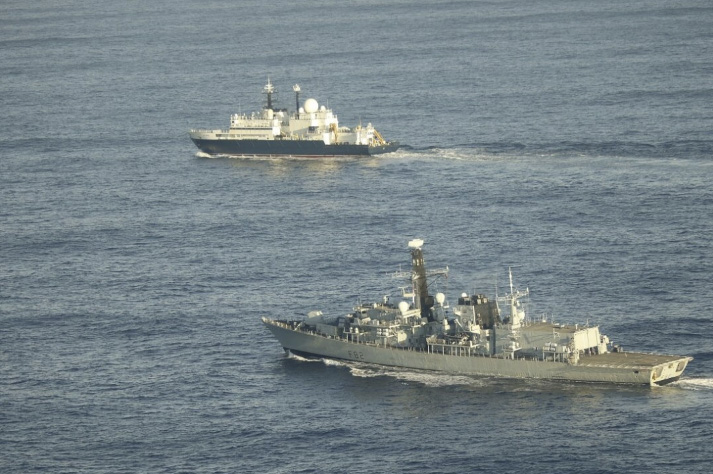
British Defense Secretary John Healey warned Moscow that the U.K. was ready to respond with “military options” after the Russian spy ship Yantar directed lasers at pilots of Royal Air Force surveillance aircraft monitoring its activities on Wednesday.
The Yantar, which is designed for intelligence gathering and mapping undersea cables, is currently hanging around off Scotland’s northern coast.
“We deployed a Royal Navy frigate and RAF P-8 planes to monitor and track this vessel’s every move, during which the Yantar directed lasers at our pilots,” Healey told a press conference.
“That Russian action is deeply dangerous. This is the second time this year that this ship, the Yantar, has deployed to UK waters,” Healy said. “My message to Russia and to Putin is this: We see you. We know what you’re doing. If the Yantar travels south this week, we are ready.”
He said that the ship is part of a Russian fleet designed to put Britain and her allies’ undersea infrastructure at risk.
“It isn’t just a naval operation. It’s part of a Russian program driven by what they call the Main Directorate of Deep-Sea Research, or GUGI, and this is designed to have capabilities which can undertake surveillance in peacetime and sabotage in conflict,” Healy said.
Earlier this year, in January, the Yantar was found over undersea cables, prompting a Royal Navy nuclear-powered submarine to surface in warning.
The Yantar has been within Britain’s exclusive economic zone, which reaches up to 200 nautical miles offshore, but has recently been on the edge of British territorial waters, which extend to 12 nautical miles from the coast.
The incident involving the laser is understood to have happened within the past two weeks, though a precise date has not been made public.
“This is the first time we’ve had this action from Yantar directed against the British RAF. We take it extremely seriously. I’ve changed the navy’s rules of engagement so that we can follow more closely, monitor more closely, the activities of the Yantar when it’s in our wider waters,” Healey said.
“We have military options ready should the Yantar change course. I’m not going to reveal those, because that only makes President Putin wiser.”
Moscow has not yet commented on the incident.
Earlier this month, the Yantar was spotted off the Dutch coast, forcing the Royal Netherlands Navy into action to escort her further out into the North Sea.
Meaning “Amber” in English, the Yantar is a Project 22010 special purpose intelligence collection vessel, but is officially designated as an “oceanographic research ship” by Moscow.
It came into service in 2015 and has a displacement of 5,200 metric tons (5,732 tons), a length of 108.1 meters (354 feet), and a width of 17.2 meters (56 feet).
Additionally, it is equipped with deep-sea manned submersibles capable of diving to depths of more than 6,000 meters (19,685 feet), according to TASS.
The UK and other NATO nations are increasingly concerned about the risk Moscow poses to offshore cables, pipelines and other infrastructure critical to internet connectivity.
At the start of this year, in January, NATO Secretary-General Mark Rutte announced that the alliance was launching a new mission to protect undersea cables in the Baltic Sea named “Baltic Sentry.”
The statement from the U.K. came on the same day that both Poland and Romania scrambled fighter jets to ensure the safety of their airspaces amidst Russian airstrikes on Ukraine.
Along with its maritime activity, Russia has frequently been blamed for incursions into European airspace in recent months, though Moscow has denied NATO’s accusations of repeated violations.
These aerial infractions prompted NATO to launch a major air operation, dubbed “Eastern Sentry,” in September with the stated aim of defending its eastern flank.