
As businesses across the U.S. navigate rising borrowing costs and mounting tax obligations, a surge in demand for certified equipment appraisals is becoming an under-reported trend, one that CFOs and finance teams cannot afford to ignore.
According to industry sources, lenders are increasingly mandating third-party valuations of heavy assets, such as forklifts, industrial extractors, and construction machinery, before approving loans. This push toward stricter asset verification reflects lenders’ concerns about collateral quality and equipment valuation accuracy.
“As interest rates rise, what used to be ‘nice to have’ becomes a prerequisite for equipment lenders,” said Joe of AppraiseItNow, a leading nationwide appraisal firm. “Businesses are now having to prove the real value of their heavy equipment before a loan is booked.”
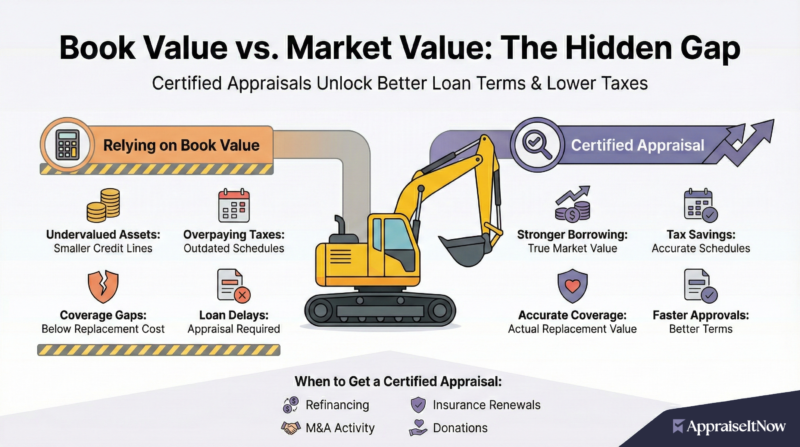
Why It Matters for Tax Bills and Borrowing Capacity?
For equipment-intensive businesses, outdated valuations are more than an accounting risk. They affect tax depreciation schedules, collateral value for lending, and insurance coverage, all of which can drive up tax bills or constrain working-capital borrowing.
Industry commentary shows that many companies still carry machine values based on original purchase or book value rather than current market value. Lenders reviewing loan packages are catching this gap and demanding current certified appraisals.
Why It Matters for Tax Bills, Borrowing Capacity, and Charitable Contributions
For equipment-intensive businesses, outdated valuations create more than an accounting discrepancy; they directly influence tax depreciation schedules, collateral strength for lending, and even insurance coverage. Inaccurate numbers can inflate tax bills, weaken borrowing capacity, or limit access to working capital. Industry commentary continues to show that many companies still rely on book value or original purchase price rather than true market value, and lenders are increasingly flagging this gap and requiring current certified appraisals before finalizing loan packages. The same attention to accurate valuation also applies to non-cash charitable contributions. When businesses donate inventory or equipment, having a well-supported fair-market-value appraisal helps ensure the gift is documented properly for IRS reporting. Updated valuations can make the filing process smoother, provide clarity for both the donor and the nonprofit, and contribute to overall financial transparency.

What Lenders Are Doing Differently?
Several changes in underwriting standards highlight the shift:
- Increased frequency of requesting independent appraisals for equipment pledged as loan collateral.
- A stronger focus on asset verification: lenders now review serial numbers, records of use, maintenance history, and market comparables to validate collateral.
- Lenders are placing more emphasis on understanding the assets backing a loan, including reviewing serial numbers, usage records, maintenance history, and comparable market data to help validate collateral.
- Reduced margin of error: lenders warn that appraisals must reflect the correct “effective date” and method of valuation, or risk rejection.
How often should companies perform asset verification?
Most experts recommend a comprehensive asset verification every two to three years, or immediately before major events such as refinancing, mergers, or insurance renewals. Frequent verifications ensure that recorded equipment values reflect current market conditions and reduce discrepancies during audits or tax assessments.
What Does This Mean for Industrial Companies?
For businesses, the implications are clear:
- Don’t wait until you need a loan to clean up your asset books. Conduct a certified appraisal now to establish reliable equipment values.
- Keep an up-to-date depreciation schedule.
- Understand that your tax bill may be impacted if your equipment’s market value differs significantly from what you carry on the books.
- Use the appraisal report as a negotiation tool with lenders, showing that a higher collateral value may reduce borrowing costs or loosen loan terms.
- Maintain documentation: age, hours of use, maintenance logs, attachments, condition, all matter when verifying asset value.
Real-Life Appraisal Scenarios
One mid-sized manufacturing firm recently engaged AppraiseItNow to reassess its used extractor fleet. When the certified appraisal revealed value was significantly higher than expected, the company leveraged that information to secure a larger line of credit and received favourable interest terms, effectively offsetting a projected tax increase for the upcoming fiscal year.
Marine Diesel Engine Appraisal Supporting an Insurance Claim
AppraiseItNow was engaged to deliver an independent valuation and repair-cost assessment for two Cummins-series marine diesel engines and related propulsion components removed from a commercial vessel following damage. Using owner-supplied documentation and photographs, the team applied a disciplined cost-approach analysis, selecting verified market comparables and adjusting for configuration, accessories, and condition to establish credible actual-cash-value conclusions. Repair estimates were itemized using industry pricing and input from service providers, with all assumptions clearly documented for insurer review. The resulting report provided a defensible basis for settlement discussions, reducing uncertainty for all parties and helping move the claims process forward.
Qualified Appraisal for a Charitable Equipment Donation
In a separate assignment, a donor requested a qualified appraisal to support a non-cash charitable contribution involving four pieces of compact powered equipment, including a utility tractor, mini excavator, side-by-side, and ATV. Adhering to IRS guidance for qualified appraisals and USPAP standards, AppraiseItNow conducted a rigorous sales-comparison analysis, reconciling dealer listings, auction data, and local market indicators to account for condition, hours, accessories, and recent maintenance. Despite the limited availability of low-hour comparables, the appraisal produced well-supported fair-market-value conclusions along with the required IRS documentation, giving the donor confidence in their tax substantiation and ensuring the contribution was properly recorded.
Bottom Line
In today’s financial environment of elevated tax bills, tighter credit conditions, and ongoing equipment demands, businesses should treat equipment valuation not as a back-office audit task but as a strategic lever. Certified heavy-equipment appraisals are fast becoming a prerequisite for borrowing, tax planning, and asset risk management.
For companies that ignore this shift, the risk could mean surprise tax assessments or under-insured assets when it matters most.
About AppraiseItNow
AppraiseItNow provides certified heavy-equipment valuations compliant with USPAP standards. With a nationwide team of credentialed appraisers, the firm specializes in asset verification, collateral support for loans, tax-planning reports, charitable donations, and equipment liquidation strategies.
DISCLAIMER: No part of the article was written by The Signal editorial staff.