By Tom Ozimek
Contributing Writer
Saudi Arabia bombed Yemen’s southern port city of Mukalla on Tuesday, saying the strike targeted a shipment of weapons it said had arrived from the United Arab Emirates to support separatist forces.
Riyadh followed the attack with a demand that UAE forces leave Yemen within 24 hours and warned that Saudi Arabia’s national security remains an inviolable “red line.” The UAE later said it would withdraw its remaining forces from the country.
Saudi Arabia and the UAE are both influential members of OPEC, which is scheduled to hold a virtual meeting on Jan. 4. Any prolonged dispute between the two could complicate efforts to maintain consensus on oil output policy, with implications for crude prices.
Yemen has been at war since 2014, when the Iran-backed Houthis seized the capital, Sanaa, forcing the internationally recognized government to flee south. Saudi Arabia and the UAE intervened the following year, backing the government in a campaign to roll back Houthi control.
Although Riyadh and Abu Dhabi entered the war as partners, they have since backed competing allies.
The UAE supports the Southern Transitional Council, a powerful southern faction that seeks to restore an independent South Yemen. Saudi Arabia, by contrast, backs the central government and allied tribal forces.
Airstrike Targets Alleged Arms Shipment
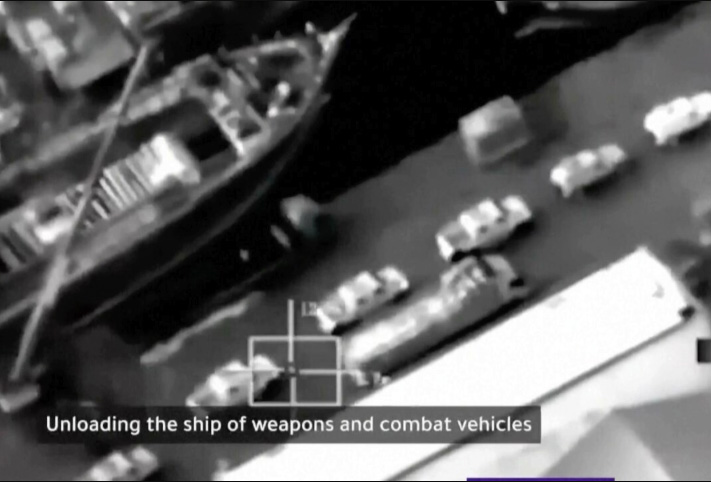
The Saudi military said in a Tuesday statement carried by the state-run Saudi Press Agency that the early-morning strike targeted weapons and military vehicles unloaded at Mukalla’s port after the unauthorized arrival of two vessels from the UAE port of Fujairah.
The military said the ships disabled their tracking systems upon arrival and unloaded “large quantities of weapons and combat vehicles” intended to support the UAE-backed separatist forces of the STC.
“Considering that the aforementioned weapons constitute an imminent threat, and an escalation that threatens peace and stability, the Coalition Air Force has conducted this morning a limited airstrike that targeted weapons and military vehicles offloaded from the two vessels in Mukalla,” the statement said, adding that the operation was carried out at night to avoid civilian casualties or collateral damage.
Saudi state television aired footage it said showed armored vehicles moving from the port to a staging area. Yemen’s state TV broadcast images of black smoke rising from the port and burned vehicles. What was struck or the origin of the cargo has not been independently verified.
Divisions Within the Anti-Houthi Camp
Following the Mukalla strike, Yemen’s Saudi-backed presidential council announced it had canceled a defense pact with the UAE and ordered all Emirati forces to leave Yemen within 24 hours, according to Yemen’s state news agency.
In a televised address, presidential council head Rashad al-Alimi accused the UAE of fueling internal conflict by directing and supporting the STC’s recent military advances.
“Unfortunately, it has been definitively confirmed that the United Arab Emirates pressured and directed the STC to undermine and rebel against the authority of the state through military escalation,” he said.
Saudi Arabia urged the UAE to comply with Alimi’s demand, warning that further actions threatening its security interests would not be tolerated.
Hours after Saudi Arabia backed the demand for withdrawal of Emirati troops, the UAE announced it would pull all its remaining forces from Yemen. The UAE’s ministry of foreign affairs also said in a statement that it was surprised by the Mukalla airstrike and disappointed with Saudi Arabia’s statement regarding Yemen.
“The ministry confirms that the shipment concerned did not include any weapons, and that the vehicles that were unloaded were not intended for any Yemeni party, but were shipped for use by UAE forces operating in Yemen, stressing that the allegations circulating in this regard do not reflect the nature or purpose of the shipment,” the ministry said.
The escalation follows a surprise offensive this month by the STC, which is formally part of a Saudi-backed power-sharing arrangement governing southern Yemen and holds seats on the presidential council. Its leader, Aidarous al-Zubaidi, also serves as the council’s deputy head.
In a joint statement with three other council members, Zubaidi rejected Alimi’s orders, saying that the UAE remains a core partner in the fight against the Houthis and arguing that no single authority can remove a member of the Saudi-led coalition.
Mukalla lies in Yemen’s Hadramout governorate, which the STC seized in recent days after pushing out forces affiliated with Saudi-backed units. The advance broke years of relative military stalemate in southern Yemen.
The STC and other UAE-supported forces now control much of the country’s south, including several key ports and oil facilities. The Houthis continue to control northern Yemen, including Sanaa, leaving the country divided among rival authorities as tensions build among anti-Houthi allies.
Reuters and The Associated Press contributed to this report.