The Canyon Springs Community School Hispanic Heritage Festival was unlike anything that’d come before it.
Somewhere in the ballpark of 100 to 150 people poured into Canyon Springs this past October for the evening showcase. Kindergarteners performed an opening dance, families made traditional arts and crafts, and in the library, a few select students embodied storied Hispanic figures throughout history in a “living museum.”
Lucero Robles’ son Mateo, 7, portrayed the Mexican artist Diego Rivera.
As a mother of three, including a 5-month-old, Robles doesn’t have a lot of free time, but it’s easy to prioritize moments when her kids will be celebrated. That’s why the festival’s dual purpose – to function as one of the school’s state-mandated meetings to convene the parents of English learners – was also considered a massive success.
“I thought it was a great idea. A lot of us are working parents … there isn’t a lot of time to invest in … after school,” Robles said. “(At) the Heritage meeting they did, I got to know what they’re doing at Canyon Springs, and I got to support my child.”
The festival was the brainchild of Canyon Springs kindergarten teacher Elizabeth Lopez, a member of the school’s specialized teacher unit, created at the beginning of this school year, to tackle English language learning in a completely new way.
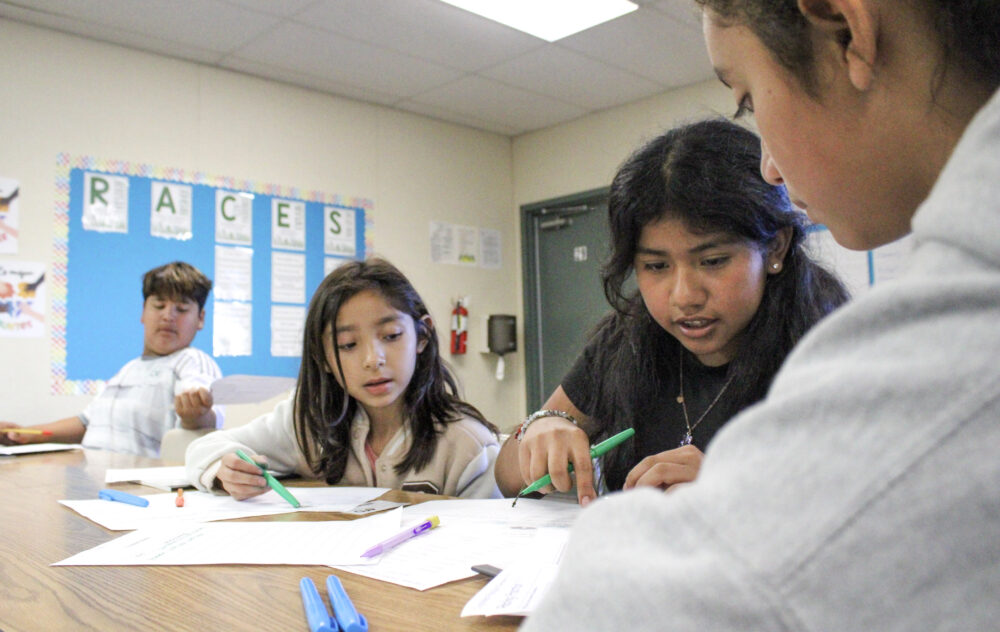
The four-teacher squad is called the Emergent Bilingual Leadership Team, and the phrase is intentional: to understand English learners as gaining an asset, bilingualism, that makes them powerful — not as students with an in-built deficit. In a school with 200 emergent bilingual students, nearly 40% of the student body, school leaders say it stands to make a huge difference.
Robles’ other son Michael, 11, would have his own spotlight this semester: as one of Canyon Springs’ first entries in the California Association of Bilingual Education essay contest, Michael was asked to read his entry – in Spanish and English – at a district board meeting back in November, on about six hours’ notice.
The contest, like the festival, is part of the school’s efforts over the past two years to supercharge its English Language Development program.
The success of that push might be the result of the special alchemy between the four-person EBLT and the arrival of Canyon Springs Principal Matt Gilpin in the 2023-24 school year.
“I don’t think we’ve ever been the way we are now this year, with all the parents wanting to participate,” said Hanin Eid, another member of the EBLT. “(Gilpin’s) making our school stand out. Every school in our district knows about us, and I appreciate that, because it was my dream for so many years that someone would come along.”
The back half of the 2025-26 school year is on track to bring in double the number of certified English-fluent students for Canyon Springs for the year as last year, up from 11%.
A turnaround
Two years ago, Canyon Springs Community School was in a very different situation.
During Gilpin’s first year as principal of Canyon Springs, the school was designated by the state as eligible for Comprehensive Support and Improvement based on its performance the previous year. There are several reasons why a school might become CSI eligible, but in Canyon Springs’ case, it was chronic absenteeism, a high suspension rate – and its English learners’ progress.
“We were red, the lowest you could be, showing a decline for multiple years in (those) categories,” Gilpin said. “So that became our mission. It was like, ‘OK, all hands on deck.’”
Several instructors at Canyon Springs have decades of experience teaching, and yet Gilpin said there was no defensiveness or ego in the staff’s reaction to the news.
“I have to give this staff just all the credit in the world. There was never a moment of like, ‘Oh shoot, this is our fault.’ It was like, ‘Oh shoot … we have students in our community that need more from us,’” Gilpin said. “‘Great. How do we learn more?’”
District Superintendent Catherine Kawaguchi brought in education consultant Paula Maeker, and with her help, after creating small groups of teacher leadership teams for tackling specific issues, they developed a system for improving student achievement scores and suspension rates. That included doubling down on literacy and math instruction, reinforcing core parts of students’ grade-level curriculum and behavioral instruction.
Gilpin said that those principles would help guide Canyon Springs out of CSI eligibility – the school was undesignated in less than 10 months – but when it came to catching up the progress indicators for the roughly 200 students at Canyon Springs tasked with becoming fluent in English as well as Spanish, the story got bigger.
English language development develops
“We used to have the kids come to our (English Language Development) classes and (hear) … ‘You’re an ELD, you need to graduate, you need to get out of ELD, or else you’re going to be in these classes forever,’” said Eid. “We explained it differently. Now … they know that they’re learning another language and that they’re going to be bilingual.”
Eid said that participation in the English learner’s program was reimagined as not only something to be proud of, but also defined by what the students, and they alone, could bring to it.
The goals of the EBLT, hashed out in its first meeting in the fall of 2024, had two major threads: to connect what emergent bilingual students were learning in their English classes with their general academics, and to make students’ cultural backgrounds a more urgent part of their academic life.
The latter would come to fruition over the next several months, but the former would warrant a transformation of the school’s ELD procedures themselves.
Eid was tasked with creating intervention cycles for English learners struggling with particular lessons similar to the ones already used for their other subjects. Studying students’ latest state-level English fluency exams helped them to determine who needed extra support in reading, writing, speaking or listening.
Before Eid’s program, those intervention measures – pulling small groups of students for reviews, identifying who struggles with what skills – didn’t exist at all in ELD.
The result was a system unlike Gilpin had ever seen, he said.
“She researched every one of the almost 200 students,” Gilpin said. “(She) knew all the backstory … ‘These are my students. This is what I know. This is what they need. They’ve got this test with this score, but they’re missing the proficiency test, so I’m going to work with a teacher.’ And she just created this web of support.”
They also put a greater emphasis on making sure students understand what the metrics of their progress scores actually mean, a change that Gilpin said is being implemented across the board when it comes to academics.
“The same things are happening with reading and English language arts, in terms of … the momentum of changing students’ feelings about their own involvement in learning. Fostering why that assessment matters and not that, ‘Hey, you got 70% on the assessment,’ whatever that means,” Gilpin said.
Communicating to students how their assessments directly reflect the skills they’re excelling in, and where and how practicing others will also be reflected in those assessments, was important to Gilpin.
“That’s changing how students feel about coming to school, the fact that we can target (those skills), just like we were able to target (them) with the emergent bilingual leadership team,” Gilpin said.
The EBLT’s other goal, to bring the cultural experiences of emergent bilingual students into the fold of their dual-language learning, would find two major outlets in 2025.
“(We wanted) to become more of an assets-driven community of learners,” Gilpin said. “Really celebrate where our students are coming from, what community and what background and cultural experiences are they experiencing outside of the school gates, and that we can then hone in on, build a connection (to) here at school.”
ELAC elation
Every public school in California with at least 21 English learners is required to put together a committee of English learners’ parents, or an English Learners Advisory Committee. When Gilpin joined Canyon Springs, the school – like many others – was struggling to pull busy parents into “ELAC” meetings, required to be held four times throughout the school year, with opaque aims.
The meetings didn’t always seem related to the wellbeing of students, especially when jam-packed into the workday.
“(We) might get one or two parents, you know, and I was not doing a great job,” Gilpin said. “I was just giving the compliance piece of information. Like, ‘I have you here, we’ve got to do the rundown. Do you have any advice for the school? No, there’s two of you.’”
Gilpin’s ELAC meetings started out with a series of whiffs in the 2024-25 school year as Canyon Springs tried to crack the code on attendance: Gilpin started by suggesting the meeting be scheduled after school – with day care provided.
One parent showed up.
Some of Gilpin’s principal colleagues suggested they hold their next ELAC meeting online. If convenience was the limiting factor, it seemed like the perfect solution for getting rid of the access barrier almost entirely.
In January, Canyon Springs threw its next meeting over Zoom, in the middle of the day. Not one person attended.
“I blame only myself. We didn’t sell it. There wasn’t a product,” Gilpin said. “We didn’t connect what we were offering our students or offering our parents to their needs, to the community.”
Gilpin said that during a conversation with the district translator for the meeting, Cruz Navarro, Navarro suggested that the school find a way to “celebrate what we have.”
The idea to transform ELAC meetings into community events got more traction after Gilpin and the EBLT attended a California Association for Bilingual Education conference, using funds the school received from its CSI eligibility designation. A few months after its January meeting, in March 2025, Canyon Springs held a very different ELAC meeting.
“We went from zero attendees … (to) 30 to 40 families, which is a total of 60 to 70 people,” Gilpin said. “I’d throw a parade for 60 to 70 people at an ELAC meeting.”
It seemed that the key all along had been making the kids themselves the point. Students at the March event got to taste samples from a nutrition presentation by the school meal program School Day Cafe, participate in a music lesson hosted by Canyon Springs’ music teacher, and listen to a story read aloud, in Spanish, by a local bilingual librarian.
“And then, in the middle of all of those activities, I would drop in a little bit of the compliance information,” Gilpin said. “‘Hey, while I got you … your student is an emergent bilingual student, (and) will be taking the (English fluency) exam. This is what reclassification means,’ dropping in some of the information that we want our parents to understand about the trajectory of their students.”
The next ELAC meeting, held the following month, put an even greater emphasis on cultural celebration: Students from Golden Valley High School put on a half-hour folklorico performance, followed by a performance from students in a Canyon Springs after-school program, RISE, who’d been learning folklorico for the past several weeks.
That three to four minutes of dancing “brought the house down,” Gilpin said.
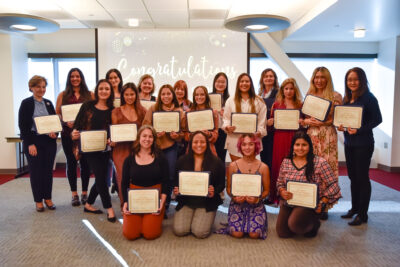
It also doubled as a reclassification award ceremony. Several students, now certified as fluent in English, were recognized in front of their families – and parents were filling the ELAC sign-in sheet.
“Kids came dressed up, and we didn’t tell them to dress up. They just were proud of themselves, and parents were taking pictures,” Gilpin said. “It was just a really, really sweet, amazing night.”
Contest to quest
This past fall, two major events brought Canyon Springs’ revamped approach to its ELD program to a new pitch: the Hispanic Heritage Festival, doubling as the first ELAC meeting of the academic year, and the bilingual essay contest.
The contest, where students would write their essays in English and Spanish, was something Gilpin remembered from a previous CABE conference, and when he shared the idea with Eid this fall, the contest happened to dovetail with her writing intervention cycle.
“I said, ‘What do you think we need? Like, four or five? How many students do you think we really have?’ And she’s like, ‘Oh, let me start interviewing them … Let me break down the essay,’” Gilpin said. “And she came to me after a couple weeks, and she said, ‘I think we’ve got 20.’”
Canyon Springs submitted 22 essays to the contest – the week before the Dec. 5 deadline.
The contest asked students to write about what it means to be a multilingual student, and why it’s worth celebrating. Gilpin said that, after Eid had brainstormed with her students to find their personal connections with the prompt, parents reported having significant conversations with their kids.
“What it did for Canyon Springs was connect the academics to the celebration of the community, and to really give us a goal to chase after,” Gilpin said. “(Eid) would come to me with stories of like, ‘I was talking to this mom the other day. She’s got two boys writing the essays there … Mom’s practicing writing Spanish with the kids, and they’re talking about the experiences that they had as a part of being a Hispanic student.”
Gilpin said that whether Canyon Springs wins or loses, that impact – those occasions for conversations, for self reflection based in pride – is itself a hard-won achievement.
“How amazing is that? How amazing is that that an activity taking place in school is changing the conversation at the home?” Gilpin said. “Isn’t that what we want for everybody, whether it’s about math word problems, or whether it’s about the novel you’re reading, or in this one, it happens to be why your community and your heritage is so important to you.”
Michael’s entry was one of those essays. He’d written, in part, about wanting to study animals for a living, and how knowing Spanish and English would help him communicate his discoveries wider. But as far as bridging the gap for the English and Spanish-only speakers around him, he’s already doing it.
“He’s made friends that only speak Spanish, and he’s able to communicate with them, especially the little kids … He’s always been very helpful in that way to other kids,” his mother said. “When he was little, I always told him, mijo, you need to speak both languages.”
In that way, he’s been a “little light” for the monolingual students around him, she said. It’s likely that, in the coming years, he’ll be one of many more at Canyon Springs.