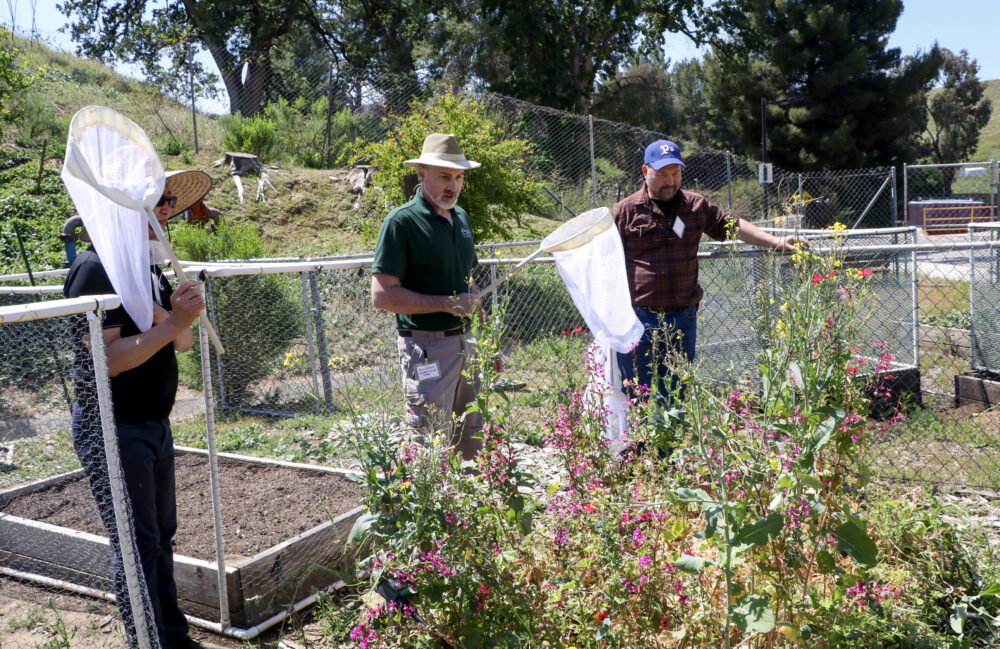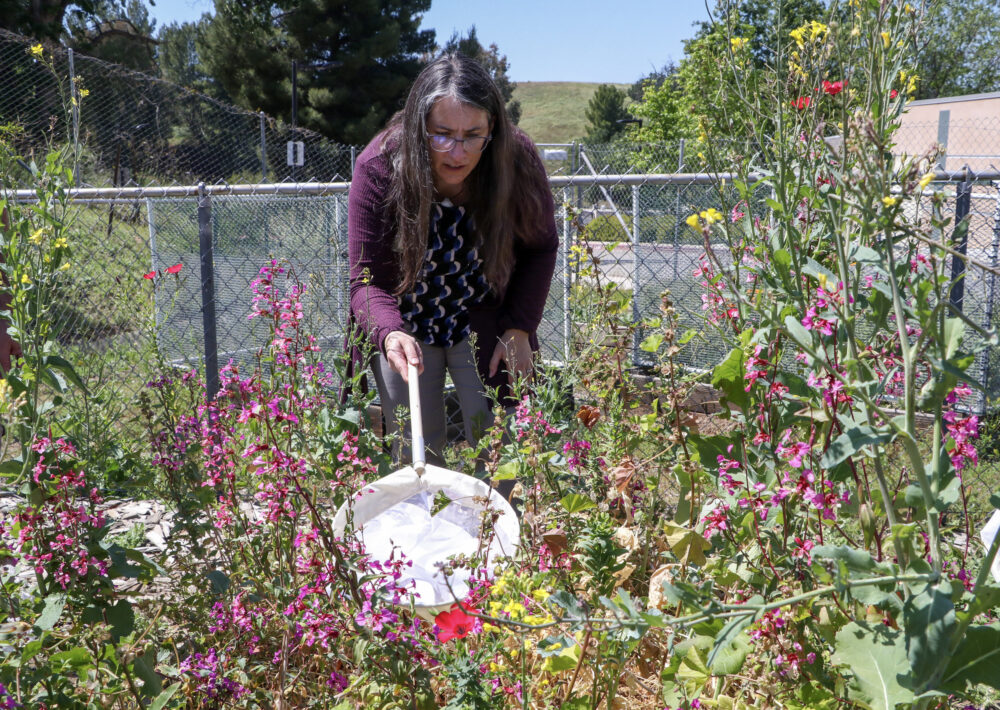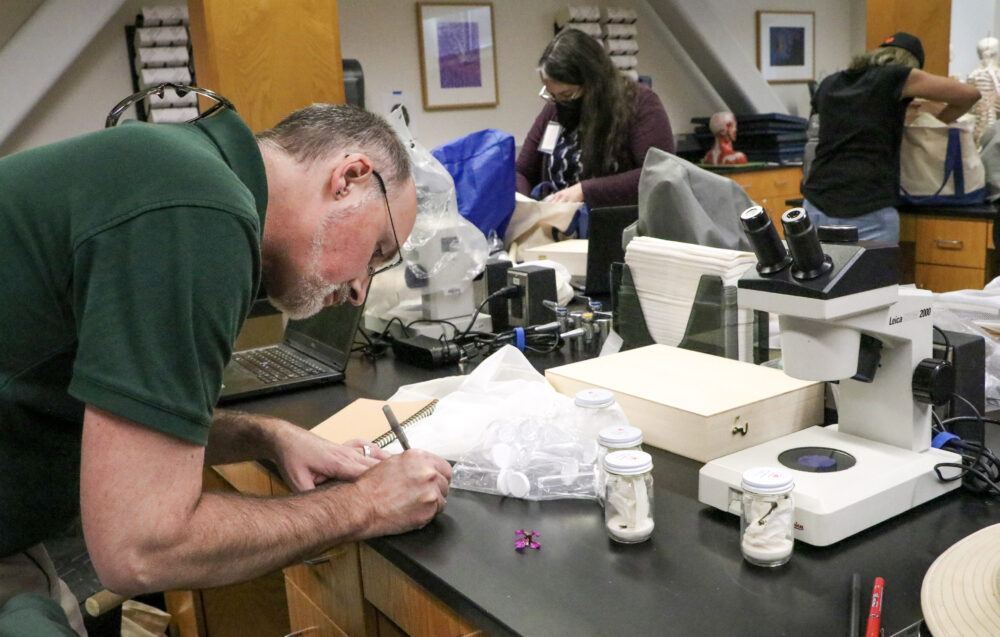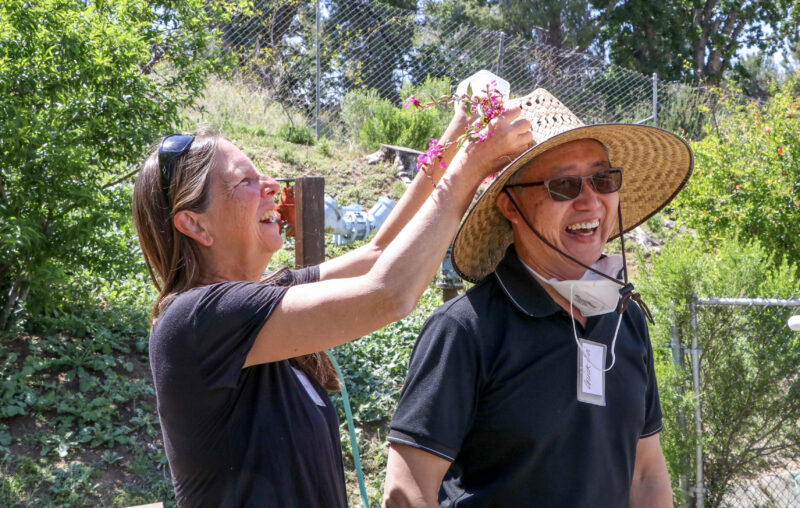
College of the Canyons became the only Southern California community college affiliated with Bee Campus USA last week, pledging to become a better place for pollinators of all stripes.
The Bee Campus USA program is run by the Xerces Society, an invertebrate conservation nonprofit. The affiliation comes with a handful of pro-pollinator commitments: Create suitable habitat – which means fostering native flora on campus – reduce pesticide use and perform educational outreach.
As it turns out, COC might be especially primed to take on the Bee Campus mantle. The college’s certification in the program comes after five years of research into the campus’ native bee population, fueled by a grant from the National Science Foundation it first received in 2021, with a follow-up grant received in 2023.
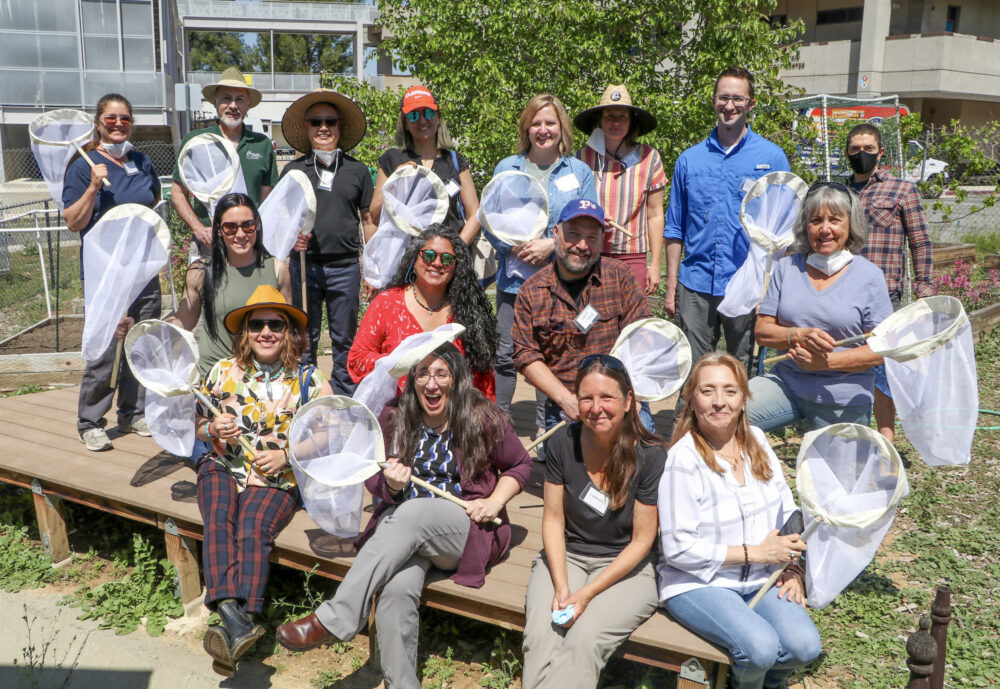
With that funding, the college has spent the past five years as the lead institution for faculty from more than 30 community colleges to participate in training to learn about native bees, as well as how to mentor students on native bee research. Those faculty members have then trained students through internships.
COC science professor Jeannie Chari was the grant’s principal investigator – and led the charge to make the college Bee Campus USA-certified.
“We’ve … been treating our campus as what’s called a living lab,” Chari said. COC students have spent the past few years researching and conducting experiments to get to know the campus’ native bee population, how they interact with the campus’ habitat, and, crucially, determining which plants have the most pollinator visitors.
As the “grant originating entity,” COC maintains the master bee photo database, Chari said. Photos of identified bees submitted to the database as part of the NSF-funded research are verified by a taxonomist, one of Chari’s co-grant writers, and are submitted into an online bee library, as well as iNaturalist.
If the grant’s goals are achieved, the program will have trained 45 faculty members from various community colleges, who will in turn have engaged 500 students, according to the 2023 award abstract.
Chari said that the program has been hugely beneficial for a broad group of students looking for research and data analysis experience, including one of her past mentees, who was recently nominated for a graduate research project on seaweed at California Polytechnic University, Humboldt.
“That’s the really nice thing about this, I’ve had some students participating in this research going off to medical school,” Chari said.
This year marks the last for training new community college faculty members, but the grant comes with two more years to support faculty already trained in the program to mentor students.
The idea to pursue the Bee Campus USA affiliation was perhaps an obvious next step for a campus already knee-deep in bee research.
Chari said that Paul Wickline, the associate vice president of the college’s Canyon Country Campus, brought up the idea of COC submitting an application for affiliation most recently, after visiting a northern California campus in the program.
After receiving college leadership’s blessing on the project, COC’s team of assembled Bee Campus USA committee members – including four students, alongside faculty across a spread of disciplines, from the English department to anthropology, environmental science and architecture – put together the final application.
“They were a really nice, diverse number of people interested in being on the committee,” Chari said. “We gave them a brief scenario of what we’ve been up to and why we think we’d be good at it.”
Colleges pay a sliding-scale fee to be a part of the program, based on the number of attending students. COC officially received its certification last week.
What will a bee-friendlier COC campus actually look like? Chari said that, after five years of research into the bee-to-campus relationship, some plants popular among pollinators were obvious, and at least one well-loved flower wasn’t.
“What we found is that the bees tend to prefer yellow flowers, so we find a lot on some of the yellow flowers that we have,” Chari said. “(We have) desert marigold, and we have the California sunflower, and interestingly enough, there’s the non-native mustard. There’s a lot of curiosity about why there’s native bees on non-native mustard.”
Little bees love to sleep in the campus’ mallow flowers, Chari said. One bee-friendly act suggested by the Bee Campus USA framework for affiliated colleges is to display signage on campus focused on pollinator conservation. Chari said that going forward, she’d like to put signage next to campus mallows encouraging passersby to plant them.
Both the college’s Valencia and Canyon Country campuses already have a heap of native plants planted, Chari said. Many are maintained by students: Students do substantial work to maintain a hefty planter in the middle of the University Center parking lot with significant native bee and bird activity, she said. This year, students will be sampling the native garden they planted last spring, next to the college’s Coffee Kiosk, for bees.
But the most important part of fulfilling their Bee Campus USA affiliation promises is community education, Chari said.
“What we want to do is bring more awareness of that to the community,” Chari said. “The community loves to walk through our campus because they’re beautiful campuses. We want to make it more obvious to the community how they can be engaged.”
Chari said she’d like to have community members tag along while they perform upkeep on bee-friendly plants on campus, as well as offer a non-credit pollinator class at the college to laypeople.
To hear the aims of COC’s Bee Campus USA initiatives, one might assume that the college’s new mission is to function as a bee oasis on par with the natural Santa Clarita Valley landscapes they’re already drawn to. But Chari said a college campus, as a man-made environment, is no match for a habitat like Placerita Canyon.
The goal is to transform the campus into a facilitator for bees to travel freely, instead of an impediment.
“The goal is to make sure you’re not a barrier to spreading populations,” Chari said. “As a matter of fact, you’re functioning as corridor, so that populations can go back and forth and have genetic diversity and stability.”
That’s the goal for any college that joins the program. As of now, that includes several major universities throughout the state, but with COC being the program’s first Southern California community college affiliate, Chari said she’s hoping the partnership will inspire an upswell of other smaller colleges to do the same.
Colleges throughout Southern California committed to making sure bees are able to flow freely throughout the Southwest could have a major influence on what the Xerces Society’s all about: no less than the protection of the natural world.