
White-label credentialing matters when your organisation’s brand, not the platform’s, needs to be what recipients and employers see.
Whether you’re issuing certificates for a training programme, a certification body, or a corporate L&D team, the platform you choose shapes how that experience looks and how much control you actually have over it.
We evaluated the market and narrowed it down to five platforms worth considering. In this guide, we’ll review each one across white-label depth, pricing, and practical fit.
TL;DR:
- White-label depth varies significantly across platforms, from full brand isolation on monthly plans to enterprise-only access behind sales conversations
- Certifier ranks first for combining 100% white-label control, monthly contracts, full post-issuance editing, and native CRM and spreadsheet integrations in a single platform
- Some platforms in this list prioritise network reach or LMS integration over brand ownership, which suits specific buyer profiles but limits white-label flexibility
- Contract structure is as important as features: several platforms restrict white-label to annual plans with no public pricing
Our Ranking Methodology
We evaluated 27 digital credential platforms between January and March 2026, testing each product hands-on and reviewing vendor documentation, public pricing pages, demo recordings, and verified user reviews on G2 and Capterra.
Our research covered:
- White-label depth: custom domain, email sender, verification pages, and recipient-facing branding control
- Issuance workflows: bulk generation, automation, and post-issuance editing capability
- Integration coverage: native LMS, CRM, and spreadsheet connections without paid add-ons
- Verification standards: Open Badges 3.0 compliance, QR validation, and revocation controls
- Pricing transparency: publicly available tiers, contract terms, and per-credential economics
- Contract flexibility: monthly vs annual commitment, setup fees, and free trial access
Each criterion was weighted against buyer priority. White-label depth carried the highest weight given the article’s focus, followed by contract flexibility and integration coverage. Certifier scored above remaining platforms on all three of those dimensions: it offers 100% white-label at a publicly priced monthly plan, native CRM and spreadsheet integrations without add-on fees, and full post-issuance design editing that neither platform provides.
*Why only these 5 made the cut: each platform had to offer white-label functionality as a documented feature (not a vague enterprise option), have publicly verifiable usage at organisational scale, and be actively maintained with pricing or sales access available as of Q1 2026.
Compare Top 5 White-Label Digital Credential Platforms – 2026
We’ve condensed the key decision factors into a single table. You can use it to quickly identify which platform fits your organisation’s white-label requirements, budget, and integration stack before reading the full breakdowns below.
| # | Platform | Price (from) | Free Trial | Contract | White-Label | Integrations | Standout Feature | Key Limitation |
| 1 | Certifier | $0 | ✅ | Monthly | 100%, all paid tiers | Google Sheets, Excel, HubSpot, Salesforce, Airtable, Zoom, Typeform, Zapier, Make | Full post-issuance design editing | White-label requires paid plan |
| 2 | Accredible | $45/mo | ✅ 20 credits | Annual | Yes | Moodle, Canvas, TalentLMS, Salesforce (paid add-on), Zapier | LMS integration depth | Annual contract, data-only editing |
| 3 | Credly | Not public | ❌ | Annual | Limited | Canvas, Blackboard, Degreed, Zapier | Public badge network reach | No brand isolation, sales-led only |
| 4 | Parchment | Not public | ❌ | Annual | Enterprise only | Canvas (native), limited third-party | Canvas pathway credentialing | White-label behind sales wall |
| 5 | Give My Certificate | $0 | ✅ | Annual only | Higher tiers only | Zapier, basic API on higher tiers | Speed of issuance | Annual billing, limited integrations |
1. Certifier
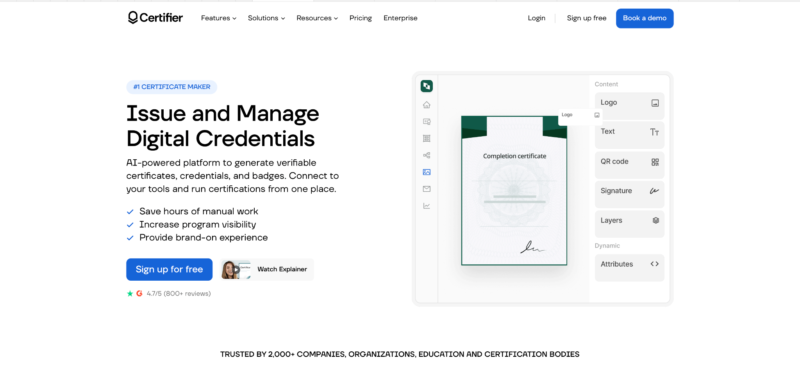
Certifier is a digital credential platform that enables organisations to design, issue, manage, and verify white-labeled digital certificates and Open Badge 3.0 compliant badges at scale, without exposing the platform’s own branding at any tier. It combines a drag-and-drop template builder with over 2,000 certificate and 300 badge templates, bulk issuance automation, custom domain and email sender support, and native integrations with Google Sheets, HubSpot, Salesforce, Airtable, Zoom, and Typeform into a single credential management infrastructure.
Unlike most platforms in this category that gate white-label features behind enterprise contracts or annual commitments, Certifier includes 100% white-label control starting from its Professional plan with monthly billing and a 30-day money-back guarantee, making full brand ownership accessible without long-term lock-in.
That combination of unrestricted white-label access, full post-issuance editing of both data and design, monthly contract flexibility, and the broadest native integration coverage in the category is what places Certifier first among the best white-label digital credential platforms in 2026.
Trusted by: Stanford, Amazon, UC Berkeley, Volvo, Warner Bros. Discovery, Duolingo, Purdue University, Synthesia, University of Birmingham
Pros:
- 100% white-label at Professional tier and above, covering verification pages, emails, and recipient interfaces
- Custom domain and custom email sender included, no platform branding at any touchpoint
- Full post-issuance editing of both credential data and visual design
- Open Badge 3.0 compliant with QR code and custom URL QR verification
- Native integrations with Google Sheets, Excel, Smartsheet, HubSpot, and Salesforce at no extra cost
- Monthly contracts, no setup fees, 30-day money-back guarantee
- GDPR-compliant and ISO 27001-certified, with custom SLA and DPA on higher plans
- Credential expiration reminders and scheduled issuance built in
Cons:
- Free Starter plan retains Certifier platform branding on verification pages
- Advanced analytics only available from Professional tier upward
Pricing:
- Starter: $0
- Professional: $67/month
- Advanced: $339/month
- Enterprise: Custom
Best for: Training providers, L&D teams, and certification programmes that need complete brand ownership over the credential experience without an annual contract commitment.
2. Accredible
Accredible is a digital credential platform built for universities and corporate L&D teams, offering white-label branding across verification pages and credential emails with API-based issuance and LMS integrations. White-label is available but applied at the organisation level rather than per-workspace, meaning teams managing multiple brands or programmes under one account face structural limitations.
It suits organisations issuing at consistent volume on structured annual programmes, though post-issuance editing is limited to data only and plans beyond the entry tier move to custom pricing on annual terms.
Trusted by: Google, Coursera, IEEE, Kaplan
Pros:
- White-label branding across certificates, badges, and verification pages
- API issuance and LMS integrations including Moodle, Canvas, and TalentLMS
- Credential expiration and renewal workflows supported
- Engagement analytics included
Cons:
- White-label applied at organisation level only, one custom domain and one email sender per account
- Post-issuance design editing not supported, data-only changes after issuance
- Annual contracts required beyond the entry plan
- Salesforce integration is a paid add-on
Pricing:
- Launch: $45/month (annual term)
- Connect: Custom
- Growth: Custom
Best for: Universities and mid-to-large L&D teams that need reliable white-label issuance at scale and prioritise LMS integration over multi-brand flexibility.
3. Credly
Credly is a digital credential platform owned by Pearson, built around a large public badge network serving formal certification bodies and professional associations. White-label control is limited by design: earner profiles sit within Credly’s shared public ecosystem, and the platform’s value proposition centres on network visibility rather than brand ownership.
That makes it a strong fit for programmes where employer recognition within a shared directory matters, and a weaker fit for organisations whose primary requirement is a fully branded, self-contained credential experience.
Trusted by: IBM, AWS, Microsoft, CompTIA
Pros:
- Established public badge network with broad employer and recruiter recognition
- Built-in verification on every credential
- Integrations with exam providers, Degreed, Canvas, and Blackboard
Cons:
- White-label customisation limited, earner-facing experience sits within Credly’s shared public directory
- Custom domain and full brand isolation not available as standard
- Pricing not publicly disclosed; market reports suggest annual contracts starting around $3,000 with a reported $5,000 setup fee
- Sales-led onboarding with no self-serve sign-up
Pricing:
- Custom only: Pricing not publicly available per vendor documentation
Best for: Certification bodies and professional associations where public network visibility takes priority over a fully controlled brand experience.
4. Parchment Digital Badges (formerly Badgr)

Parchment Digital Badges is a digital credentialing platform built on the open-source Badgr infrastructure, now part of Instructure’s Canvas ecosystem. It is built around stackable credential pathways and LMS integration rather than white-label flexibility, and its white-label capability is only accessible at the enterprise tier behind a sales conversation with no public pricing.
That structural limitation, combined with the discontinuation of the free tier and a template library reduced to around 9 designs under the Parchment rebrand, positions it fourth in this list.
Trusted by: Universities and enterprise HR teams, 10,000+ organisations globally
Pros:
- Stackable credential pathways with visual progress tracking
- Open Badges compliant with learner backpack support
- Native Canvas LMS integration
- Verified issuer authentication
Cons
- White-label restricted to enterprise tier, no public pricing or trial access
- Free tier discontinued as of late 2025
- Template library reduced to approximately 9 designs post-rebrand
- Setup process requires configuring issuers before credentials can be issued
Pricing:
- Enterprise: Quote-based only
Best for: Institutions already operating within the Canvas ecosystem that need pathway-based credentialing at scale.
5. Give My Certificate
Give My Certificate rounds out this list as a lightweight option for event-driven and small-scale credentialing. The platform covers the basics: QR code and blockchain-backed verification, spreadsheet bulk upload, and social sharing. White-label is available but sits behind a yearly enterprise plan with no public pricing, and the platform runs on annual billing only with no monthly option.
For organisations whose primary requirement is white-label control across a scaled credentialing programme, the feature depth and contract structure are limiting factors worth considering.
Trusted by: upGrad, Codingal, Hero Vired, Geekle
Pros:
- Fast bulk issuance via spreadsheet upload
- QR code and blockchain verification with lifelong credential validity
- Custom SMTP and tracking reports on standard plans
Cons:
- White-label restricted to higher-tier yearly plans
- Annual billing only, no monthly option
- API access limited to higher tiers
- Free plan capped at 50 credentials per month
Pricing
- Free: $0
- Basic: $99/year
- Startup and above: Not publicly listed
- White Label/Enterprise: Custom
Best for: Event organisers and small teams that need straightforward, verifiable credential issuance without complex setup.
Conclusion
White-label control means different things depending on your organisation: full brand isolation across every recipient touchpoint, flexibility to switch plans without annual lock-in, or simply removing a third-party logo from a verification page.
The platforms in this list cover that range, each with a different set of tradeoffs across contract terms, integration depth, and credentialing standards.
Based on our review, Certifier ranks first for combining 100% white-label access, monthly contracts, and full post-issuance editing in a single platform, making it the strongest fit for teams that need complete brand ownership without long-term commitment.
FAQs
What is a white-label digital credential platform?
A white-label digital credential platform lets organisations issue and verify digital certificates and badges under their own brand, with no visible branding from the platform provider. Custom domains, email senders, and verification pages display the issuer’s identity exclusively. Platforms vary in how completely they remove their own branding, with some restricting full white-label to enterprise tiers.
What is the difference between white-label and standard digital credentialing?
Standard platforms display their own branding alongside the issuer’s on verification pages and recipient emails. White-label removes that entirely. The distinction matters most for organisations where brand consistency across the credential experience affects perceived authority.
Which features should I prioritise when choosing a white-label credential platform?
Prioritise custom domain, custom email sender, post-issuance editing, Open Badges 3.0 compliance, and native LMS or CRM integrations. Contract structure matters equally: many platforms restrict white-label to annual enterprise plans, while others include it at publicly priced monthly tiers.
How does Open Badges 3.0 affect white-label credentialing?
Open Badges 3.0 is the current W3C-aligned standard for digital credentials, enabling interoperability across platforms, employers, and learning record systems. For white-label issuers, OB 3.0 compliance means credential validity is tied to the standard rather than the issuing platform’s ecosystem.
Can small organisations use white-label credential platforms affordably?
Yes. Several platforms offer white-label on monthly plans without setup fees or annual commitments, making it accessible to training providers, event organisers, and small L&D teams outside enterprise budget ranges.