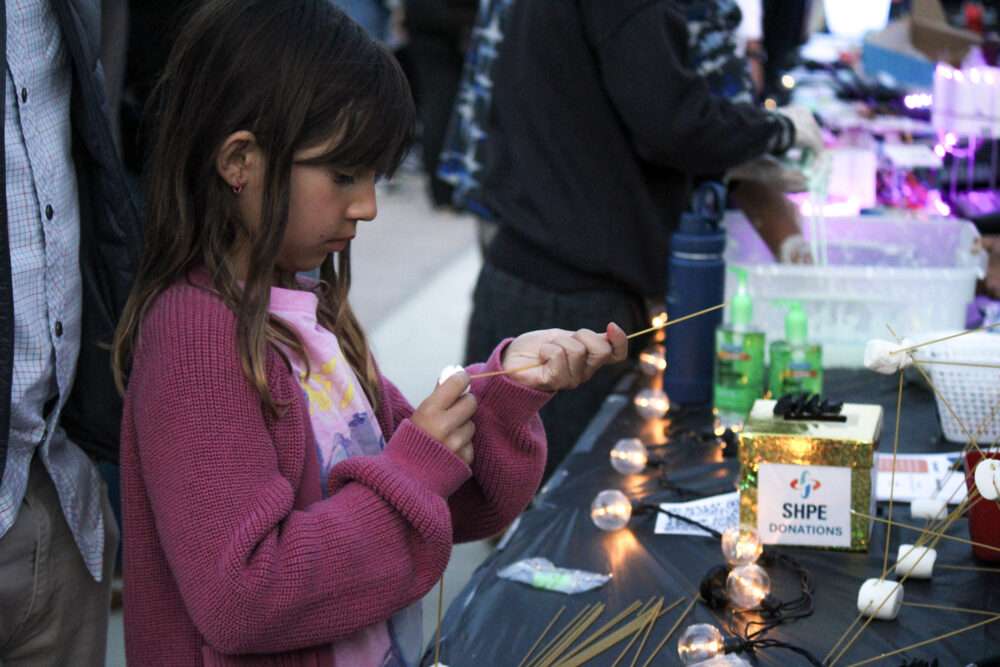
The College of the Canyons’ spring Star Party brought young academics, teachers and researchers together at what’s necessarily a time of great change for students.
Many of COC’s science club members, crowding tables set up in a big square in the courtyard outside the Takeda Science Center Friday evening, have already received the acceptance letters from colleges that’ll change their lives.
This semester’s keynote speech, “The Life of a Star: From Birth to End” presented by COC physical science and astronomy professor Teresa Ciardi, was perhaps especially fitting: Ciardi’s reflection on the varied ways stars can evolve might be a fitting metaphor for the ways a life of scientific inquiry might change the people who find it.
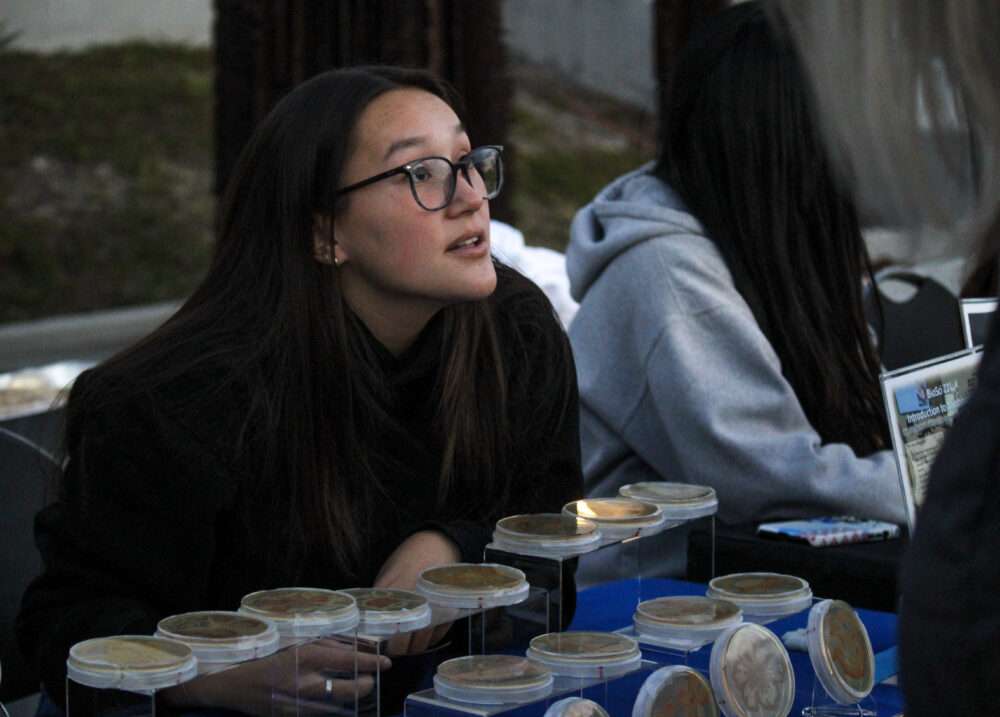
Ava Gerhardt, a sophomore studying public health sciences at COC, is one of those students: she’ll be on the road to becoming a physician’s assistant this fall.
At the Star Party, Gerhardt had mold to display. Rows of plastic dishes contained pictures of flowers, animals and cartoons in shades of green, red and orange-ish yellow.
“We’re getting started … using all these different forms of bacteria and seeing how they present with different colors,” Gerhardt said. “We inoculate first six stock organisms they give us … and we will use aseptic technique to plate them and then put them in test tubes and just observe their colors.”
Gerhardt’s display, like many others typically at the Star Party, is meant to give visitors the chance to see what the study of a particular field looks like in action, especially at COC’s science, technology, engineering and math programs — from the biological mechanisms of mold to the activity of solar flares.
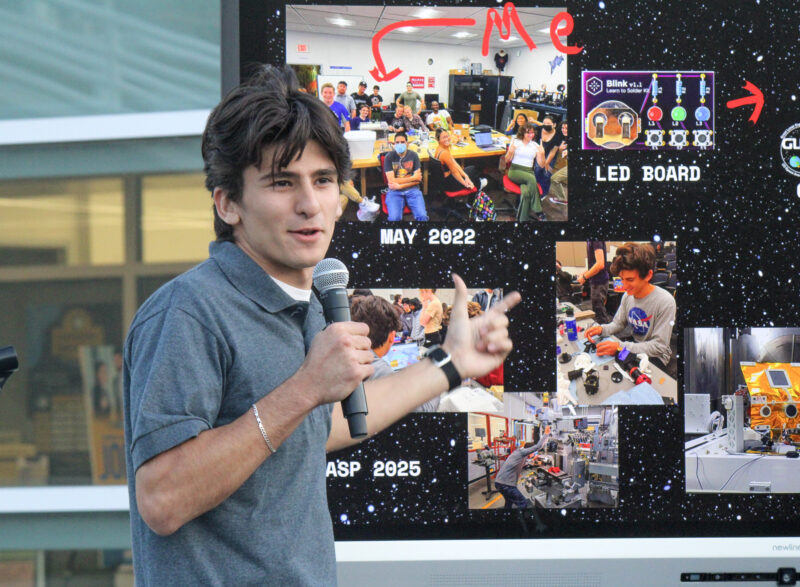
Christian Soltanian, a junior at Valencia High School and a member of the college’s Astronomy and Physics Club, presented in the Star Party courtyard on the club’s experiments sending payloads to space.
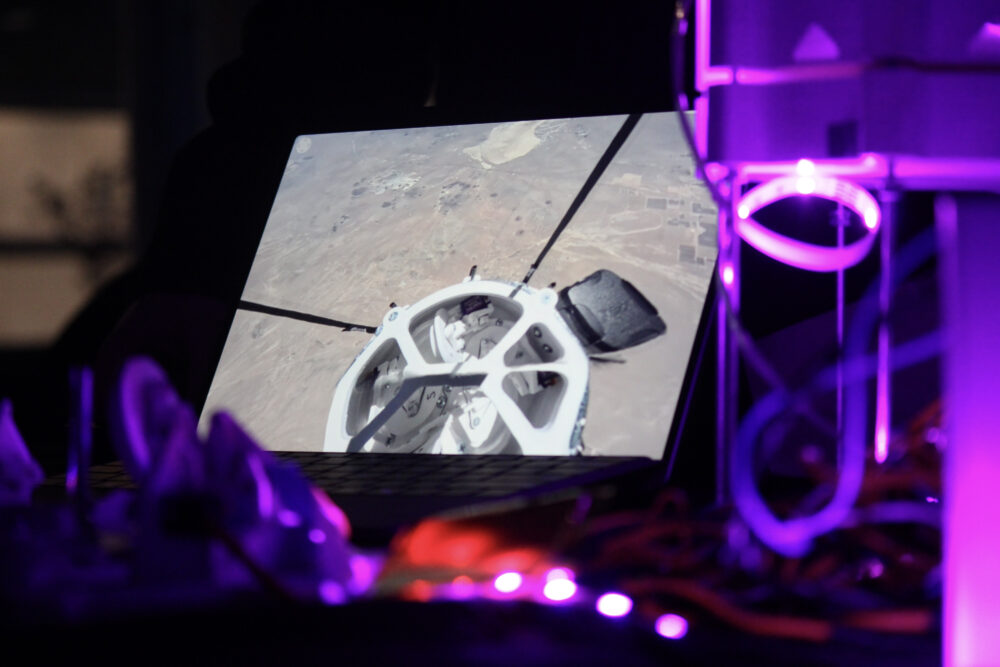
The club sends projects many thousands of feet in the air through the NASA HASP program, or High Altitude Student Platform, on a scientific balloon, as well as NASA’s RockSat and RockOn programs — on real NASA rockets.
“The last couple (HASP) payloads we did, they were related to experiments that take spectra of the sun, or taking pictures of the solar flares on the sun, and this year, we’re going to be working with Geiger counters trying to detect radiation,” Soltanian said during his presentation. “A couple of projects that we’ve worked on in the past are … machine learning, self-stabilizing gyro capsules, always switching it up every single year.”
Soltanian told The Signal that he’d actually found the Astronomy and Physics Club through a Star Party, almost four years ago exactly. It was a discovery that’d radically influence his middle and high school career.
“I figured a lot of times, people want to hear about the experience, right? So I was like, ‘I’ll talk about how I kind of stumbled into this club when I was in junior high,’” Soltanian said. “I didn’t do anything that significant in junior high (as) part of this club, but it made me familiar.”
Soltanian said the club has given him a way to engage in serious — and quite competitive — scientific research outside the classroom, which hasn’t always been his ideal environment for learning.
“I’m not that crazy about school. I do find joy in it, but I like science. I like engineering, and it’s just so rewarding to find something that I genuinely don’t mind,” Soltanian said. “Like … tomorrow, I want to go to my meeting and talk about this stuff … so finding something that I’m actually really passionate about, it’s definitely been a cornerstone thing in my life.”
Sparking a passion for STEM inquiry may be exactly what defines a successful Star Party, said Michaela Blain, a professor of astronomy at COC and the keynote speaker at last year’s spring Star Party.
“It’s less about, ‘Do people walk away with accurate astronomy facts, or accurate science facts’ … and more about, ‘Was science engaging, was it something that (was) presented … in a way that sparked and fostered curiosity?’” Blain said.
Blain said that goes equally for young kids seeing science in action for the first time, adults considering going back to school or seniors interested in taking classes for fun.
One feature of the Star Party that caters to the curiosity of all ages of visitors equally: the telescopes. Blain was manning one of the college’s telescopes set up in the courtyard Friday evening, alongside telescopes brought by local astronomy groups, which are always a draw for Star Party visitors — though perhaps none more so than this spring’s, Blain said.
“I was chatting about that with my student assistant, and they suggested that maybe there’s an uptick in interest in astronomy specifically because of the Artemis II mission,” Blain said. “It sounds like a not insignificant fraction of people were watching the livestream all day, every day.”
The planets had aligned, literally, for an especially vivid view of the moon Friday night. Blain said the moon was in the perfect phase for light hitting its surface to cast long shadows, creating a particularly three-dimensional view of its features.
That was a special experience to offer Star Party guests, Blain said, and very much in the spirit of the event’s goals.
“They walk away with a new interest to pursue, and if that leads them to taking new classes, that’s great,” Blain said. “But the positive experience of interacting with scientists … the community building, it’s positive, it’s social, I think all of those are wins.”