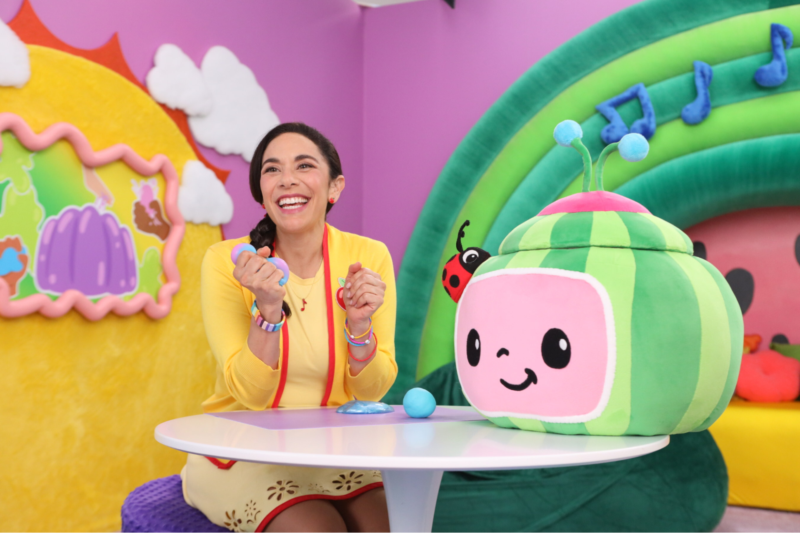
Before a child can read a word, identify a number, or name a color with confidence, something else is already happening. Rhythm is organizing the brain. The capacity to detect patterns in sound, to track a beat, to anticipate what comes next in a melodic sequence; these abilities develop remarkably early in life, and the research on what they predict about later learning is striking. Rhythm discrimination in young children has been linked to grammar acquisition. Melodic exposure supports phonological awareness, the same skill that underlies learning to read. Singing to infants, one study found, predicted vocabulary size at fourteen months when parents began doing it consistently at six months.
This body of research did not build CoComelon. But it describes, with some precision, why the show’s core design choice, putting music at the center of everything, not as decoration but as the actual delivery mechanism for learning, turns out to be more defensible than it might look from the outside. Moonbug Entertainment’s newly announced partnership with the Center for Scholars & Storytellers (CSS) at UCLA is, among other things, an institutional commitment to taking that foundation seriously and deepening it through formal academic collaboration.
Why Music Works the Way It Does
The connection between musical processing and language development runs through shared neural architecture. Both music and language depend on timing, pattern recognition, and auditory memory. When children engage with rhythmic, melodic content, they are training the same cognitive systems that will later support reading fluency, sentence comprehension, and vocabulary retention.
A 2022 peer-reviewed study published in the Journal of Child Language found that parents who sang frequently with their babies by six months of age had children with notably larger vocabularies at fourteen months, a finding that points to early musical input as a catalyst for language mapping and word recognition. A 2025 systematic review in the field of early childhood education, drawing on six studies published between 2015 and 2025, concluded that songs improve children’s word learning, speech fluency, and engagement in communication through a combination of rhythm, repetition, and multisensory stimulation. The review also found that songs help children predict language in real time, activating cognitive and auditory pathways important for comprehension.
None of this is accidental in CoComelon’s production. The show was built around music deliberately, drawing on the same general principles that early childhood educators have long applied in classroom settings. Every episode leads with a song. Transitions are sung. Routines are taught through melody. The characters do not simply model behavior; they sing about it, building the kind of repetitive, rhythmic scaffolding that the developmental literature identifies as conducive to early learning.
Repetition as Pedagogy, Not Formula
One of the most common criticisms of children’s programming is also one of its most misunderstood features: repetition. Parents who watch the same episode multiple times in a single afternoon with a two-year-old are often baffled by their child’s appetite for repetition. That appetite is not arbitrary. It reflects how toddler cognition actually works.
Young children consolidate learning through repeated exposure. Each time a familiar song plays, the child is not passively receiving old information — they are rehearsing a cognitive routine, strengthening neural pathways, and building the kind of predictive processing that underpins language comprehension and emotional regulation. A child who can anticipate the next line of “The Bath Song” is practicing a cognitive skill, not just singing along.
CoComelon’s music-centered content builds directly on these principles, using songs with predictable structures, simple vocabulary, and clear narrative frames to give children something they can internalize across repeated viewings. The viewing numbers attached to routine-focused songs reflect this utility in practice. “The Bath Song” has accumulated nearly 7 billion views; the “Yes Yes Bedtime Song” has surpassed 1.7 billion. These figures do not simply measure entertainment appeal. They measure how reliably parents have returned to the same content because it genuinely helped their child navigate a daily challenge.
What the UCLA Partnership Formalizes
Moonbug has worked with learning consultants on CoComelon for years. Dr. Natascha Crandall has provided developmental guidance through the show’s production. But as Moonbug’s programming slate expanded and the company committed publicly to a more structured, research-backed approach, the need for a consistent framework, one grounded in the peer-reviewed literature and applied systematically across shows, became clear.
The partnership with CSS at UCLA addresses that need. CSS conducted a comprehensive review of early childhood learning research alongside a detailed analysis of Moonbug’s existing programming and creative process. The resulting learning framework is now being applied through dedicated learning consultants embedded in the development pipeline for CoComelon and other Moonbug titles. Rather than reviewing content after the fact, these consultants work with creative teams from the earliest stages, shaping season goals, episode themes, and script development, to ensure that developmental intentions are built in from the start.
Dr. Yalda T. Uhls, Founder and CEO of CSS and a research scientist in developmental psychology at UCLA, described the collaboration’s purpose plainly: “Research shows children can learn from content, but only when it’s designed with how they develop in mind. Our work with Moonbug is about bringing research and storytelling closer together, strengthening what’s already working in their shows while offering clearer guidance for families and creators.”
The phrase “strengthening what’s already working” is worth pausing on. CSS is not arriving with a corrective agenda. The partnership begins with recognition that CoComelon’s music-first design aligns with what the developmental literature supports. The framework’s role is to make that alignment more explicit, more consistent, and more fully integrated across the range of learning domains the show addresses, from language acquisition and social-emotional development to daily routine-building and transitions.
Social-Emotional Learning Through Song
One of the areas where the CSS framework is likely to matter most is social-emotional learning. The ability to recognize and name emotions, to manage transitions, to understand social expectations, these skills develop substantially during the preschool years, and they are among the most important predictors of school readiness and long-term well-being.
CoComelon has addressed these themes through storytelling and character modeling across its episodes and spin-offs, including CoComelon Lane on Netflix, which follows JJ and his friends through “big moments” like first swim lessons and haircuts. The franchise’s approach to social-emotional themes gives families practical frameworks for talking about feelings and navigating new experiences with young children. Characters who handle fear, disappointment, and excitement in recognizable ways give children something to reference when they encounter those emotions themselves.
The CSS partnership adds academic scaffolding to this approach. Working with a learning consultant who brings expertise in how young children develop emotional regulation — and who can review scripts and story arcs against that knowledge, gives Moonbug’s creative teams more precision in how they handle these themes. The difference between content that gestures toward social-emotional learning and content that is carefully designed to support it is often invisible to the viewer. It shows up in outcomes.
A Music-Led Franchise at an Inflection Point
Moonbug’s expansion of the franchise in 2025 and 2026 reflects a company that has moved well beyond a single YouTube channel. The Melon Patch, a live-action educational series, brings the music-and-learning ethos into a new format. The “CoComelon Playdates with Sanrio Friends” crossover series, which launched globally on YouTube in January 2026, was developed alongside educational and cultural consultants with an explicit focus on social-emotional growth, kindness, and cooperation. A feature film, co-produced with DreamWorks Animation and distributed by Universal Pictures, is set for theaters in 2027.
Each of these expansions carries the same core identity: music as the primary teaching tool, character modeling as the delivery mechanism for social learning, and everyday childhood experiences as the subject matter. Research into how CoComelon supports early development has consistently found the franchise strongest in exactly those areas where music and repetition have the most demonstrated value: vocabulary building, routine establishment, and the emotional scaffolding of daily transitions.
The UCLA partnership enters the picture at a moment when Moonbug is both expanding its reach and deepening its commitment to formal developmental rigor. For a franchise whose identity is already built on the relationship between music and learning, formalizing that relationship with academic research is less a pivot than a maturation. CoComelon was always making a bet on music. The CSS collaboration is the evidence that the bet was well-placed, and the mechanism for making it better.
What Parents Can Take From It
For families making media choices for toddlers and preschoolers, the UCLA partnership offers something practical beyond headline credibility: it signals that the content being produced under its influence is designed with specific learning goals in mind, reviewed against developmental research, and shaped by expert input at the stage where it can actually matter.
That does not mean a toddler watching CoComelon is receiving a classroom education. It means the content is built the way quality early childhood education is built — with music, repetition, relatable scenarios, and age-appropriate complexity that increases alongside children’s growing capabilities. The show’s routine-focused songs have earned the kind of viewership numbers that reflect genuine utility for parents navigating the real friction points of early childhood. The academic partnership formalizes what those numbers already suggested: the music-first approach was never arbitrary, and it is now backed by the kind of institutional research collaboration that gives families a more informed basis for trusting it.
DISCLAIMER: No part of the article was written by The Signal editorial staff.