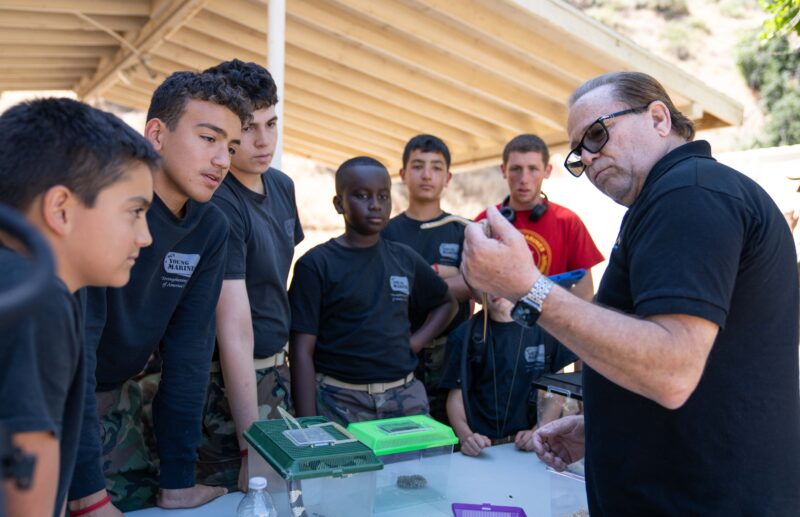
The Southern Pacific rattlesnake, once set in the center of the semi-circle of Young Marines, didn’t strike, just as its handler had predicted — but its rattler was in overdrive.
In fact, the snake rattled for several minutes while Cary Quashen, CEO of the drug rehabilitation organization Action — and host of the talk show “In the Trenches” on The Signal’s streaming network, The Buzz — paced in a circle around its coiled body, laid down beside it, and eventually used a claw instrument to stretch its rattler away from its head for the Young Marines to touch.
Quashen assured them the snake wouldn’t attempt a bite unless it was scared.
“If I went to grab him, I’d be in the hospital,” Quashen said.
Quashen’s rattlesnake was the grand finale of the morning snake exhibition slotted into the Santa Clarita Valley Young Marines’ map and compass course: The 14 teens and pre-teens had pitched their tents and spent the night outside at the Jack Bones Equestrian Center in Castaic, said Tim Stratton, the unit’s commanding officer.
After breakfast burritos, Quashen had brought a handful of buckets and small plastic pet carriers out onto the center’s shady picnic benches, unleashing snakes in ascending order of size.
In the nearly 90-degree heat Saturday, the snakes moved fast once unboxed. Each had their own appeal for the Young Marines: a puny 6-month-old gopher snake bit Quashen several times, and Quashen pointed out a baby rattlesnake’s distinct features, such as its diamond-shaped head — and took care to dispel the myth that baby rattlers don’t carry venom.
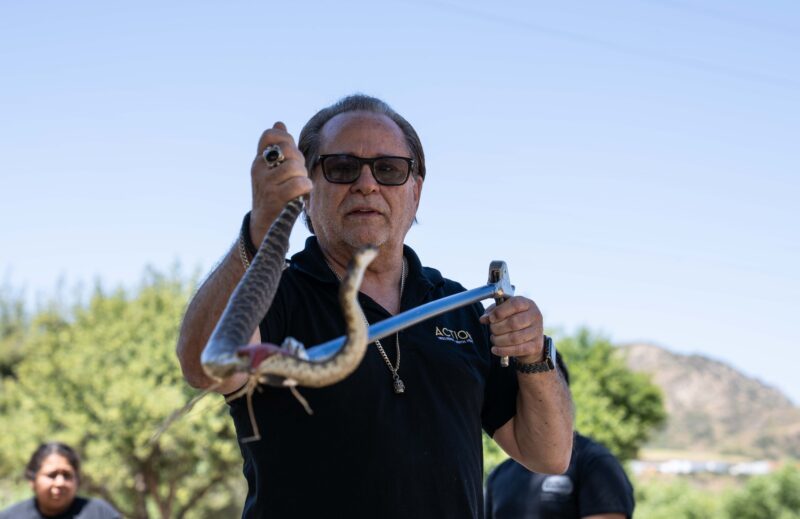
“You’ll still get venom. It’s still deadly. It can kill you. But the fact is, if you get bit by a bigger snake, it’s got more venom, and you’re in more trouble. So that other thing is just a myth. But as I said, this is still very dangerous,” Quashen said, holding the snake up with a large pair of tweezers.
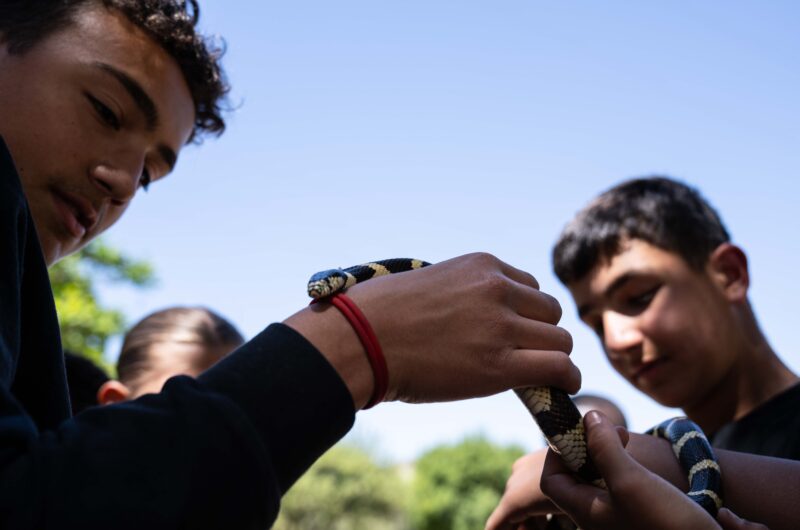
But the non-venomous kingsnake was its own show: Several of the Young Marines clambered to have Quashen loop the snake over their necks, after wrapping itself in Quashen’s chain necklace. The teens reminded each other to support the snake’s body when it started to go down their arm, or stretch away from them.
Stratton said Quashen had been invited to bring the snakes to the map-and-compass course after a staff member caught wind of him — Quashen makes himself available within Santa Clarita for snake wrangling and removal — in anticipation of an upcoming hike up Templin Highway.
A few years ago, the Young Marines had witnessed a snake bite incident in that same area on a hike that’d turned into a close call.
The group had stopped to eat when a young man, hiking with his girlfriend, passed nearby.
“He decided to pick the snake up off the trail, because the kids were there,” and was immediately bitten, Stratton said. “We had two staff members and two senior Marines go out with him. By the time he got out, luckily, they ran into a sheriff (deputy) on horseback, and he called the paramedics. He was going down.”
Education is key for kids being able to protect themselves in an uncontrolled environment, Quashen told The Signal, recalling the three deadly snakebites this year so far in California. The average is about one a year.
“Knowledge is power,” Quashen said. “We can educate people that, ‘You know what? These snakes are not bad, but they’re here. They’ve been here before us.’ So if we can learn how to live with them and respect them, good things happen.”
Quashen has no official snake-wrangling certification — his handling skills have come from dealing with snakes for years at his ranch rehabilitation center in Santa Clarita, he said — but his snake education services serve a similar purpose as his drug rehabilitation outreach work: “Teaching kids to make good choices in life.”
“You’ve got kids that were very excited to touch them, and they love snakes,” Quashen said. “And then you’ve got kids that never thought they would even look at a snake, or touch them. (Then) they have them around their neck, so they walk through their fears.”
Still, he cautioned snake-wrangling isn’t an amateur’s game.
“I will say to people, ‘Don’t do this at home,’” Quashen said. “I am a professional. I’ve been doing it for a lot of years. These are venomous snakes, they could do serious harm and potentially kill you, so please don’t do this at home.”