By Kristen Hwang
CalMatters Writer
A union wants California’s billionaires to rescue the state’s health care system. The billionaires have other ideas.
On Wednesday, an initiative to tax the state’s wealthiest residents qualified for the ballot, according to the secretary of state’s office, which verifies petition signatures.
Gov. Gavin Newsom, who has consistently swatted down the idea of tax increases, emerged early as an opponent of the proposed tax. Wealthy allies in Silicon Valley joined the fray armed with deep pockets and threats to leave the state, which depends disproportionately on high earners for revenue.
The union funding the measure, Service Employees International Union-United Healthcare Workers West, says California needs the revenue that would be generated by the measure to rescue the health care system from deep cuts that the Trump administration made last year in the president’s tax reform package, known as the “One Big Beautiful Bill Act.”
Newsom is reportedly trying to negotiate a last-minute deal that would pull the initiative before the ballot is finalized on June 25.
What would it do?
The initiative would levy a one-time 5% tax on California residents whose net worth exceeded $1 billion at the start of this year. The tax would hit roughly 200 people, and billionaires could pay in installments over five years.
Proponents of the measure estimate it would generate $100 billion for the state. The revenue would go into a special fund with 90% reserved for health care spending and 10% for education and food assistance programs.
The Legislature would control the funds and could allocate up to $25 billion annually to designated programs including Medi-Cal and CalFresh.
It needs a simple majority to pass.
Who is supporting it?
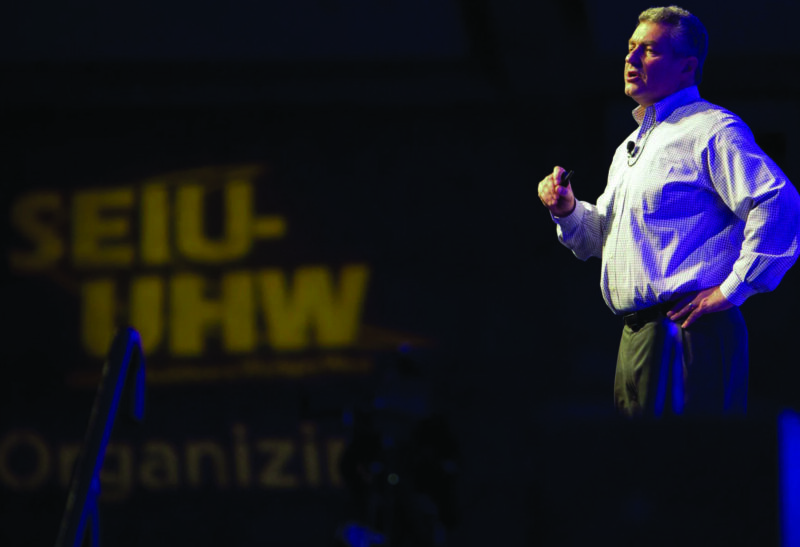
The state’s largest health care workers union is bankrolling the measure, pouring more than $31 million into the campaign. “We are facing literally a collapse of our health care system here in California and elsewhere,” Dave Regan, president of SEIU-UHW, said in October when the campaign launched.
The union, which is known for wielding ballot measures aggressively, argues that federal health care cuts will result in hospital and clinic closures, worsened patient access and thousands of lost jobs if the state doesn’t step in to backfill tens of billions of federal dollars. The group also contends that the Trump tax breaks for income, businesses and investments disproportionately benefit the wealthy people who would then be subject to the proposed billionaire tax.
“Whether or not folks support this, they can’t deny that these massive cuts to health care are coming,” said union spokesperson Renée Saldaña. “Nobody else has a solution to fill this massive $100 billion funding gap that is facing California.”
Saldaña said people signing the initiative petition were supportive and sometimes wanted the tax to be continuous rather than one-time.
“This is popular. The public is feeling the strain of their own health care costs,” she said.
The measure has won high-profile support from Vermont Sen. Bernie Sanders and former Secretary of Labor Robert Reich. A handful of local unions as well as the Teamsters and AFSCME California have also backed the measure.
Who is opposed to it?
Newsom is a vocal critic of the proposal. He has long argued that increased taxes would drive wealthy people and businesses out of the state. In a recent appearance on Real Time with Bill Maher, Newsom said “we’ve already seen dozens and dozens of people leave the state.”
Google co-founder Sergey Brin, with a net worth of $300 billion, according to Forbes, reportedly moved to Nevada because of the tax threat. Brin, a one-time supporter of liberal causes turned Trump supporter, is also the biggest spender among opponents. As of June 15, he has contributed $82 million to Building a Better California, which is funding multiple countermeasures designed to invalidate or weaken the initiative should it pass. The committee has not, however, taken a position on the wealth tax.
The top two measures — the Retirement and Personal Savings Protection Act and the Improving Transparency, Effectiveness and Efficiency in California Government Act — will also likely appear on the November ballot. The retirement act would prohibit new state taxes on personal property, effectively canceling the billionaire tax if both measures pass. The transparency act would require audits of state programs funded by special taxes.
Other tech and industry titans, including Google CEO Eric Schmidt, worth $43.3 billion, Kleiner Perkins chairman John Doerr, worth $25 billion, and The Wonderful Co. President Stewart Resnick, worth $5.4 billion, have donated millions of dollars to Brin’s committee.
Ripple Labs co-founder Chris Larsen, worth an estimated $12.4 billion, also started Golden State Promise, a political action committee dedicated to opposing the tax initiative directly. Venture capitalist Ron Conway, who does not appear on Forbes’ billionaires list, is funding a third group, Stop The Squeeze.
Collectively, the opposition campaigns have raised $107.9 million as of June 15, according to state campaign finance data.
Robert Lapsley, president of the California Business Roundtable, said one of the most concerning parts of the proposal is a provision allowing the Legislature to amend the tax after passage. “They can change the level of taxation; they can change how often they get taxed; they can keep ratcheting down the income level of who pays it.”
The union disputes this claim.
Progressive groups like Planned Parenthood and the California Teachers Association have opposed the measure in recent weeks. Health care industry groups like the California Medical Association, California Primary Care Association and California Hospital Association also oppose it.
Early polling shows 50% of voters favor the initiative, with most strongly behind it, according to the UC Berkeley Citrin Center for Public Opinion Research-POLITICO poll. But that is not as strong a position as it may seem: 54% of voters are concerned about wealthy individuals leaving the state, and 63% are concerned about them taking their businesses with them. A UC Berkeley Institute of Government Studies-Los Angeles Times poll from March showed similar division among voters with 52% in support.
Generally, campaigns running ballot initiatives want their early polling numbers to be much higher because support nearly always dwindles as the election creeps closer.