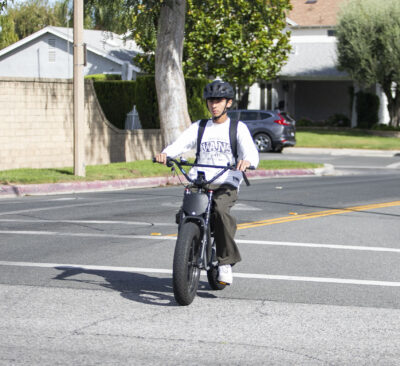
While City Manager Ken Striplin told a group of residents last month that city officials were working on e-bike rules that the staff could bring to the City Council when the City Council returns from its summer recess, there are several legislative efforts that could also speed things along.
There are four bills introduced in this session that were held in legislative committees last month, aimed at various aspects of the concerns that have been raised around the e-vehicles throughout California.
The legislative efforts are coming from both sides of the aisle, largely stemming from beach communities, as several experts have said that’s where the problems began, before spreading inland.
The bills could be brought back for future discussion, held permanently for the rest of the current legislative session, or incorporated into another bill. The Legislature reconvened Monday to complete the state’s budget due next month.
July 2 is the last day for policy committees to meet and report bills in this session, providing the statutorily required budget has been approved.
The bills
Assembly Bill 1557 is an attempt to reign in increasingly powerful e-bikes, reigning in the top speed for a Class 1 vehicle to a top speed of 16 mph and prohibiting the sale of Class 1 or Class 2 e-bikes with motors that exceed 250 watts of continuous power, according to a summary of the bill.
Class 3 e-bikes would still be allowed to provide pedal assistance up to 28 mph and could still use motors up to the existing e-bike limits. The bill was introduced by Assemblywoman Diane Papan, D-San Mateo.
One of the concerns mentioned by local law enforcement has been the modification of otherwise trail- and bike-path-legal vehicles, allowing them to exceed their legally allowable capabilities. The bill also would prohibit anyone under the age of 16 from riding such a bike.
The bill also would make it easier for law enforcement officials to impound vehicles being operated illegally.
This bill passed the Transportation and Judiciary committees in the Assembly, and it was listed as being on hold by the Appropriations Committee as of May 14.
AB 1942 is an effort to create a registration and special license plate program for Class 2 and Class 3 e-bikes, with noncompliance resulting in a $100 traffic infraction.
The state registration system and funds would: create an Electric Bicycle Registration Fund; have the DMV create a system and rules; and allow the state to collect fees to run it.
The author’s intent is “accountability,” according to an April 20 hearing, when the bill passed out of the Transportation Committee.
“I’m here because our kids are hurting themselves,” Rebecca Bauer-Kahan , D-Orinda, the bill’s author, told the Transportation Committee. “The safety issue is real, and we really want to make sure people are following the rules of the road.”
It’s currently under the same status as AB 1557, as of May 14.
Another bill seeks to identify manufacturers that don’t comply with state laws regarding their e-vehicles.
The primary purpose of AB 2284 is to create a state-maintained public list of electric two-wheeled devices that are being marketed or perceived as e-bikes, but do not actually meet California’s legal definition of an e-bike.
The bill by Assemblywoman Diane Dixon, R-Newport Beach, is part of an increased enforcement to identify vehicles that aren’t in compliance, according to a legislative analysis of the bill.
The bill passed out of the Assembly’s Transportation Committee on a reconsideration vote April 20. The bill’s committee status has not yet been updated online.
Last but not least, Senate Bill 1167, by Sen. Catherine Blakespear, D-Laguna Hills, seeks to further define what can be an e-bike.
The bill treats mislabeling a non-e-bike vehicle as a false advertising violation under California law, not just a Vehicle Code issue, as well as updates the definitions of e-vehicles under state law.
“This bill would explicitly clarify that off-highway electric motorcycles are subject to identification as off-highway motor vehicles. The bill would also prohibit the use, allowing to use or operation of an off-highway electric motorcycle, motorcycle, motor-driven cycle or moped powered by an electric motor on any forest-covered land, brush-covered land or grass-covered land unless the vehicle has been certified,” according to the text of the bill. “By creating new crimes related to the operation of off-highway vehicles, this bill would impose a state-mandated local program.”
Nina Moskol, president of the Santa Clarita Valley Bicycling Coalition, said she was a big supporter of the educational components, and would like to see a broader implementation of that aspect, mentioning the potential for more classes in the city’s programming catalogue, Seasons.
She also suggested a grant program, whereby the city could offer vouchers with the purchase of an e-bike that would come with a rider-awareness/education component, or a class through the city.
In mentioning the need for more of the educational component, she brought up something she noticed from her parenting experience, as someone with grown children: Younger ones are being driven around and encouraged to look at screens built into vehicles or tablets, she said, which means they miss out on valuable lessons as back-seat observers.
She’s seen it impact their ability to navigate, and it could impact the younger generation’s understanding of their surroundings and road etiquette, she said.
“There’s been screens put into cars to entertain your children and large commutes. Then it became laptops and then it became iPads and it became smartphones,” she said, “and I can tell you, when they became a motorist, I was getting phone calls saying, ‘I don’t know, how do I get back from this place.’”