Santa Clarita Valley Sheriff’s Station officials shared several months of response-time data for patrol deputies in emails Monday from the station.
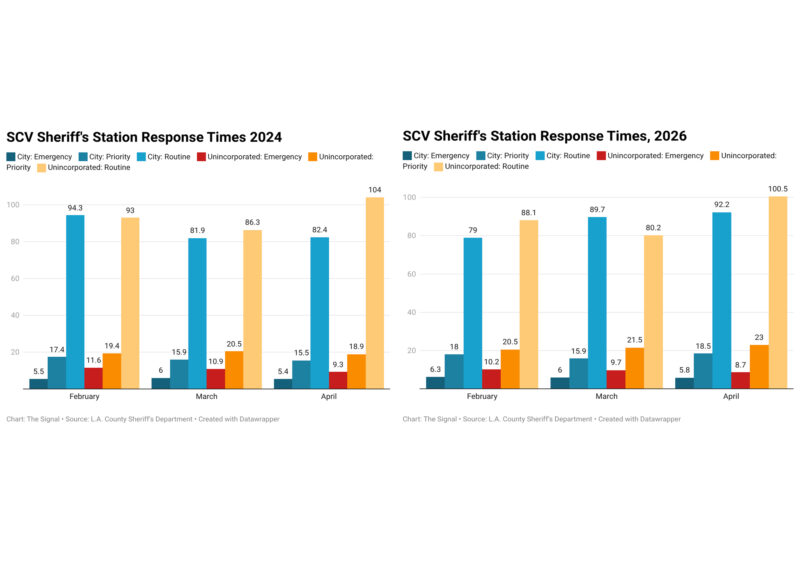
In a month-to-month comparison looking at March response times for 2024, 2025 and 2026, the SCV Sheriff’s Station reported a response time for emergency calls at 6 minutes exactly in March 2026, which is up about a half-minute over the same response time for 2025, when it was 5.4 minutes. The response time in March 2024 also was 6 minutes, according to past station data.
The station also shared the numbers for March, April and May. The most recent numbers available had the station response time clocked in at 5.8 minutes for an average response time to calls in city limits and 8.7 minutes for the unincorporated areas, which range from Stevenson Ranch to Lebec.
Cmdr. Justin Diez has referred to a 6-minute mark for the station’s average response time to emergency calls as the “gold standard” in a previous interview.
Historically, the Sheriff’s Department has broken down its response time in terms of emergency, priority and routine calls, which are separated by both ones in the city and unincorporated portions of its jurisdiction. In addition to patrolling the city of Santa Clarita, the station takes emergency calls from just south of the Newhall Pass area, to unincorporated areas including Castaic, Acton, Gorman and Neenach. This large patrol area, nearly 600 square miles, can have a significant impact on response-time averages.
Emergency calls are considered the most serious the station responds to, which include calls where a public-safety threat is emergent, such as an assault-in-progress call. A priority call might involve a member of the public reporting a serious crime with a suspect who is still in the area. A routine call might involve a report of a nonemergency crime, such as a break-in that happened the previous evening.
The response times also represent both an increase in the response time for priority calls, and the fluctuations in response times for routine calls.
SCV Sheriff’s Station Capt. Brandon Barclay did not return a request for an interview regarding the numbers or the release of response-time data for the unincorporated areas.
The station often reserves comment on its personnel situations; however, during recent community events, Barclay has mentioned the station’s current staffing level is about three-quarters of what the station previously has had, due to a number of factors.
Station officials also have previously indicated that due to the station’s resources, a major incident that ties up deputies for several hours can have a noticeable impact on response times for calls of a lesser priority.
For example, in February this year, the average response time is listed as being 18 minutes flat for a priority call. That went down to 15.9 minutes in March, but then increased to 18.5 minutes in April.
Similarly, the time for routine calls in the city also has fluctuated.
In February, deputies reported a 79-minute average response time for routine calls in February, which had grown to 92.2 minutes as of the April numbers.
While the response times have changed, the total number of incidents reported to the station have continued to decrease this year, based on the latest data available from the L.A. County Sheriff’s Department.
The latest crime data available, through the end of April, indicates the station has seen 5.4% fewer Part-I incidents in a year-over-year comparison, which comes out to a total of 60 fewer incidents.
Most of that reduction came in property crimes. There was an overall increase of almost 21% in violent crimes reported, an increase of 27 incidents.
While station leadership declined to comment, the Sheriff’s Department has made multiple efforts to increase the number of deputies on its employment roll.
The personnel numbers are part of a national concern expected to worsen this year for law enforcement agencies across the country, according to the National Policing Institute, an advocacy group for police organizations.
“The crisis centers around a multi-pronged threat,” according to the NPI’s website, which involves challenges in recruitment, retention and wellness.
Santa Clarita is regularly ranked on lists of “safest cities,” due to its crime rate, which is based on the number of Part-I crimes per 100,000 people.
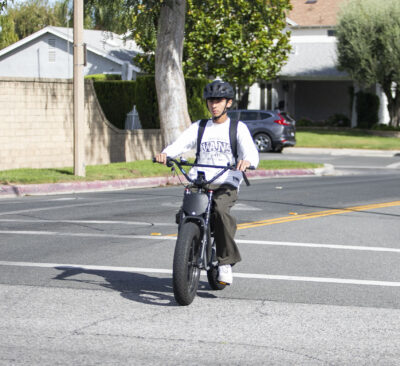
One of the biggest laments the City Council has heard in terms of law enforcement issues over the past several months is repeated concerns about e-bike and e-motorcycle riders, based on public comments at City Hall.